
A Closer Examination of the South Aisle
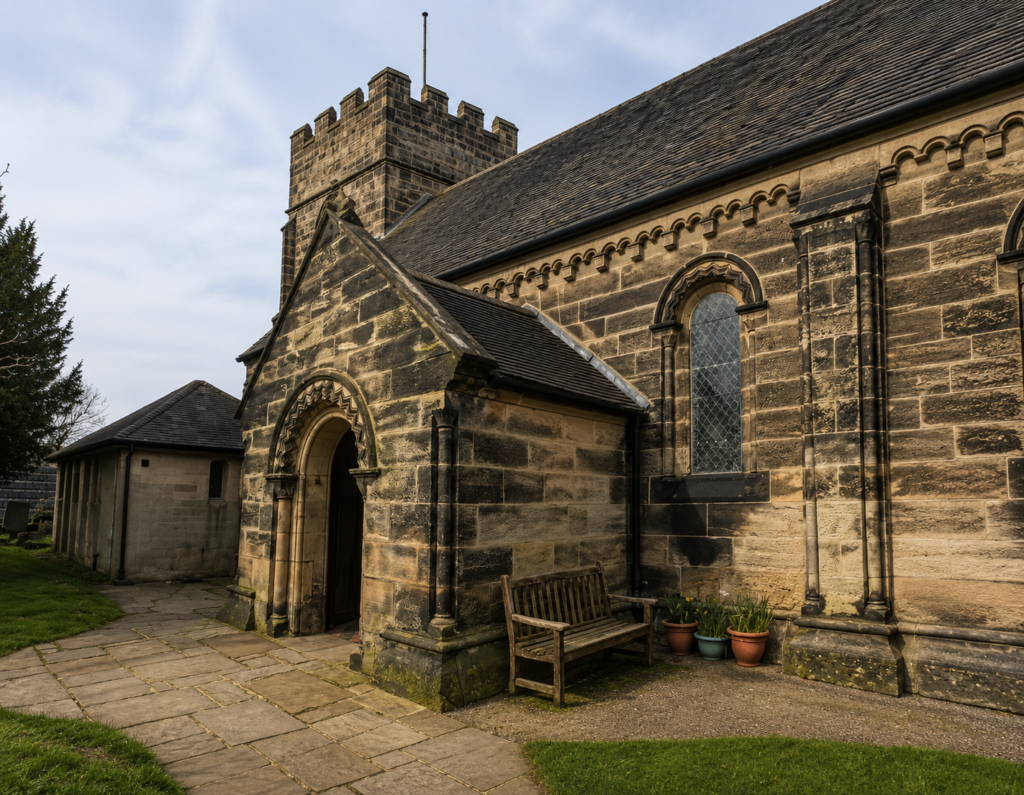
The south aisle of St. John the Baptist differs fundamentally from the nave and north aisle because, unlike them, it formed no part of the medieval church described by Stebbing Shaw in the 1790s. It was added during Henry Ward’s rebuilding between 1844 and 1847, when increasing congregation numbers required additional seating and circulation space. Yet although entirely Victorian in construction, the south aisle was carefully designed to harmonise with the Romanesque character of the earlier church.
Externally, the aisle continues the Norman Revival treatment established throughout the rebuilding. Round-headed windows, shafted buttresses and Lombard friezes beneath the eaves all echo the vocabulary of 12th-century Romanesque architecture. The projecting south porch forms the architectural centrepiece of the elevation, creating both a ceremonial entrance and a visual focus within the long aisle wall.
The porch itself was clearly intended to preserve the memory of the medieval church. Shaw had described the earlier south doorway in remarkable detail, referring to its twisted shafts, zig-zag mouldings and grotesque carvings. Although he mistakenly termed it “Saxon”, his description unmistakably records a sophisticated Romanesque doorway. During the rebuilding Henry Ward recreated and amplified these Norman features in the new porch and entrance arch. The patterned tile floor of the porch matches that used in the nave and chancel, reinforcing the sense that the rebuilt church was conceived as a unified Victorian interior rather than a purely archaeological reconstruction of the medieval building.
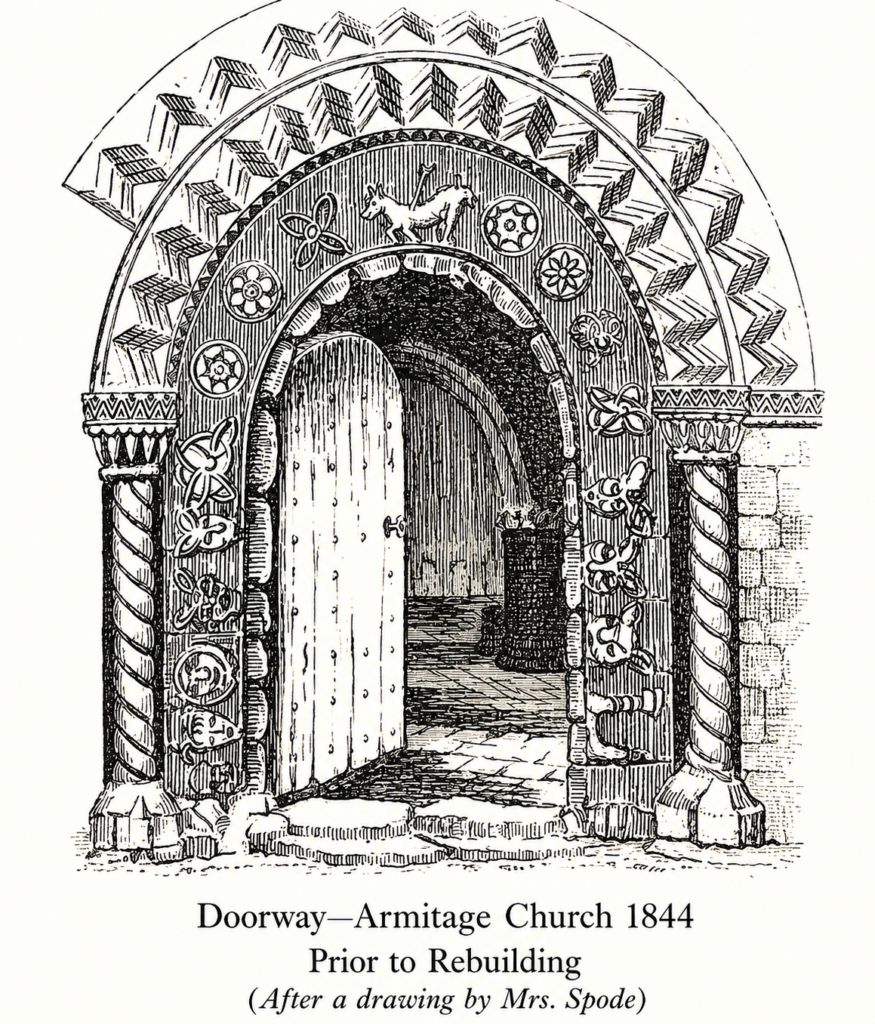
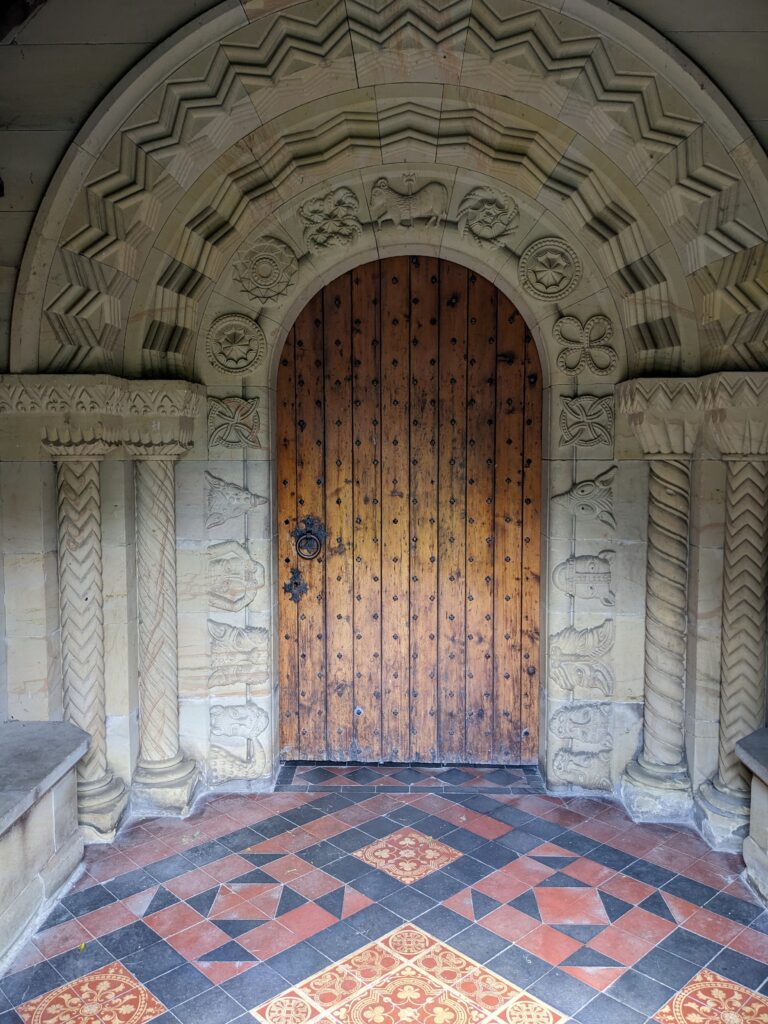
The entrance remains one of the most striking survivals of the rebuilding. Multiple orders of chevron ornament surround the doorway, creating deep shadow and strong visual rhythm. Around the jambs and arch are carved grotesque heads, knotwork roundels and symbolic figures, culminating in the lamb above the crown of the arch. W. G. Wright later recorded that the “17 decorative stones around the arch and jambs” were “apparently a faithful copy from the Old Church”, suggesting that Ward was consciously attempting to preserve elements of the earlier Norman entrance rather than inventing an entirely new design.
Particularly effective are the paired shafts flanking the doorway. Some are cable moulded, others cut with spiral or zig-zag ornament, introducing variety within an otherwise disciplined composition. The carvings themselves combine humour, symbolism and theatricality in a manner entirely appropriate to Romanesque architecture. The grotesque heads create a symbolic threshold between the ordinary world outside and the sacred space within.
The porch also preserves something of the physical experience of entering the medieval church. Shaw noted that there was “the descent of one step from the yard into the porch, two more into the church, and a fourth into the middle of the nave”, emphasising the gradual transition inward. The stone benches within the porch similarly continue an older ecclesiastical tradition, turning the space into more than a simple shelter.
Inside, the south aisle forms a broad and comparatively open companion to the older north aisle. Henry Ward repeated the heavy cylindrical piers and chevron arches of the nave arcade so successfully that the south aisle feels visually inseparable from the rest of the Romanesque interior. The repeated round arches establish a strong rhythm along the length of the church and help unify nave, aisle and tower into a single architectural composition.
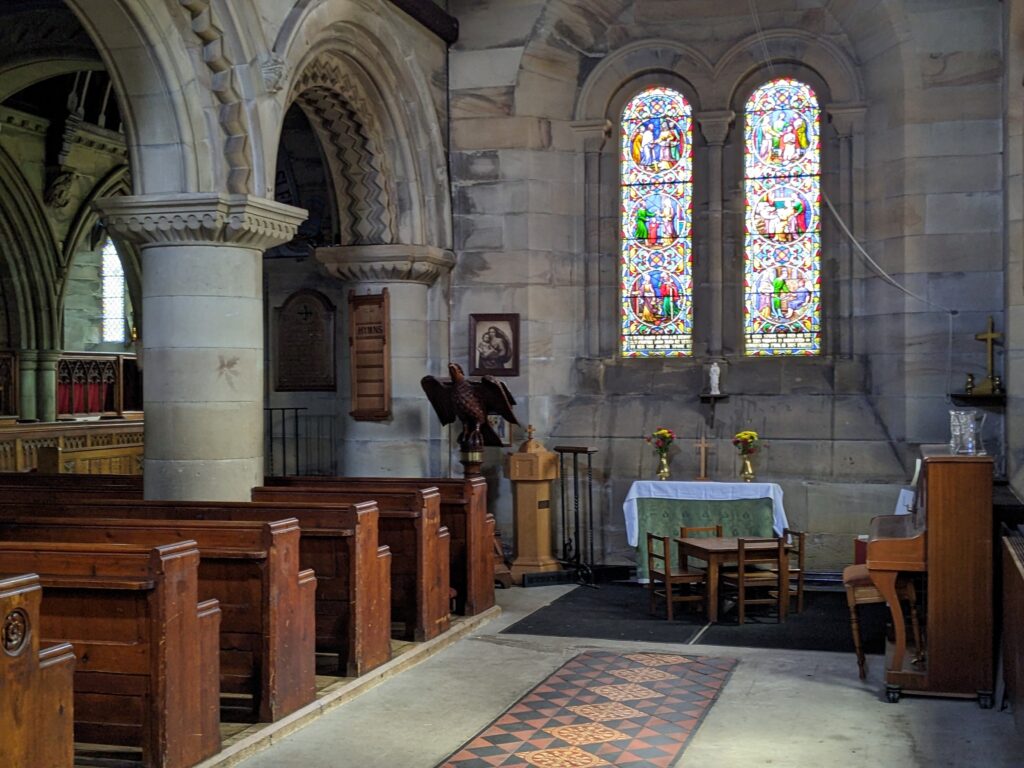
The proportions of the south aisle contribute strongly to its atmosphere. The comparatively low arches and massive piers create a sense of solidity and permanence characteristic of Norman architecture, while the dark timber roof and pale sandstone walls produce strong contrasts of light and shadow. Sunlight entering through the narrow round-headed windows tends to fall in concentrated shafts rather than broad washes, reinforcing the heavy character of the interior.
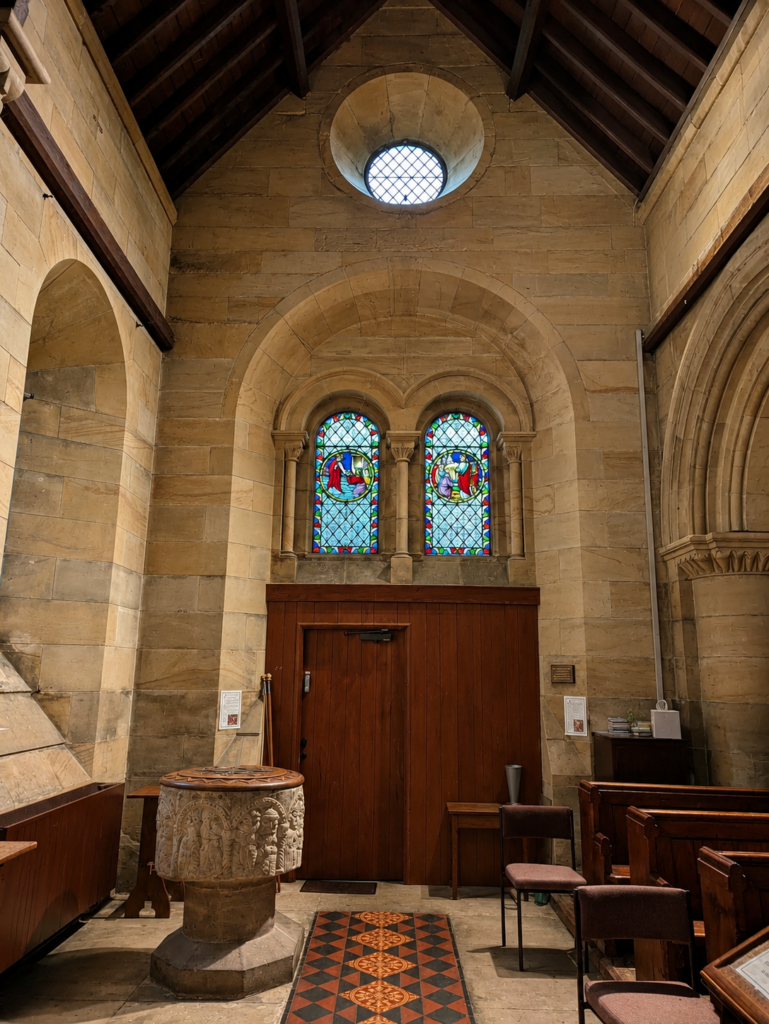
The west end of the south aisle now forms the baptistery area, dominated by the church’s remarkable Norman font. Although the font itself predates the Victorian rebuilding by several centuries, its present position dates only from 1932. W. G. Wright recorded that it was moved here from a position nearer the doorway when the baptistery was dedicated in memory of the Revd John Keal Powell.
The relocation was architecturally successful. The heavy cylindrical font now stands beneath the rebuilt Norman arches and below the circular west window of the tower, allowing the medieval carving to sit naturally within Ward’s Romanesque Revival interior. The font itself, with its arcaded figures beneath round arches, remains one of the most important genuinely Romanesque survivals in the church.
The north aisle retains the clearest impression of the Victorian rebuilding’s original internal composition, while the south aisle was later adapted to provide access to the parish meeting room. The altered south wall demonstrates how the church continued to evolve to meet changing parish needs long after the 1840s reconstruction.
The stained glass of the south aisle belongs largely to the later Victorian and Edwardian periods and introduces a richer decorative layer into the otherwise restrained Norman interior. Unlike the architecture, which deliberately imitates 12th-century forms, the windows reflect later Gothic Revival taste, with brightly coloured narrative scenes and geometric quarry glazing. Their vivid colouring contrasts strongly with the subdued sandstone walls and dark timber roof.
The south aisle also demonstrates how Henry Ward’s rebuilding combined archaeological imitation with Victorian practicality. Shaw’s medieval church possessed only a north aisle, leaving the south side comparatively confined. The addition of a matching south aisle created a far more balanced and spacious interior suited to Victorian worship while preserving the perceived Norman character of the earlier building.
Architecturally, the south aisle therefore occupies an unusual position within the church. It is entirely a Victorian creation, unknown to the medieval building Shaw described, yet it is also one of the clearest expressions of Henry Ward’s determination to preserve and amplify the Romanesque identity of St. John the Baptist. Rather than contrasting with the older parts of the church, the aisle completes the unified Norman Revival vision established throughout the rebuilding.
The result is a space which feels at once medieval and Victorian: medieval in its heavy arches, carved ornament and symbolic doorway, yet Victorian in its careful regularity, enlarged scale and consciously picturesque treatment of Norman architecture.