
A Closer Examination of the Nave
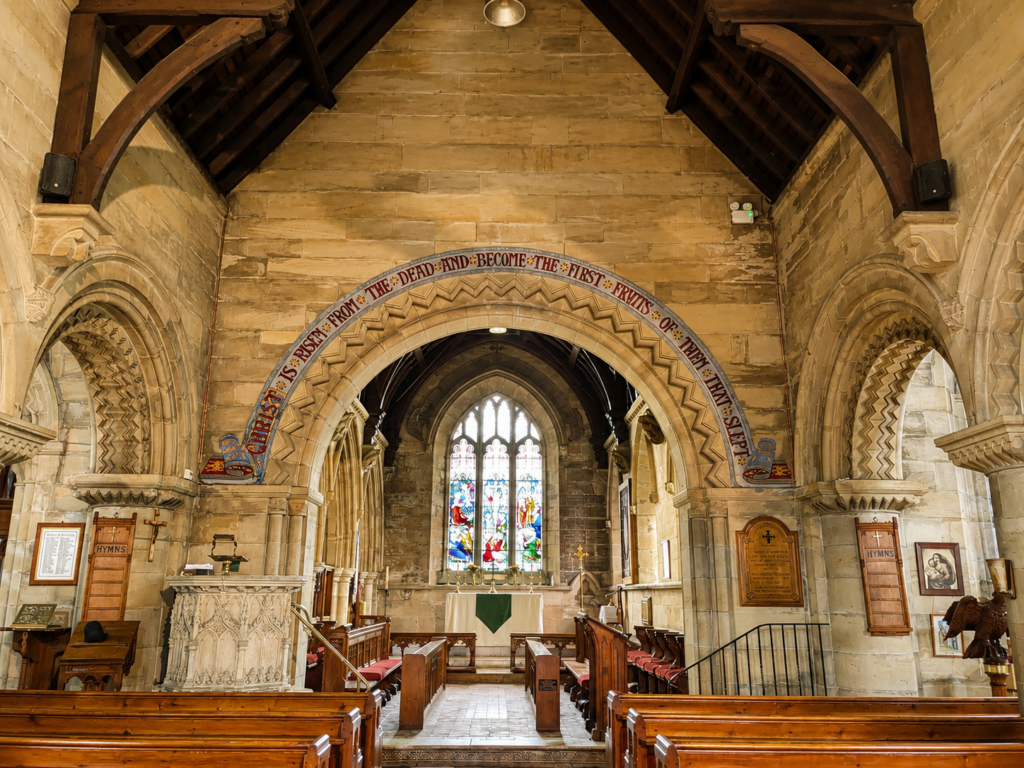
Although rebuilt between 1844 and 1847, the nave of St. John the Baptist still gives a strong impression of the Norman or Romanesque character, with its round arches and zig-zag carving of the earlier medieval church described by Stebbing Shaw in the 1790s. Henry Ward’s rebuilding reused the scale, round arches and zig-zag carving of the Norman structure while creating a more unified and dramatic interior than the one Shaw encountered in its final years.
The nave formed the principal gathering space of the church and remains the architectural centre of the building. While the medieval church Shaw described was already “somewhat ruinous” by the late 18th century, his account preserves important evidence for its appearance before the Victorian rebuilding swept much of the older fabric away. Ward’s task was not simply to repair the church but to recreate its heavy Norman character in a form suited to Victorian worship and taste.
Shaw described the nave as forty-one feet long and twenty-three feet broad, lit by three windows “of one light apiece”, all of which had already been altered. He also observed that part of the south wall had evidently been rebuilt. His description suggests that, by the 1790s, the medieval nave was structurally irregular and had already undergone centuries of piecemeal repair and modification.
What impressed Shaw most was not the walling itself but the surviving Romanesque detail. The south doorway, enclosed within the porch, clearly belonged to a sophisticated mid-12th-century campaign. Shaw described its zig-zag mouldings, twisted shafts, grotesque heads and carved ornament in remarkable detail. Although he referred to it as “Saxon”, the doorway is unmistakably Romanesque in style and provides some of the strongest evidence for the church’s Norman origins.
Henry Ward repeated these Norman features through the rebuilt nave and north aisle and in the newly added south aisle. The four-bay arcades on either side are formed of broad semicircular arches enriched with chevron ornament, carried on massive cylindrical piers with scalloped capitals and square abaci. The repeated zig-zag moulding creates a strong rhythm through the length of the church and visually links nave, tower arch and chancel arch together.
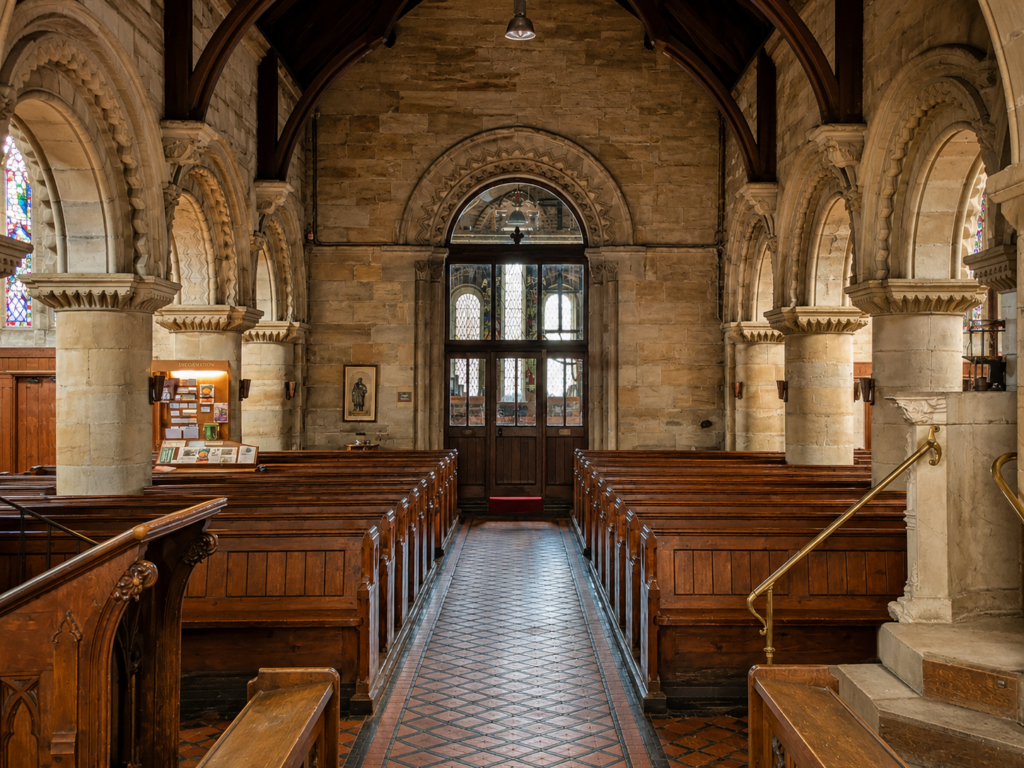
Shaw’s account suggests that the medieval church may not have been quite so visually unified. His observation that the arches between nave and north aisle might not have been “coeval with the pillars” implies that parts of the arcade had already been rebuilt or altered in the medieval period. Henry Ward therefore appears not simply to have copied the earlier nave but to have produced a more coherent and idealised interpretation of Norman architecture.
Particularly striking are the outer arch mouldings ending in grotesque heads at the springing of the arches. These carved stops introduce moments of humour and individuality within the otherwise regular arcade system. Their treatment feels consciously medieval in spirit, even if the execution is unmistakably Victorian.
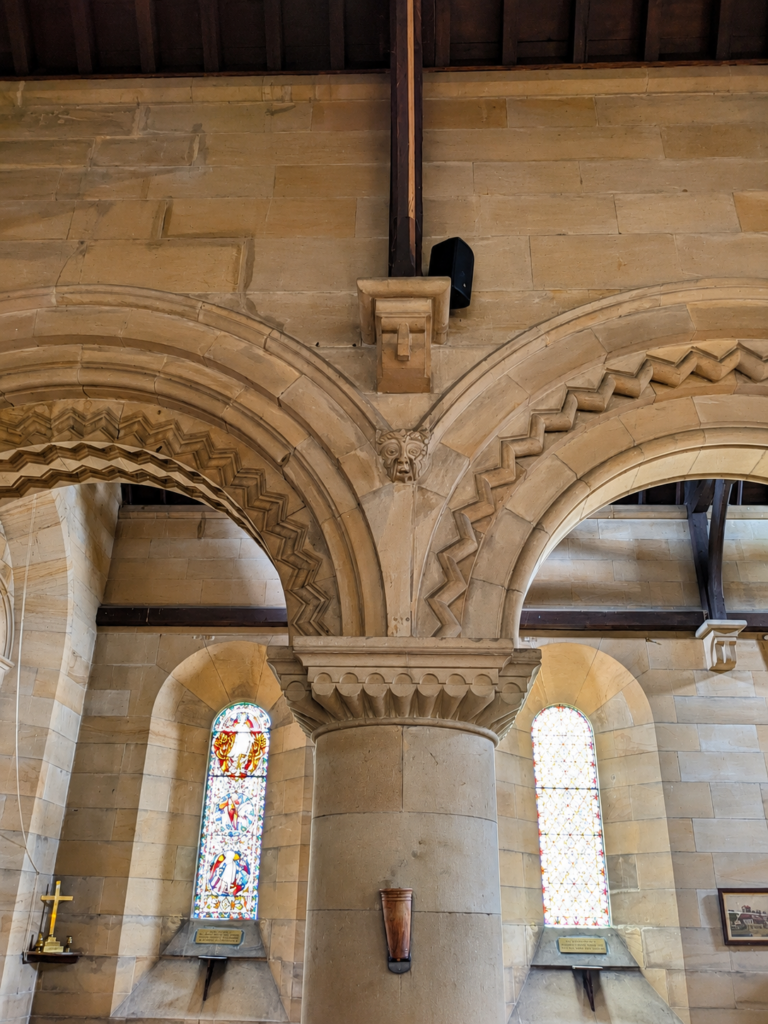
The proportions of the nave contribute greatly to its atmosphere. The heavy cylindrical piers and comparatively low arches create an impression of solidity and permanence, while the narrow round-headed aisle windows prevent the interior from becoming oppressive. Sunlight falling across the pale sandstone and dark roof timbers produces constantly changing contrasts of light and shadow.
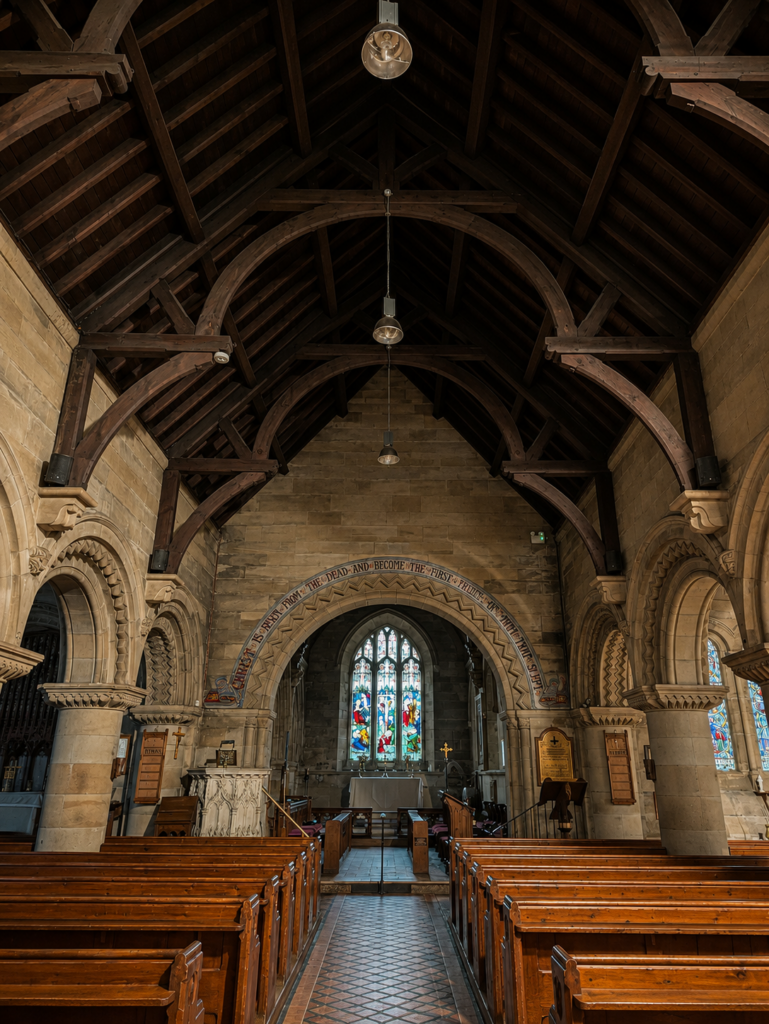
The roof is one of the most successful features of the rebuilding. The dark timberwork rises above the arcades in a series of sweeping braces which draw the eyes upward and prevent the Norman detailing from appearing overly heavy.
This roof almost certainly differs from the medieval arrangement Shaw would have seen. A genuine 12th-century nave would probably have possessed a much plainer timber roof, perhaps altered several times across the centuries. Ward instead created a dramatic open timber structure consistent with Victorian ideas of medieval church architecture.
The listed building description refers to “hammer beam roofs over nave and aisles”, although there is no evidence that the medieval church possessed roofs of this kind. Shaw, whose account describes many other architectural details in considerable depth, makes no mention of an elaborate timber roof. The present roof should therefore be understood as part of Henry Ward’s Victorian interpretation of medieval architecture rather than a recreation of the original 12th-century structure. The earlier church probably possessed a much simpler timber roof, altered and repaired across the centuries before the rebuilding of the 1840s.
The relationship between masonry and timber is central to the success of the interior. Pale ashlar walls and piers contrast strongly with the dark roof timbers and polished pews, while the encaustic tiled floor draws the eye eastward toward the sanctuary. The surviving Victorian tilework strengthens the sense of movement towards the altar.
Several features stand out within the rebuilt nave. The massive cylindrical piers convincingly evoke Norman construction, while the repeated chevron carving links the arcades and arches into a single design. Grotesque carved heads introduce moments of humour among the heavy stonework, and above them the dark timber roof shapes much of the church’s atmosphere.
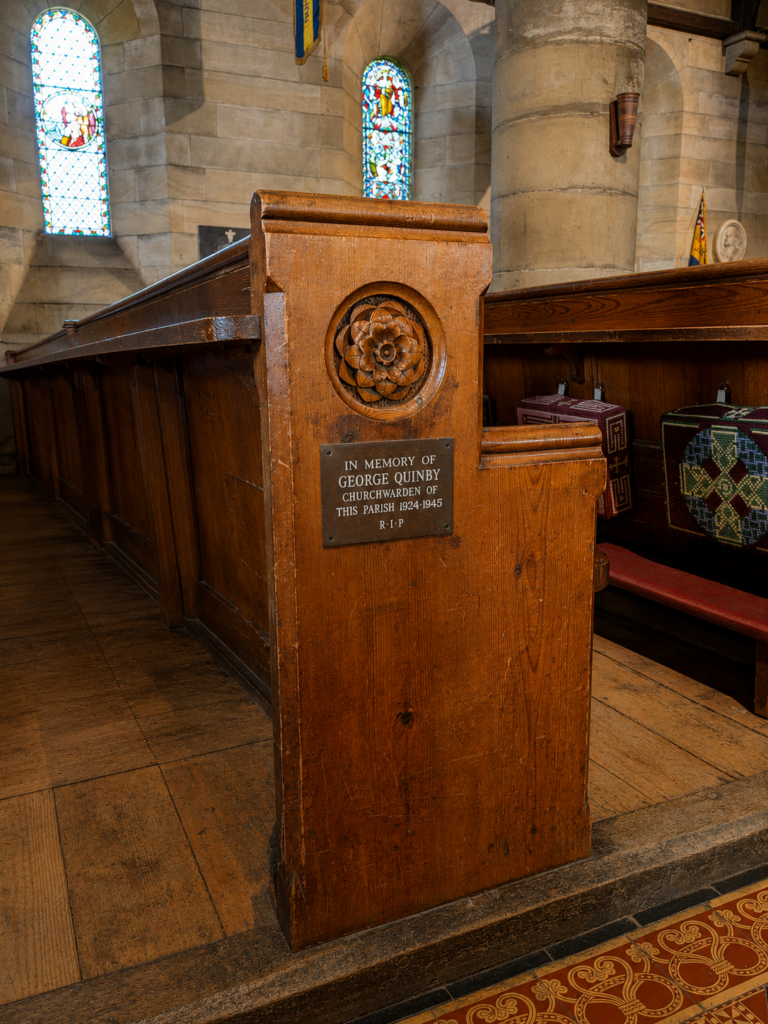
The furnishings also reflect the church’s continuing social history. Shaw described “many old-fashioned benches with low backs”, together with a parish chest and pulpit associated with local families including the Lycetts. Most of these earlier fittings disappeared in the rebuilding, but the nave still preserves evidence of parish life in later memorials attached to pews and furnishings. The plaque commemorating George Quinby, churchwarden from 1924 to 1945, is a reminder that the rebuilt church quickly became woven into the identity of the village community.
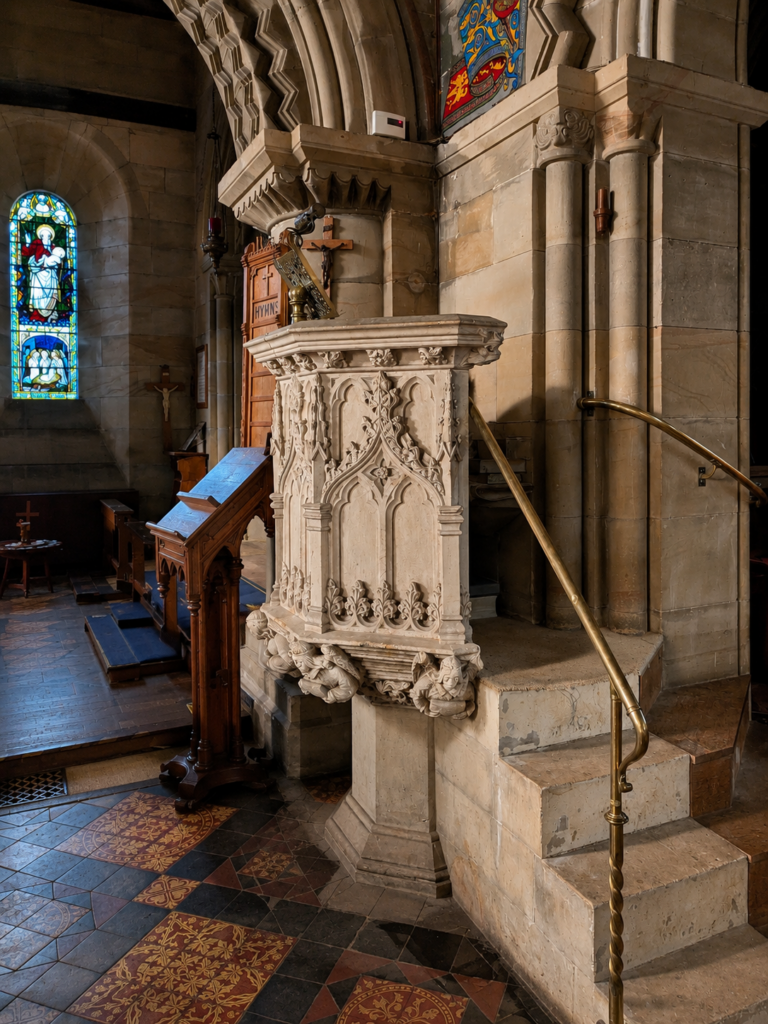
The pulpit forms an interesting contrast with the Romanesque arcades around it. Its more elaborate Gothic carving reflects the Victorian tendency to combine architectural styles where symbolism or visual effect demanded it. This mixture of Norman and Gothic forms appears throughout the rebuilt church, particularly in the transition from the round-arched nave to the more Gothic chancel beyond.
Architecturally, the nave should therefore be understood not as an exact recreation of the medieval church but as Henry Ward’s interpretation of what a Norman parish church at Armitage ought to look like. Shaw encountered an ancient building that was picturesque, irregular and already heavily altered. Ward instead produced a carefully unified interior which amplified the Norman character of the earlier church and made the church feel regular and unified.
W. G. Wright’s otherwise detailed account of the church says remarkably little about the nave itself. This may partly reflect the architectural character of the interior, where the nave is experienced less as a separate compartment with its own walls and windows and more as an open central space formed by the arcades, roof and adjoining aisles. In describing the arches and pillars of the north aisle, much of the nave’s structure had effectively already been described. The listed building description similarly recognises the architectural importance of the nave arcade, noting the “cylindrical columns, scalloped capitals, square abaci and chevron moulded round arches” together with the “hood moulds terminating in grotesque heads” and the hammerbeam roofs over nave and aisles.