
A closer look at the chancel
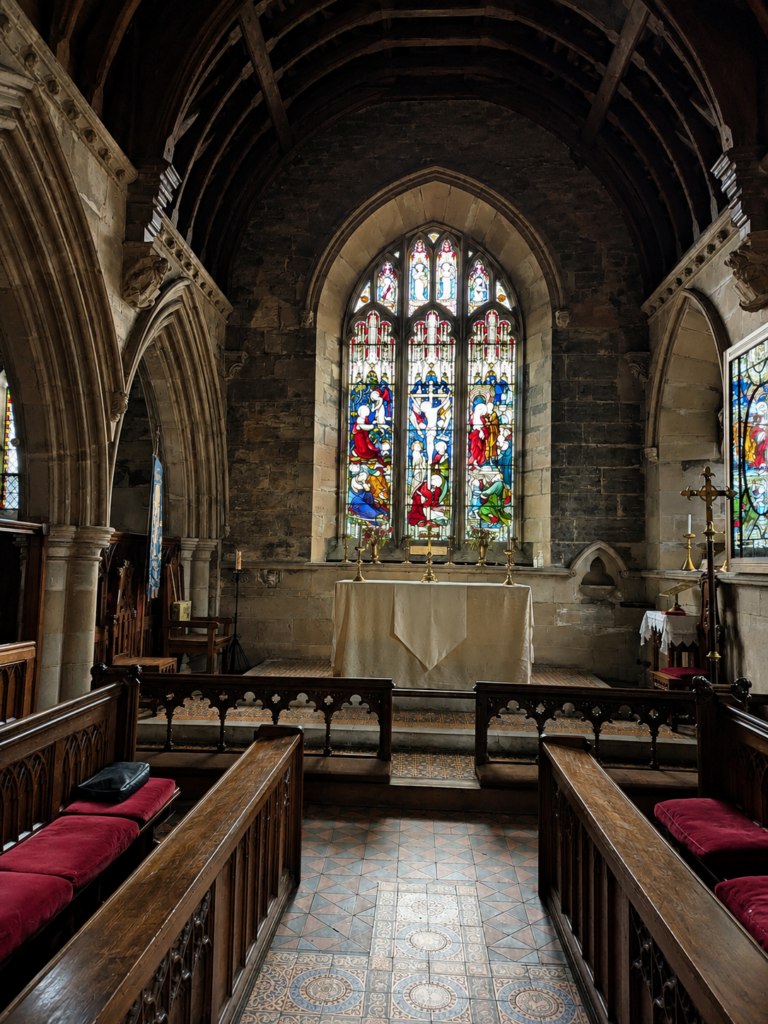
The chancel of St. John the Baptist forms a marked contrast with the heavy Romanesque character of the nave beyond. Although much of the present fabric dates from Henry Ward’s rebuilding of the 1840s, the space still preserves the impression of a later medieval Gothic chancel developing eastward from an earlier Norman church. The transition remains immediately visible in the architecture itself. Beyond the round arches and massive cylindrical piers of the nave, the chancel introduces pointed arches, taller windows and a stronger sense of vertical movement. Even after Victorian rebuilding, the eastern end of the church still feels quieter, more enclosed and more devotional in character.
The medieval chancel encountered by Stebbing Shaw in the 1790s already appears to have belonged to a different architectural phase from the Romanesque nave and south doorway. Shaw described the chancel as measuring about thirty feet by sixteen feet and separated from the nave by “a handsome zig-zag arch”. Although the arch itself retained Norman character, the windows Shaw recorded were Gothic in form, with a large east window of three lights and pairs of two-light windows to north and south. His description strongly suggests that the earlier Romanesque sanctuary had been remodelled or entirely rebuilt during the later medieval period.
The surviving architectural evidence points toward this gradual development. The massive simplicity of the nave arcade belongs firmly within the Romanesque tradition of the mid-12th century, but the chancel introduces a noticeably different architectural style. The pointed arches, larger traceried windows and greater emphasis on height suggest that the chancel belonged to a later medieval rebuilding campaign distinct from the earlier Romanesque nave. An 1823 drawing by John Buckler, produced before the rebuilding of the 1840s, shows the chancel already Gothic in character but with only two south windows beneath broadly the same roofline seen today. The rebuilt chancel now contains three windows within almost the same wall length, suggesting that Henry Ward retained the scale and proportions of the medieval structure while regularising and elaborating its design. The earlier drawing survives at Staffordshire Past Track.
Shaw’s account preserves valuable details of the medieval arrangement before the Victorian rebuilding swept much of the older fabric away. He noted a piscina in the south-east corner together with a stone bracket above it, presumably for an image, and observed traces of painted glass surviving within several windows. Fragments of angels with censers and crowned initials could still be seen in the east window, suggesting that despite centuries of alteration the medieval chancel retained traces of its earlier decoration and devotional life.
He also recorded a low round-arched doorway in the south wall leading into the churchyard, already blocked by his time. The survival of this doorway is particularly interesting because its round arch may indicate that part of the earlier Romanesque structure survived within the later Gothic rebuilding. The chancel therefore may not have been rebuilt in a single campaign but developed gradually, incorporating older fabric into newer work over several centuries.
By the 1840s the medieval chancel had become structurally unsound during the wider rebuilding of the church. While the nave and north aisle were already intended for reconstruction, the chancel appears initially to have been expected to survive. Instead, weakening during the works forced its rebuilding as well. Henry Ward was therefore confronted with the problem faced throughout the church: how to recreate an ancient building whose fabric was failing but whose character remained deeply valued within the parish.
The rebuilding was also constrained by the survival of a vault beneath the chancel. Constructed for the Lister family around 1800, the crypt was retained during the Victorian works and probably helped preserve the earlier dimensions and alignment of the sanctuary even as the upper structure was rebuilt.
Although the rebuilding recreated the architectural form of the earlier church, the interior decoration appears to have developed more gradually. The discovery that the chancel also required rebuilding increased the cost of the project and further appeals for funding became necessary. It is therefore likely that much, if not all, of the rebuilt church initially contained plain diamond-leaded glazing rather than stained glass. The earliest known stained-glass installation was the East window donated by Josiah Spode IV in 1852, with further memorial windows being added over the following decades.
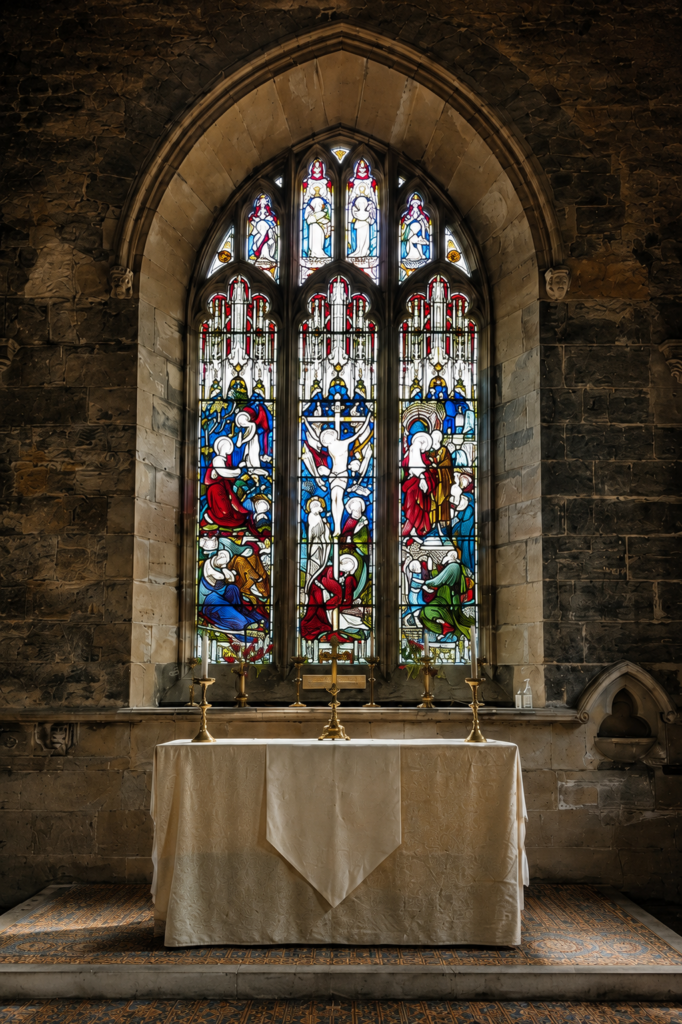
The east window dominates the interior visually and forms the natural focus of the chancel. The present stained glass was installed after the rebuilding and reflects the growing Victorian interest in medieval church decoration and symbolism. Earlier glazing described by Shaw had already survived only in fragments by the late 18th century, so the present glass represents not preservation but renewal in a consciously Gothic spirit. Rich colour and figurative scenes transform the eastern wall into the visual centre of the church, particularly when sunlight passes through the glass into the darker stone interior.
The side windows continue this Gothic character through the length of the chancel. Their pointed forms and tracery reinforce the sense of verticality absent from the heavier Norman nave. Individually, several of the windows also preserve the memory of parish families and clergy through Victorian memorial glass. In this way the rebuilding of the chancel became not simply an architectural exercise but part of the continuing social and religious life of the village.
Before the later vestry and organ chamber were added in the 1850s, the north wall of the chancel was probably arranged broadly symmetrically with the south wall. Shaw described two windows on each side of the sanctuary, corresponding closely with the arrangement visible in Buckler’s drawing.
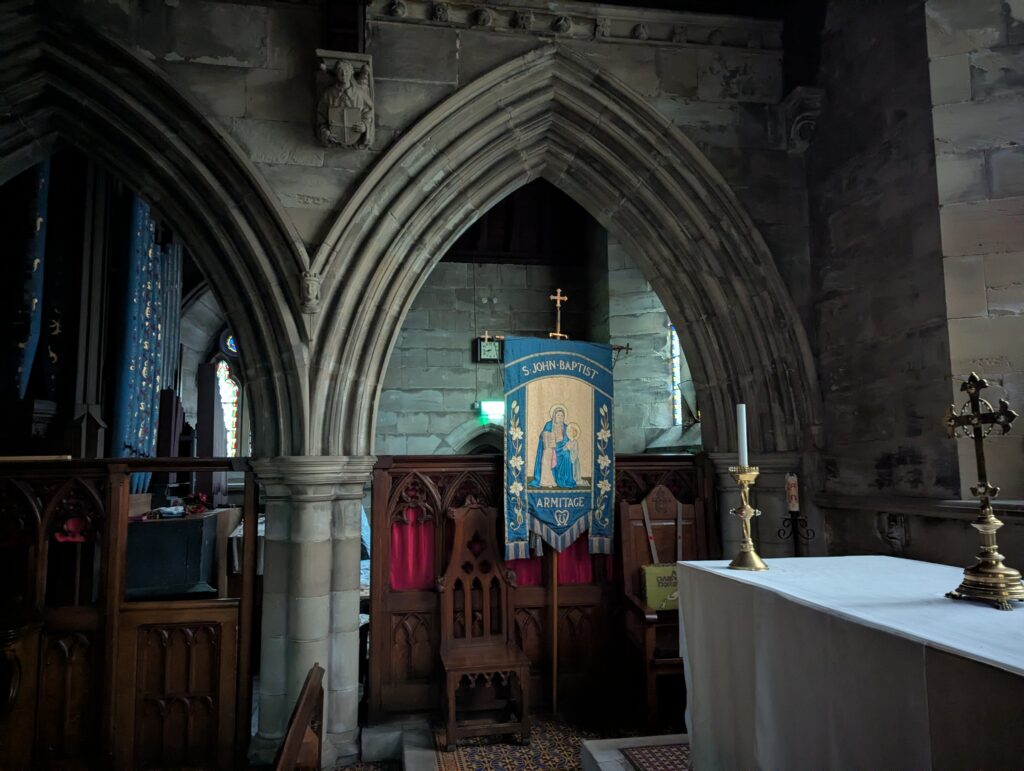
Particularly striking is the relationship between the chancel and the later organ chamber and vestry to the north. W. G. Wright recorded that the east end of the north aisle had originally opened into the chancel through an arch corresponding with that on the south side before later alteration associated with the vestry and organ installation. The series of Gothic arches leading into the organ chamber still preserves something of this layered development. Here the church reveals not a single medieval design but centuries of adaptation shaped by changing liturgical and musical requirements.
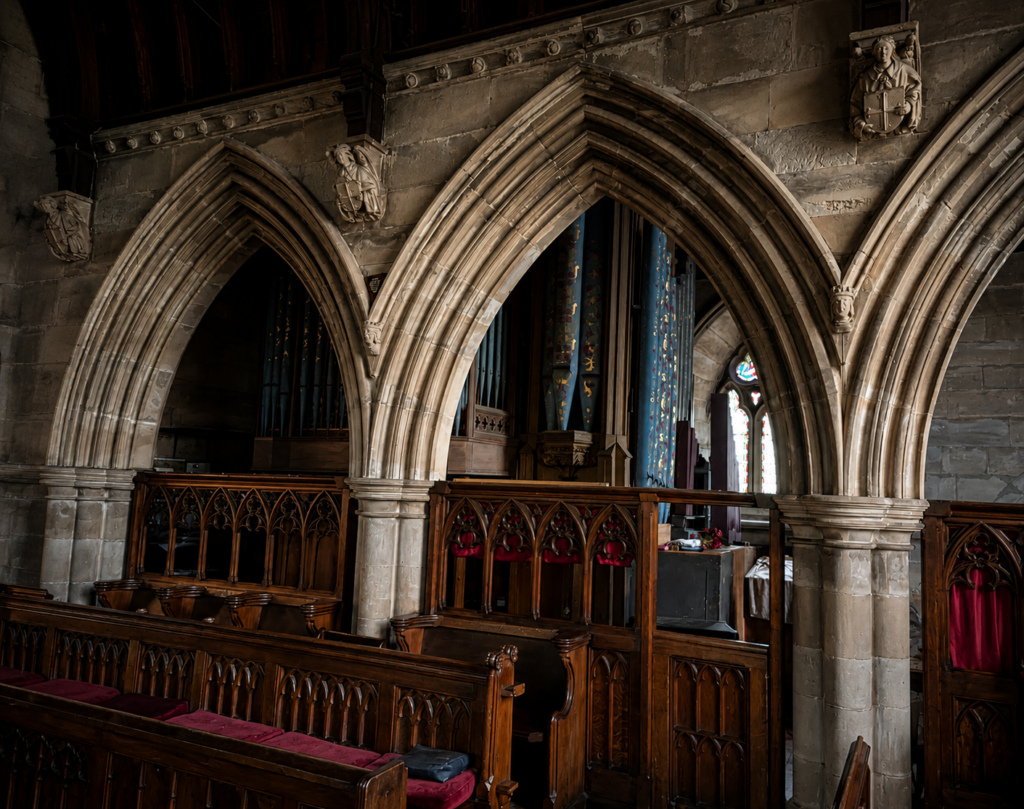
The organ itself forms part of this continuing Victorian enrichment of the church interior. Acquired through the patronage of Josiah Spode IV after its earlier use in Lichfield Cathedral, it introduced a scale of music far removed from the simpler worship of the medieval parish church. Wright observed that its tremendous volume was moderated by the comparatively low chancel arch and the heavy Norman character of the church beyond. The placement of the organ beside the chancel therefore created both a visual and acoustic dialogue between the Gothic eastern sanctuary and the earlier Romanesque nave.
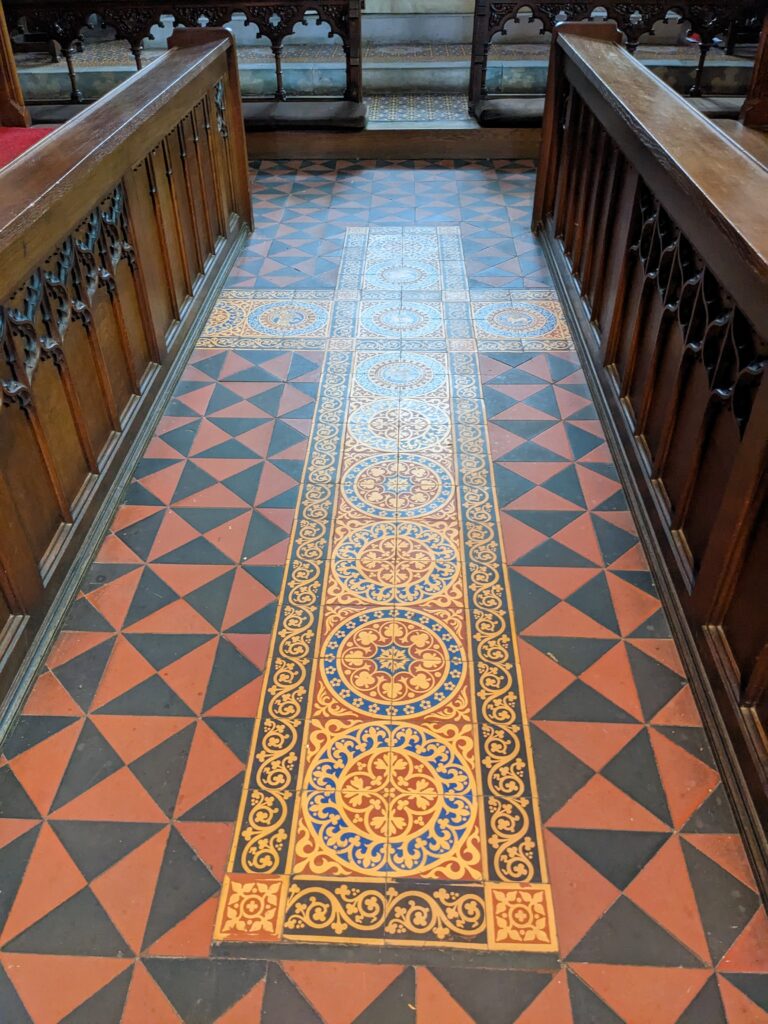
The atmosphere of the chancel depends as much upon texture, colour and light as upon its architecture. Dark roof timbers rise above pale sandstone walls, while encaustic tilework leads the eye toward the altar and east window. The Victorian floor tiles, supplied by Herbert Minton in 1848 through the influence of the Spode family, contribute greatly to the richness of the interior. Their repeating geometric patterns provide a strong visual contrast with the heavy stonework and help unify the rebuilt church.
Light behaves differently here than in the nave. The narrower enclosed space, deeper window embrasures and coloured stained glass create a shifting pattern of shadow and colour across the stone surfaces throughout the day. The result is a chancel that feels both intimate and ceremonial, separated architecturally and atmospherically from the broader congregational space to the west.
Several furnishings reinforce this sense of continuity between medieval tradition and Victorian rebuilding. The piscina beside the altar, although probably Victorian in its present form, preserves the position and function of its medieval predecessor noted by Shaw. Carved choir stalls, memorial plaques and liturgical furnishings similarly reflect the continued adaptation of the sanctuary to the needs of parish worship across successive generations.
The chancel of St. John the Baptist should therefore be understood as the product of several distinct building phases rather than a single moment of construction. Beneath Henry Ward’s carefully rebuilt Victorian interior lies evidence for a later medieval Gothic remodelling of an earlier Romanesque church, itself probably altered and repaired many times before the rebuilding of the 1840s. Shaw encountered a structure that was already ancient, irregular and partially decayed. Buckler’s drawing and Shaw’s description both suggest that the medieval chancel was less regular and more restrained than the present interior. Ward instead created a more unified and visually coherent interpretation of the earlier church while preserving its scale, Gothic atmosphere and relationship to the Norman nave.