
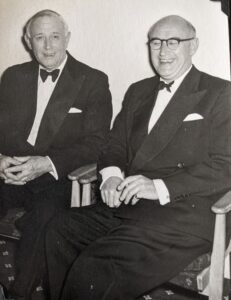
For fifty years, if an important decision was taken at the Armitage pottery, the chances are that two brothers had discussed it first. From the factory floor to the boardroom, through war, expansion, mergers and changing fashions, Ken and Alan Stott quietly transformed a Staffordshire family business into the international Armitage Shanks group.
Their achievements can be measured in factories built, companies acquired and products developed. Yet those successes tell only part of the story. What made the brothers remarkable was the way they worked together, the practical way they approached problems and their ability to recognise opportunities before they became obvious to others.
They probably never regarded themselves as industrial strategists. They were simply doing what they believed was common sense. Looking back today, that common sense proved remarkably successful.
Learning Together
The brothers entered the company only four years apart. Ken joined Edward Johns & Co. in 1924 and Alan followed in 1928. Both were nephews of Edmund Corn, who had already transformed the fortunes of the pottery and whose influence on their early careers was immense. Their training was carefully planned.
Ken developed the commercial side of the business, travelling widely to meet customers and understand markets. Alan learnt manufacture from the shop floor upwards, documenting every stage of production in notebooks that were personally reviewed and corrected by Edmund.
Alan’s education continued with a year-long world tour during 1933–34. He visited agents, architects, builders and customers across South Africa, Australia, New Zealand, Canada and the United States, sending detailed reports home not only on sales opportunities but on economic conditions and changing patterns within the building industry.
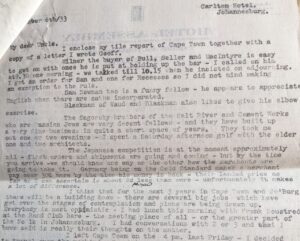
By the time the brothers assumed greater responsibility they understood both how the factory worked and how the markets it served were changing.
One Partnership
Many successful businesses have been built by brothers. Many have also been divided by them. Remarkably, there is little evidence that this ever happened at Armitage.
Their responsibilities naturally evolved in different directions. Ken increasingly concentrated on finance, customers, acquisitions and the wider development of the company. Alan became responsible for manufacturing, organisation and the day-to-day running of the works.
Each trusted the other’s judgement.
Alan later admitted that there were occasions when he would personally have preferred a different course of action, but believed that once a decision had been reached his responsibility was to support it completely. His well-known joke that “my brother is Head of the Block and I am the Block Head” concealed an important truth. The partnership worked because neither brother appeared interested in personal prominence. Their loyalty was directed towards the success of the company rather than individual recognition.
Together they provided continuity of leadership for more than thirty years.
Although they worked as a remarkably united partnership, they brought different strengths to the company. Ken naturally looked outward towards customers, acquisitions and the future direction of the business. Alan’s interests lay in manufacture, organisation and the people who made the company work. Together they formed a partnership that proved stronger than either man could probably have achieved alone.
Looking Beyond Today’s Problems
Throughout their careers the brothers displayed a recurring habit of looking beyond immediate problems towards longer-term opportunities.
The brothers approached opportunities in two different ways. Sometimes they prepared the company for developments they believed were coming. Troman was one example. On other occasions they went much further, creating entirely new markets that scarcely existed before. Integrated Plumbing Services was perhaps the finest example of this approach.
The brothers rarely seemed satisfied simply to improve the existing business. Again and again they strengthened the company in ways that prepared it for future developments.
One of the clearest examples came in 1966 with the purchase of Troman Brothers.
On the surface, this appeared to be the acquisition of a small acrylic bath manufacturer. In reality it solved two important problems. The company was no longer dependent upon outside suppliers for baths, and it gained control of a technology that, although still in its infancy in Britain, showed considerable promise. Acrylic baths had made little impact on the domestic housing market and their future was by no means certain.
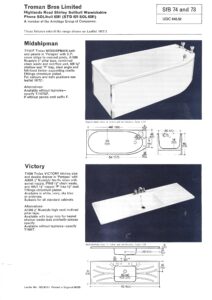

The brothers were not reacting to an established trend. They were ensuring that, if acrylic baths became important, Armitage would already possess the knowledge, manufacturing capability and freedom to exploit the opportunity.
That decision proved far-sighted.
Within a few years fashion colours transformed the bathroom market. Because Armitage now manufactured its own acrylic baths, it could produce matching coloured baths at essentially the same cost as white ones, something that was far more difficult for manufacturers dependent upon cast-iron baths.
The purchase of Troman had quietly given the company an advantage before most of the industry realised one existed. It was typical of the brothers’ willingness to invest in capabilities before they became essential.
Creating New Markets
Sometimes the brothers prepared for future developments. Sometimes they created them.
Integrated Plumbing Services (IPS) was unlike anything that had previously existed within the sanitary ware industry.
Instead of selling individual basins, baths and lavatory pans , the company began supplying complete factory-assembled plumbing systems for hospitals, schools and other large buildings.
The significance of IPS lay not simply in the product itself.
It fundamentally changed what the company sold.
Customers no longer purchased a collection of sanitary fittings.
They purchased a complete solution.

In doing so, the company created a substantial new market that had never existed before. Rather than competing more aggressively for existing business, it expanded the business itself. IPS demanded design, engineering, factory assembly and logistics as well as the manufacture of sanitary ware. It therefore changed not only what the company sold but also what it had to become.
Listening as Well as Leading
The creation of Avocado illustrates another side of the brothers’ character.
When the company decided to develop its own fashion colour range, more than twenty possible colours were prepared and nearly a thousand employees were invited to score them and choose their favourites. More than seventy per cent independently selected the same shade, Number 18, which became Avocado.
The exercise was not a publicity stunt. It was a practical way of answering a question for which there was no engineering solution. What colour would ordinary people choose for their own homes? The directors accepted the collective judgement of the workforce.
The decision proved inspired.
Launched in November 1969, Avocado became the biggest-selling fashion colour in Britain. More than one million bathroom suites were sold during the following decade, exceeding the combined sales of every other colour.
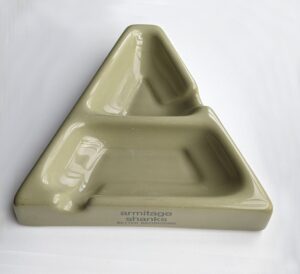
Looking Beyond Sanitary Ware
The same down to earth thinking lay behind the steady expansion of the company.
Engineering.
Transport.
Plastics.
Overseas manufacturing.
Each addition strengthened the business.
The acquisition of Shanks in 1969 completed the process.
The merger certainly created Britain’s largest sanitary ware manufacturer, but it also brought engineering expertise, battery casting technology, Scottish market leadership and overseas manufacturing. The enlarged company was not simply bigger. It was more capable.
Looking back, a consistent pattern emerges.
The brothers improved the existing business, strengthened its capabilities and then used those capabilities either to exploit new developments or, in the case of IPS, to create entirely new markets.
Beyond the Factory Gates
The brothers’ lives extended well beyond the pottery.
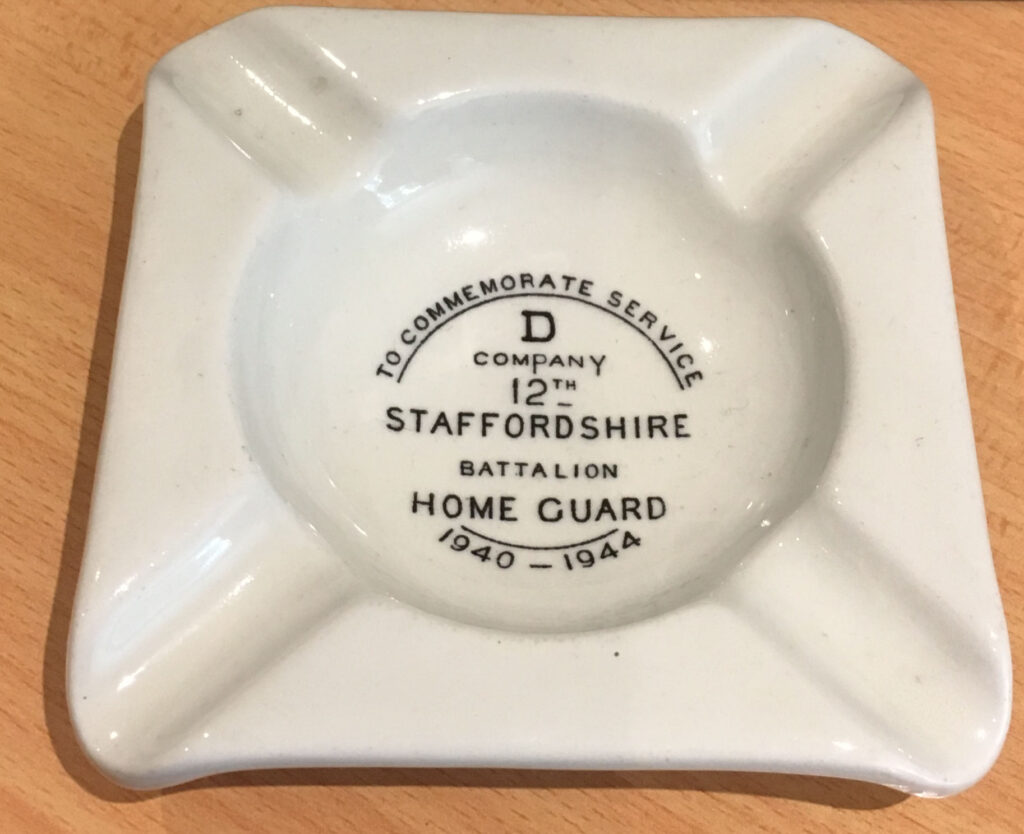
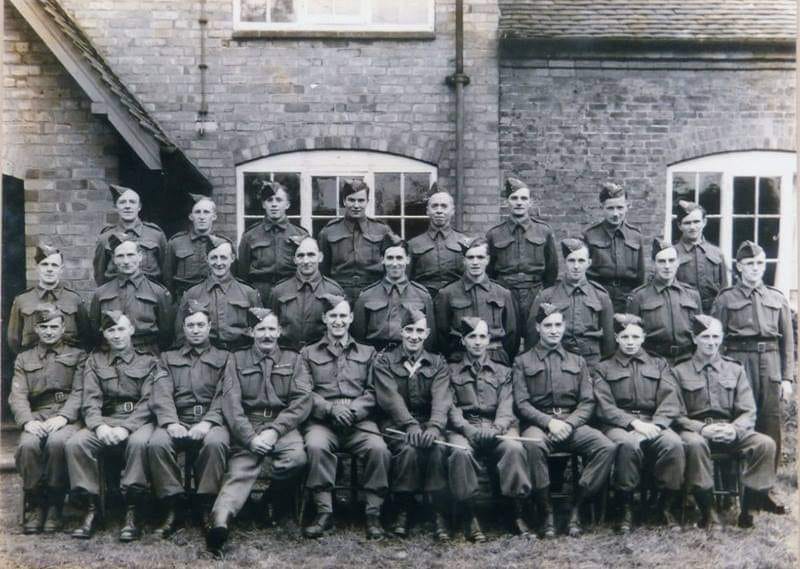
During the Second World War both joined the Home Guard almost immediately after the government’s appeal for volunteers. Alan commanded the Kings Bromley platoon while Ken commanded D Company based at Armitage before later becoming major in command of the Rugeley Battalion.
After the war their public responsibilities continued to grow.
Ken served as a magistrate for many years and chaired the local bench while becoming one of the leading figures within the sanitary ware industry.
Alan became President of the British Pottery Manufacturers’ Federation during its Jubilee year, later serving as High Sheriff of Staffordshire and Deputy Lieutenant.
Neither appears to have sought honours for their own sake. Rather, they reflected the respect both men had earned within industry and public life.
The Men Behind the Company
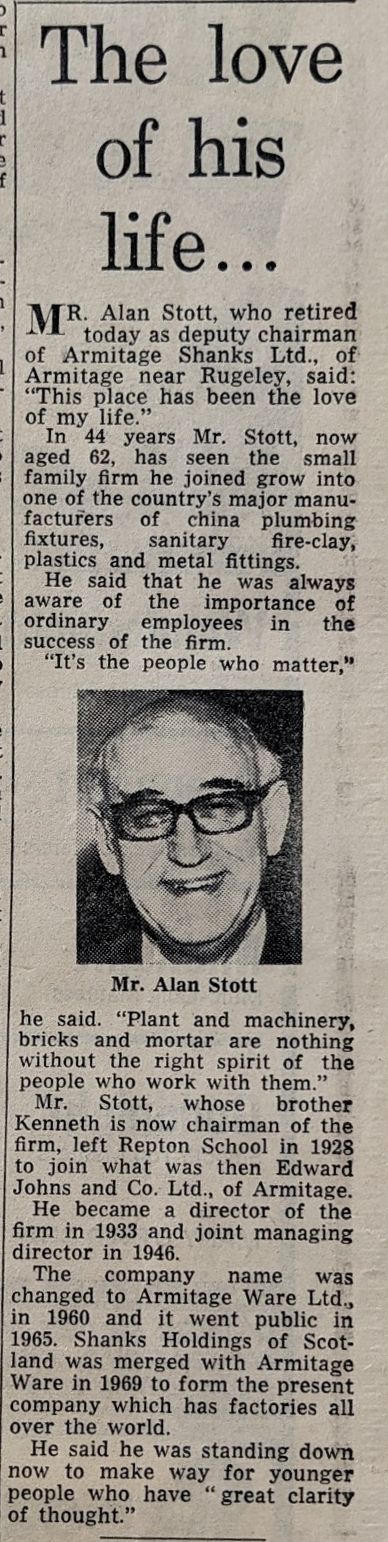
During his retirement interview Alan described the Armitage works as “the love of my life”. He believed that “it’s the people who matter. Plant and machinery, bricks and mortar are nothing without the right spirit of the people who work with them.” Those words neatly summarised both brothers’ approach to business. Behind the factories, products and acquisitions lay a genuine belief that successful companies were built by people.
Another story is equally revealing. Only one copy of the Express & Star was delivered each afternoon and the brothers would jokingly argue over who should read it first. It apparently never occurred to either of them simply to order another copy.
For all their success, the brothers remained recognisably those who had entered the company as young men.
Ken genuinely believed he was approachable and was surprised if employees thought otherwise, although within the offices he was still respectfully known as “Mr Kenneth”.
Such stories may seem trivial.
In reality they reveal two practical men who never lost the habits of a carefully run family business, even while leading one of Britain’s largest manufacturing groups.
Legacy
When Alan retired in 1972 and Ken followed two years later, they brought to an end the final chapter of Corn family leadership stretching back to the Victorian era.
Ken and Alan belonged to the final generation of Corn family leadership. Trained by their uncle Edmund Corn, they inherited a successful business but took it in directions that even he could scarcely have imagined. Their legacy was not confined to successful products or profitable acquisitions. They recognised emerging developments before they became mainstream, strengthened the company so that it could exploit them, and, on occasions such as Integrated Plumbing Services, created entirely new markets.
Just as importantly, they demonstrated that it was possible to build a major international business without losing the practical values of the family firm from which it had grown.
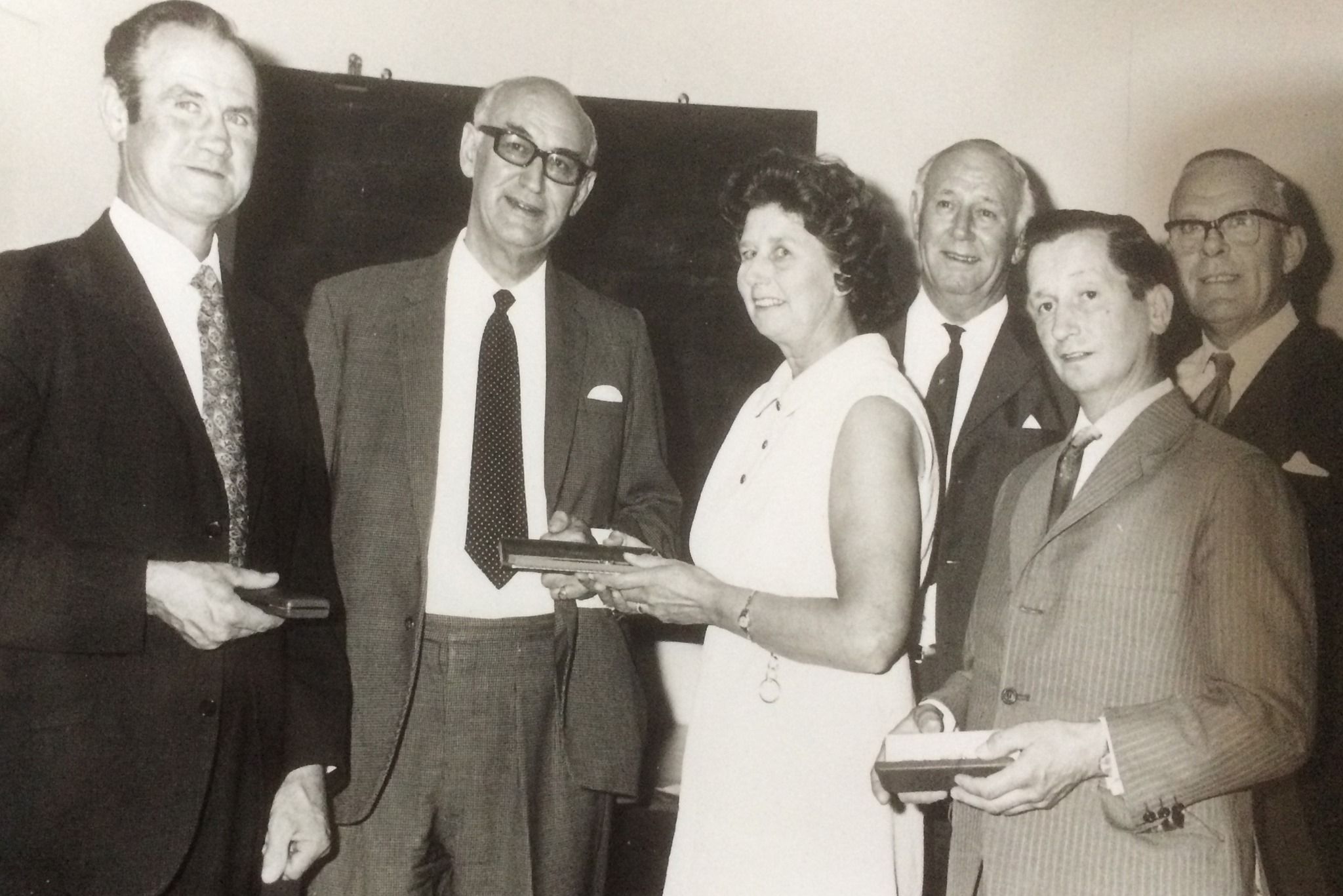
The products they developed have long since been replaced. The factories have changed and ownership has passed to others. Yet many former employees still remember not simply the company they built, but the two brothers who built it together. Their greatest legacy was not only the creation of Armitage Shanks, but the example they left of practical leadership, mutual trust and a belief that successful businesses are ultimately about people.
Ken and Alan Stott never sought to become famous industrialists. They simply believed in running a business well, treating people fairly and preparing for tomorrow rather than worrying only about today. Those principles transformed a Staffordshire pottery into an international company and left a legacy that extended far beyond the factory gates.