
Edward Lewis Williamson Johns
A different kind of owner
When Edward Lewis Williamson Johns inherited the Armitage pottery in 1893, he stepped into the shoes of one of Staffordshire’s most remarkable industrialists.
His father, Rev. Edward Johns, had transformed a struggling rural pottery into a thriving sanitary ware manufacturer whose products were exported around the world. Yet the son who inherited that success was a very different man. While his father had concentrated on building kilns, workshops and production capacity, Edward Lewis Johns appears to have been drawn towards design, presentation and prestige products. His brief seven years in charge would produce some of the most extravagant sanitary ware ever made at Armitage before ending with a dramatic sale that brought the Johns family’s ownership to a close.
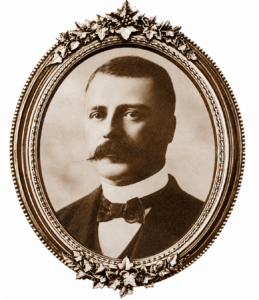
Born in 1858 at Brook End, Longdon, Edward was the eldest child of Edward and Martha Johns. His early years were marked by tragedy when his mother died while he was still a child. The family subsequently moved to Armitage, where his father was becoming increasingly involved with the pottery before purchasing it outright in 1867.
Edward was educated at Trent College, Long Eaton, a recently established boarding school intended for the sons of businessmen, farmers and professional men. It was a very different upbringing from that of his father and perhaps helped shape a different outlook on life.
Outside the pottery Edward immersed himself in village life. He attended the Congregational Chapel, played football and cricket, and helped organise the village flower show. Newspaper reports place him in goal for an Armitage football team that included the rector’s son, the village schoolmaster and several members of the Conway family. He later played as a full back and also captained the local cricket team. Unlike many Victorian industrialists, he was not a distant employer but a familiar figure in village life.
The Inventor
One indication of Edward’s interests came in 1888 when his name appeared on a patent for an improved wash basin. The design featured a recessed front edge that allowed users to stand closer to the bowl, together with integrated soap and brush trays. More than a century later the concept remains familiar, particularly in hairdressing salons.
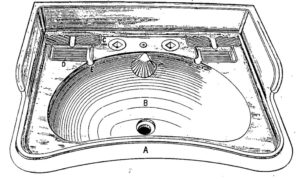
Unlike many patents that never progressed beyond the drawing board, Edward’s design entered production and became a recognised selling point. Company catalogues proudly advertised “Lavatories with Patent Recessed Front”, demonstrating that the innovation was being actively marketed.
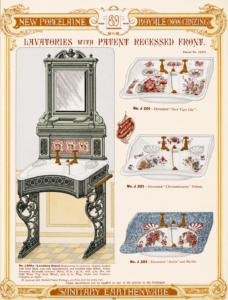
The catalogue illustrations reveal something else about Edward’s approach. These were not merely practical fittings. They were designed as pieces of furniture, complete with mirrors, decorative cast-iron stands and elaborate ornamentation. Edward appears to have understood that the Victorian bathroom was becoming an increasingly fashionable room within the home.
Making Sanitary Ware Fashionable
Everything changed in April 1893 when Edward inherited both the pottery and The Mount following his father’s death.
The business he inherited was successful and respected, but it was also facing new challenges. Competition was increasing, legislation was beginning to require improvements to working conditions, and further investment would be needed to maintain growth.
Rather than following his father’s path, Edward appears to have pursued a different vision for the company.
The sanitary ware industry of the 1890s was becoming increasingly fashionable. Bathrooms were no longer simply functional spaces but symbols of wealth and status. Under Edward’s ownership the company produced some of its most decorative and ambitious products. Catalogue illustrations reveal elaborately decorated fountain basins with floral designs such as Tiger Lily, Chrysanthemum and Azalia. Others were finished in marbled colours and highlighted with real gold leaf.
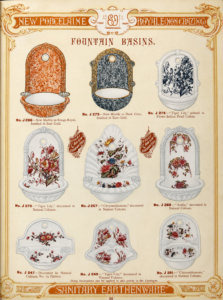
These products were marketed not merely as sanitary ware but as objects of taste and refinement.
The most spectacular example was the Lion closet. Supported by a sculpted lion and decorated with classical motifs, it was one of the most ambitious sanitary products ever produced at Armitage. It represented the complete opposite of the practical cane-and-white sanitary ware that had made the company successful.
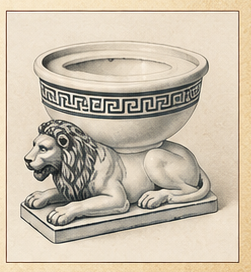
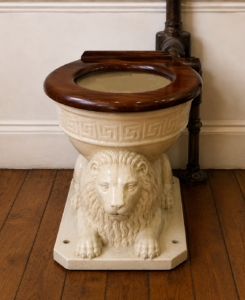
There is an irony at the heart of Edward Lewis Johns’ story. Some of the most attractive and ambitious products ever produced at Armitage appeared during his ownership. Yet the very effort to move sanitary ware up-market may have weakened the economics of the business. Decorative fountain basins, marbled finishes, gilded decoration and products such as the Lion closet undoubtedly enhanced the company’s reputation, but they were far more costly to produce than the practical wares that had built its success.
Such products could command higher prices, but they were also likely to appeal to a small, niche, market. A plain basin could be manufactured repeatedly and sold in large numbers. A heavily decorated basin required additional processes, skilled labour and more careful handling. If sales volumes failed to match the increased costs, the result would have been lower profitability despite the products’ impressive appearance.
During Edward’s ownership there were no major expansions of the works and the workforce declined. It is therefore possible that his strategy improved the company’s image while doing little to improve its financial performance.
The End of the Johns Era
Edward’s time in charge ended as suddenly as it had begun.
According to later accounts, he had fallen in love with Hannah Timmis, the daughter of a substantial farmer. Whether local stories about family objections are entirely accurate can no longer be known, but events moved rapidly during 1900.
On 28 September that year Edward sold the pottery to Edmund and Alfred Corn. Two months later he married Hannah in London by Archbishop’s Licence. Five months after the wedding their first child was born. The timing suggests that family circumstances may well have played a significant role in his decision to dispose of the business and leave Staffordshire.
Yet Edward did not simply walk away from the company.
As part of the sale agreement, the business continued to trade as Edward Johns & Co. The arrangement made obvious commercial sense. The Johns name had become well known throughout Britain and overseas. But it may also have represented a final tribute to his father, whose efforts had transformed the pottery’s fortunes.
Whatever the reason, the Johns name remained. Long after Edward had left Armitage and settled in Kent, the company continued trading as Edward Johns & Co. It was not until 1960, sixty years after the sale, that the name finally disappeared when the company became a public limited company.
Legacy
Edward Lewis Williamson Johns remains an intriguing figure. He lacked his father’s appetite for industrial expansion, but he possessed an eye for design and a willingness to experiment. Under his ownership the pottery produced some of the most decorative and imaginative sanitary ware in its history.
He owned the pottery for only seven years. Yet when he left, he ensured that the Johns name endured. The company traded under that name for almost six decades