
How one man guided a Staffordshire pottery through four turbulent decades and helped create a brand recognised around the world.
The history of Armitage pottery is often told through three names. Thomas Bond founded the pottery, Edward Johns transformed a struggling pottery into a successful sanitary ware manufacturer, while the Stott brothers later modernised the business and oversaw the creation of Armitage Shanks.
Between those eras stood Edmund Corn.
For more than four decades he guided the company through some of the most challenging years in British industrial history. He was a technical innovator, an exporter, a businessman and a demanding manager. Under his leadership the factory expanded, new products were introduced, overseas markets were developed and the foundations were laid for the remarkable post-war success that followed.
Most importantly, it was during Edmund Corn’s era that the Armitage name began its journey from a Staffordshire village to an internationally recognised brand.

A Potter Rather Than a Proprietor
Unlike Edward Johns, who came to the pottery from outside the trade, Edmund Corn understood the business from the factory floor upwards.
He took a close interest in every aspect of manufacture. Throughout his career he experimented with materials, altered compositions, refined production methods and sought improvements in efficiency and quality. He was not content simply to sell sanitary ware; he wanted to understand precisely how it was made and how it could be improved.
This technical knowledge shaped his management style. Edmund knew the costs of production in detail and understood the relationship between labour, materials, fuel and selling prices. When difficult decisions had to be made, he was making them from a position of knowledge rather than theory.
That knowledge would prove invaluable as the company entered the turbulent decades of the twentieth century.
Innovation and Expansion
Edmund Corn inherited a well-founded business that had lost its way.
One of his first actions was to reduce wages by 30 per cent, bringing them into line with those paid at the Henry Richards Tile Company. Such a drastic measure suggests a business whose costs had become uncompetitive and whose profitability needed urgent attention. The decision was undoubtedly unpopular, but it demonstrated Edmund’s determination to restore the company’s competitiveness and secure its future.
One of his early innovations was the introduction of a new syphonic water closet. The product sparked a prolonged dispute that eventually involved other sanitary ware manufacturers across the Potteries. Whether admired or criticised, Edmund had demonstrated that he was prepared to challenge accepted practice.
His most important technical achievement was the introduction of casting.
The new process transformed production and helped prepare the factory for future expansion. It enabled greater consistency, increased output and represented one of the most significant manufacturing changes in the pottery’s history before the Second World War.
The years immediately before the First World War saw substantial growth. Factory buildings were extended, production increased and exports expanded. While later generations would introduce vitreous china and once-firing, Edmund had already shown that technological change could drive the business forward.
The measure was effective. By the time Edmund handed responsibility to the next generation, the company was larger, stronger and far better positioned than the business he had inherited.
A Colour Revolution
Perhaps Edmund Corn’s most overlooked achievement was helping to transform the bathroom itself.
Until the 1920s sanitary ware had changed remarkably little from Edwardian times. White was the accepted standard and bathrooms were viewed largely as practical necessities rather than rooms to be decorated.
The breakthrough came from an unexpected direction. In 1925 the Henry Richards Tile Company began producing its Recesso range of built-in bathroom fittings. These cast and tunnel-fired fittings were available in coloured glazes and could be incorporated into tiled walls. During the disruption caused by the 1926 miners’ strike, experimentation with coloured and mottled glazes appears to have produced an entirely new idea.
The close relationship between Edward Johns and the Henry Richards Tile Company made such collaboration possible. Edmund Corn directed both businesses, members of the Corn family worked across the two firms and Ken Stott was studying pottery technology in the Potteries. Ideas flowed readily between Armitage and Tunstall.
The result was revolutionary.
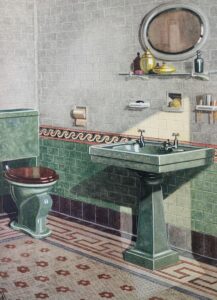
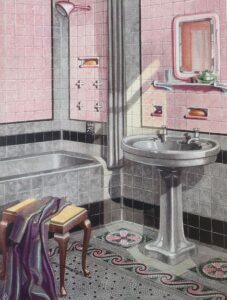
In 1927 Edward Johns launched four coloured sanitary ware finishes: Mottled Armitage Green, Mottled Amber, Mottled Staffordshire Blue and Mottled Dove Grey. These were matched by Henry Richards tiles, allowing complete coordinated bathroom schemes to be created.
Today coloured bathrooms may seem unremarkable, but at the time the concept was entirely new. The introduction of coloured sanitary ware helped transform the bathroom from a purely sanitary necessity into an important room within the home. It also proved highly profitable, with coloured suites selling at more than twice the price of traditional white ware.
Whether by deliberate design or fortunate experimentation, Armitage appears to have produced the first coloured sanitary ware suites in the world.
The World Beyond Armitage
Edmund understood that growth could not rely solely upon the domestic market.
Together with his wife, he travelled extensively to meet customers and develop overseas business. At a time when many manufacturers depended heavily upon agents and intermediaries, Edmund preferred direct contact. He wanted to understand markets for himself and establish personal relationships with customers.
These efforts helped secure valuable export business and encouraged the development of new overseas brands.
One of these was the Armitage Line, created for the Canadian market.
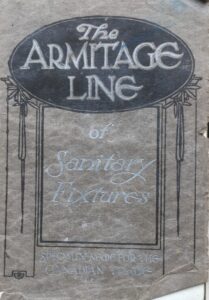
What began as a marketing identity gradually evolved into something much larger. In the 1920s the company began replacing the Edward Johns identity with the Armitage Ware brand. Over the following decades the Armitage name became the public face of the business and eventually eclipsed the company name itself.
It was a development whose significance would only become clear decades later. The Armitage name that appeared on sanitary ware around the world ultimately evolved into the Armitage Shanks brand that remains familiar today.
Difficult Years
It is easy to overlook how challenging Edmund Corn’s period of leadership actually was.
The first half of the twentieth century brought industrial disputes, economic uncertainty, war and depression. Many companies struggled. Others disappeared altogether.
The death of Edmund’s brother in 1916 added another burden. Edmund now found himself responsible not only for Edward Johns but also for the Henry Richards Tile Company, later known simply as Richards Tiles, which was in many respects the larger of the two businesses.
Yet despite these challenges the company continued to expand.
Exports increased, new products were introduced and the factory remained successful through decades that tested manufacturers throughout Britain. By the late 1930s the company was stronger and larger than it had been when Edmund first assumed responsibility.
That achievement alone would have secured his place in the history of the pottery.
A Demanding Character
Those who knew Edmund did not always find him easy to work with.
Family recollections suggest a strong-willed and sometimes intimidating personality. One family member described him as a bully. He expected high standards and took a close interest in the smallest details of the business. Decisions that affected production, costs or quality often attracted his personal attention.
Yet many successful industrialists of the period shared similar characteristics. The same determination that could make Edmund difficult in negotiations also helped him steer the company through difficult economic conditions and continual change.
He was not a distant owner. He was immersed in the business and involved in its daily operation.
Preparing the Future
Edmund and his wife had no children of their own. As a result, the future leadership of the business lay elsewhere within the family.
One of Edmund’s most important contributions was ensuring that the company would prosper after his own active involvement diminished.
He made sure that his nephews received practical and technical training throughout the business. They were expected to understand production as well as management and to gain experience across multiple departments.
Among them were Geoff Corn, Ken Stott and Alan Stott.
Geoff Corn would eventually become Chairman of Edward Johns and Chairman and Managing Director of Richards Tiles. Ken and Alan Stott increasingly took responsibility for the Armitage operation during the late 1930s and wartime years before leading the company into its most dramatic period of technological and commercial expansion.
The success of the next generation was not accidental. Edmund had spent years preparing them for that role.
The Making of Armitage Ware
Thomas Bond founded the pottery. Edward Johns created a successful sanitary ware company. Ken and Alan Stott transformed it into the modern business that became Armitage Shanks.
Edmund Corn’s achievement lay between those eras.
He introduced new manufacturing methods, pioneered coloured sanitary ware, expanded production, developed export markets, built the Armitage Ware identity and guided the business through four decades of uncertainty and change. Most importantly, he handed over a thriving company to the next generation.

Today his name is less familiar than either Edward Johns or Armitage Shanks. Yet much of what followed was built upon foundations laid during his leadership.
If Edward Johns created the business and the Stotts modernised it, Edmund Corn ensured that the company survived, prospered and evolved into Armitage Ware.