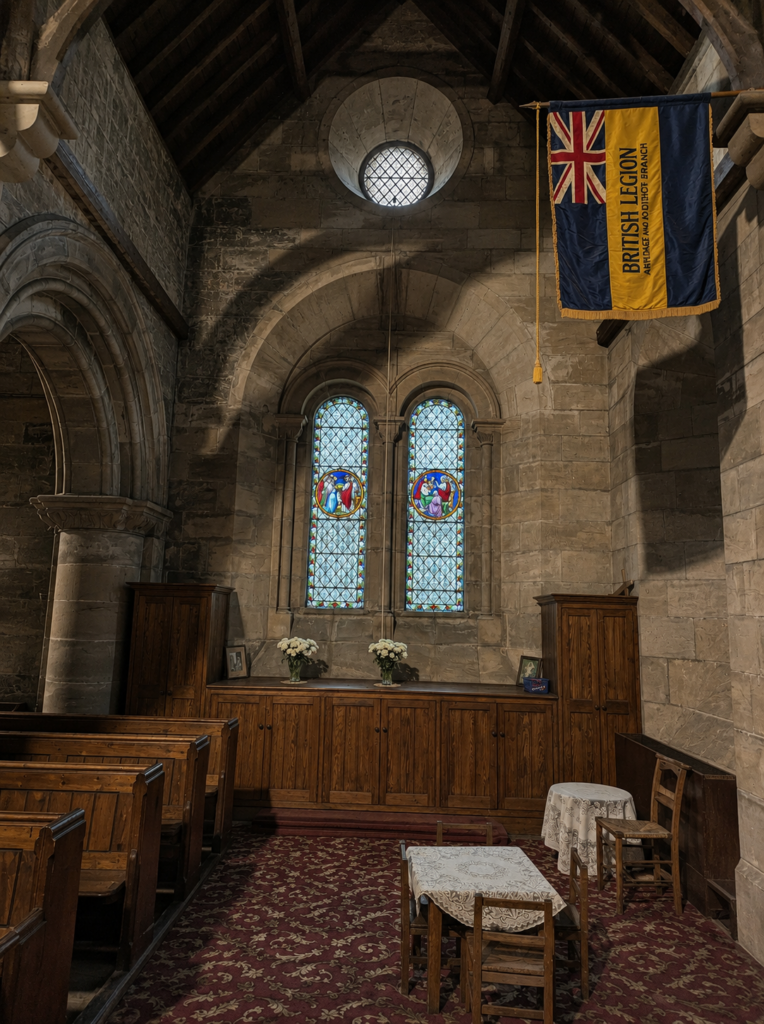
A Closer Examination of the North Aisle
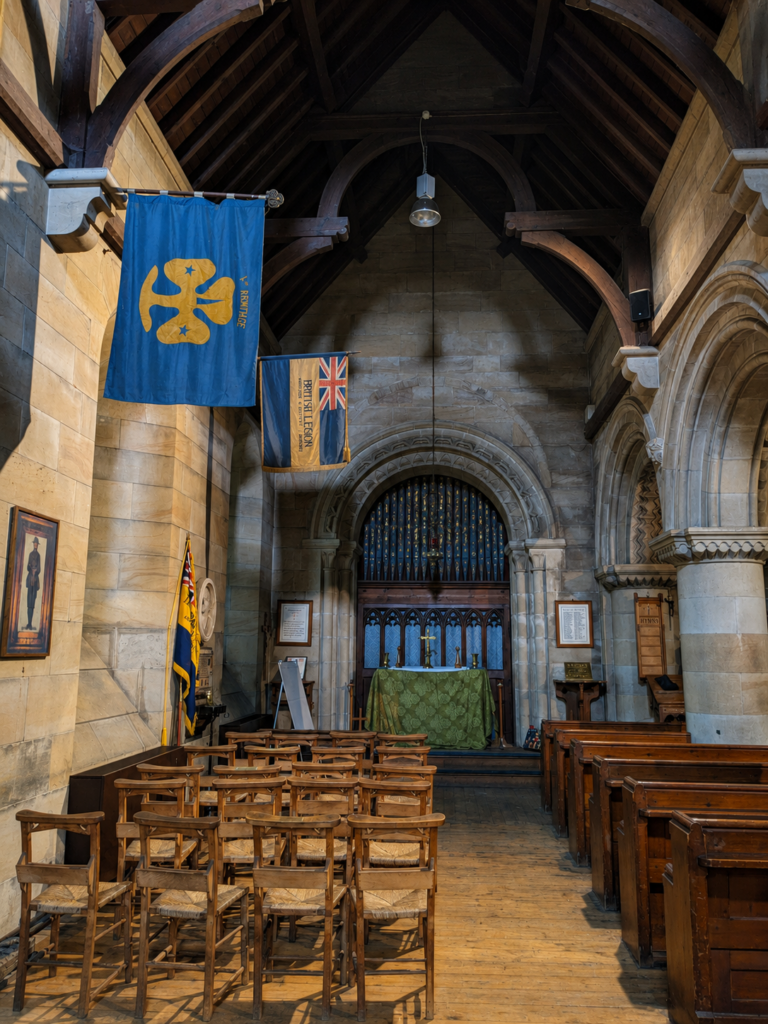
The north aisle of St. John the Baptist forms one of the most important survivals of the church’s Norman or Romanesque character, even though the visible structure largely dates from Henry Ward’s rebuilding of 1844–1847. Together with the nave arcade, it preserves the heavy round-arched forms and massive cylindrical piers which Stebbing Shaw described in the 1790s and which appear to reflect the character of the earlier medieval church.
Shaw described the north aisle in considerable detail. He recorded it as forty-one feet long and fifteen feet broad, divided from the nave by four round arches supported on five “plain, massy, round pillars”. He was uncertain whether the arches themselves were “coeval with the pillars”, suggesting that parts of the arcade may already have been rebuilt or altered by the late eighteenth century. His description hints at a church which had evolved gradually across the centuries rather than one built in a single uninterrupted campaign.
The relationship between nave and north aisle remains central to understanding the development of the church. The cylindrical piers and semicircular arches create a remarkably unified Romanesque appearance, raising the possibility that nave and aisle formed part of a broadly contemporary mid-12th-century rebuilding programme. At the same time, Shaw’s doubts about the arches imply that the arcade may already have undergone medieval modification long before Henry Ward rebuilt the church in the Victorian period.
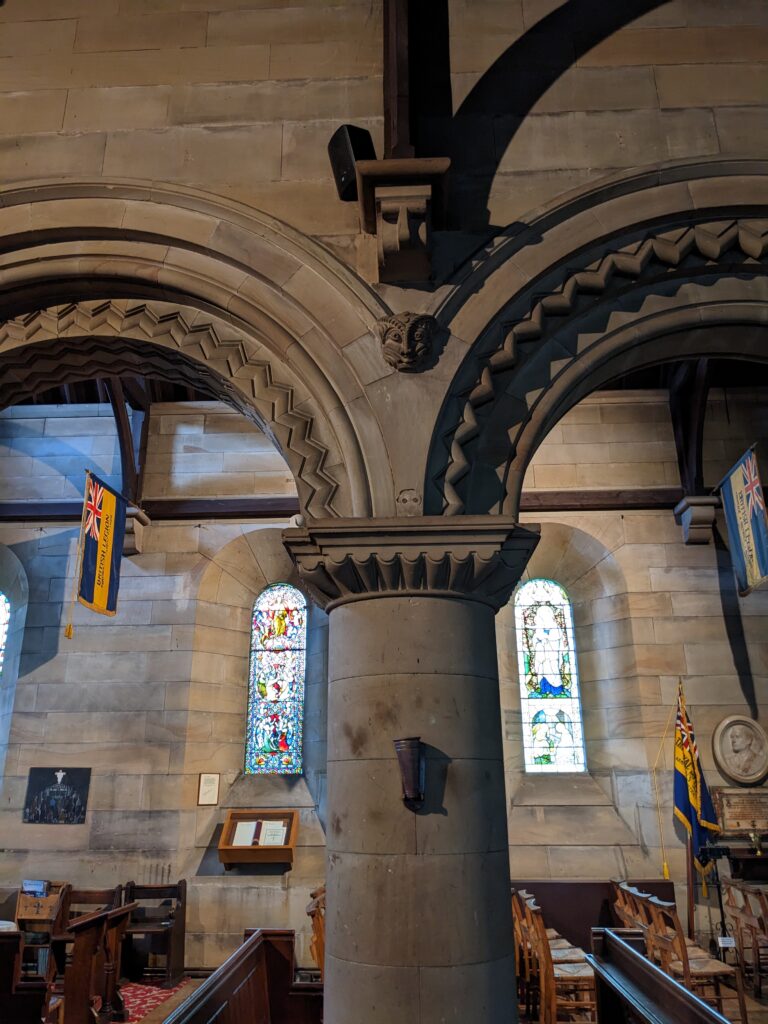
Henry Ward’s rebuilding amplified and regularised this Norman character. The rebuilt arcade presents a carefully ordered sequence of broad semicircular arches enriched with chevron moulding carried on heavy cylindrical piers with scalloped capitals and square abaci. Although Victorian in execution, the overall effect is convincingly Romanesque and produces much of the church’s architectural atmosphere.
Particularly striking is the depth of the arches and walling surrounding the aisle windows. The round-headed windows are set within massive sandstone splays which emphasise the thickness and solidity of the masonry. Sunlight falling across these angled surfaces creates dramatic contrasts of shadow and illumination which change constantly through the day.
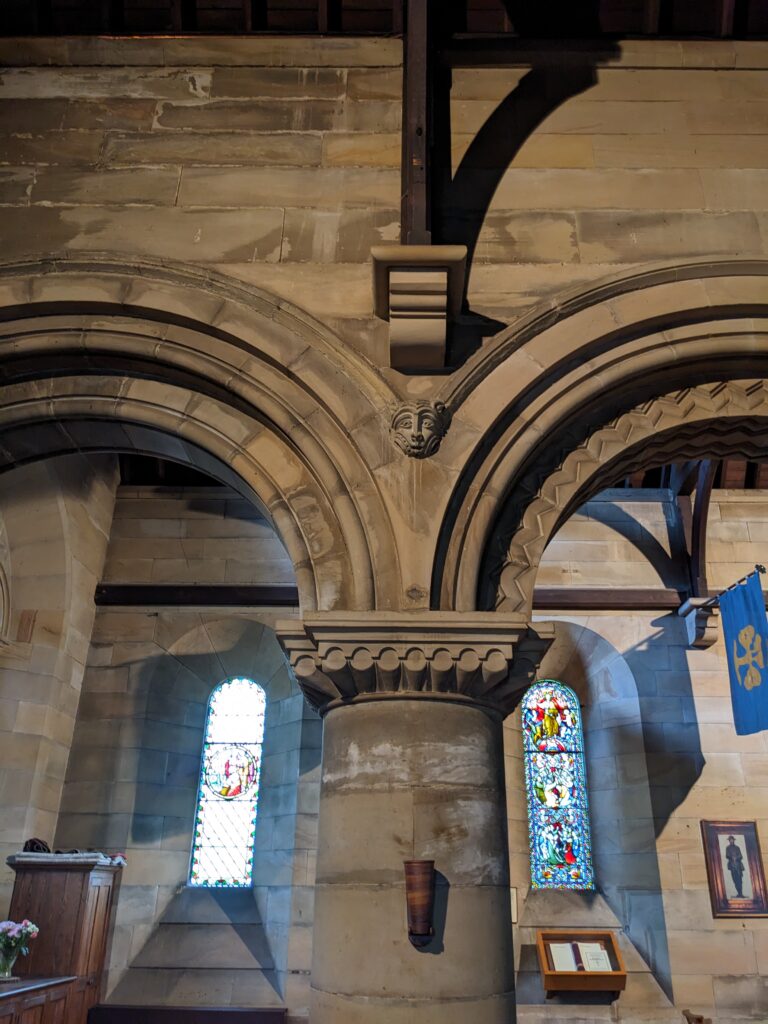
The rebuilt north aisle possesses a quieter and more enclosed atmosphere than the nave. The lower light levels, heavy masonry and narrow round-headed windows create a sense of calm and permanence which suits the aisle’s later memorial function particularly well. While the Victorian rebuilding sought to recreate Norman character architecturally, the aisle gradually acquired additional layers of meaning through memorials, remembrance and parish memory.
Several of the stained-glass windows belong to this later phase of the church’s history. Unlike the east window of the chancel, which was installed shortly after the rebuilding, many of the north aisle windows date from the late nineteenth and early twentieth centuries and reflect changing devotional and memorial tastes within the parish.
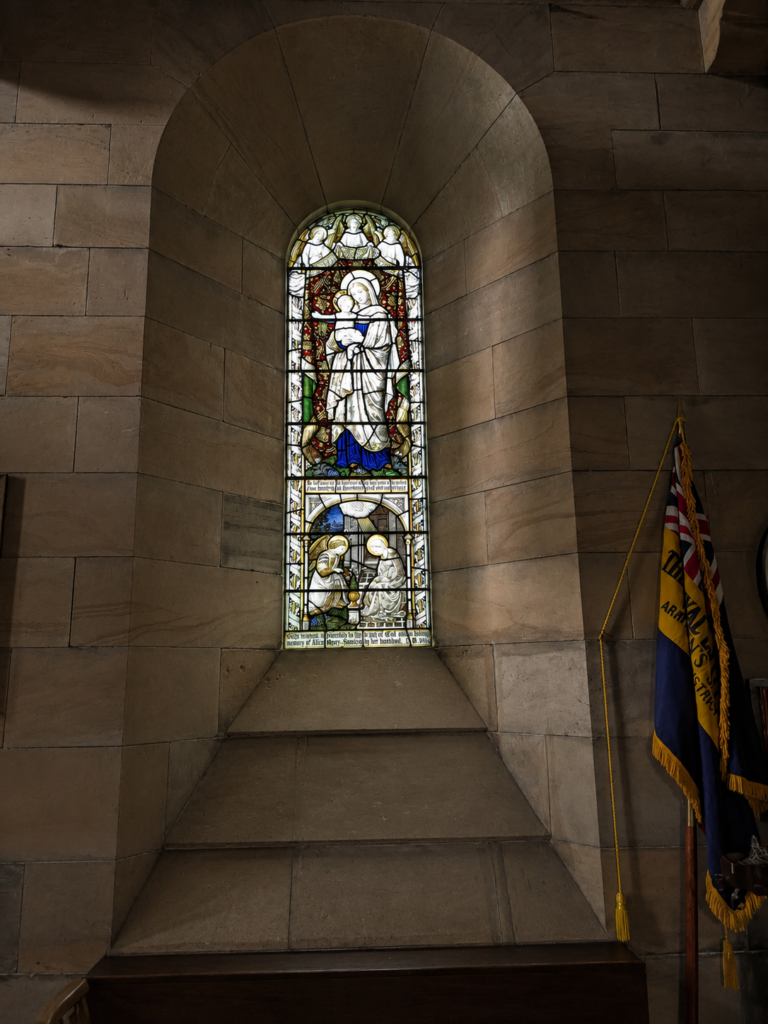
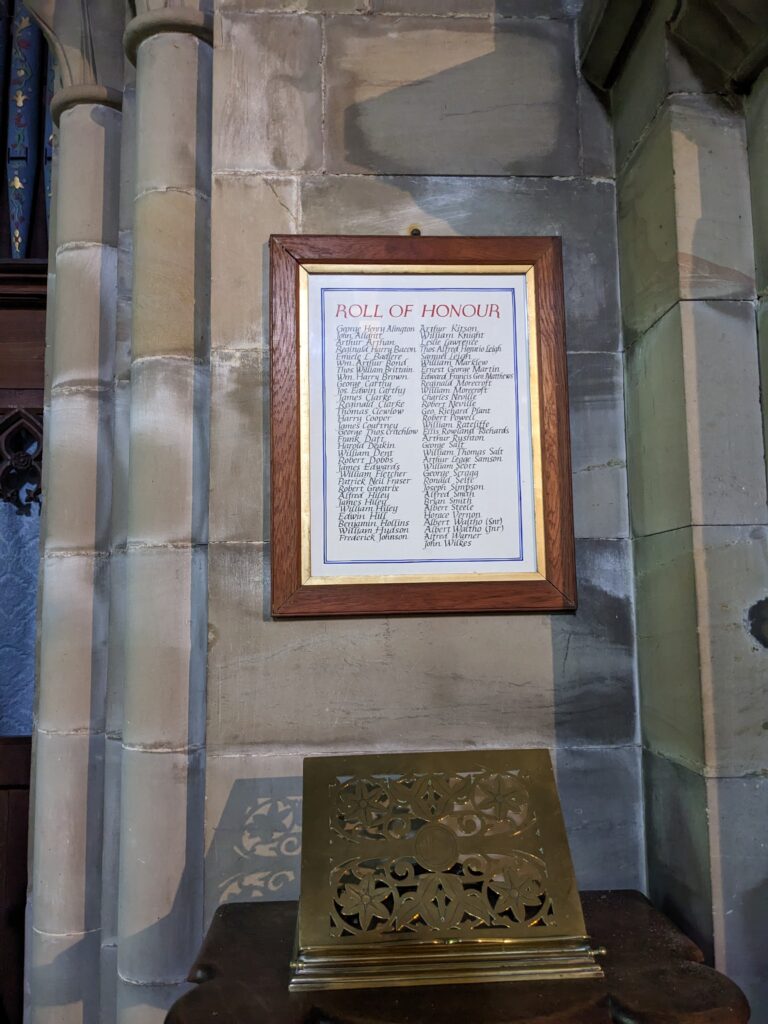
The aisle also became closely associated with remembrance following the First World War. The Roll of Honour listing parishioners who served, together with the later memorial chapel arrangements, transformed part of the aisle into a space devoted to memory and reflection. The presence of the British Legion banner further strengthens this association between the church and the military history of the village.
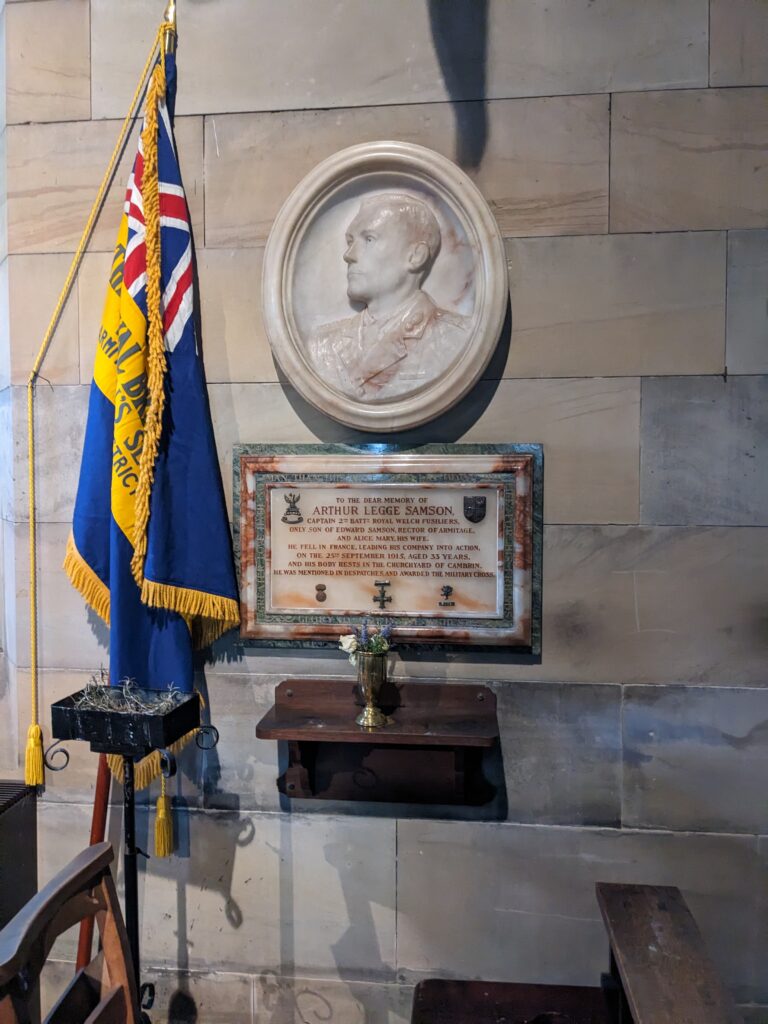
Among the most significant memorials is that to Captain Arthur Legge Samson of the Royal Welch Fusiliers, killed in action in 1915 while leading his company. The marble memorial and portrait medallion introduce a more personal and individual dimension to the wider commemorative role of the aisle. Such memorials demonstrate how the rebuilt Victorian church quickly became woven into the social and emotional life of the parish community.
The architectural setting enhances these memorials considerably. The heavy Romanesque arches and massive masonry provide a sense of permanence and stability which complements the commemorative purpose of the space. Henry Ward’s interpretation of Norman architecture therefore proved unexpectedly suited to the evolving memorial role the aisle later acquired.
The relationship between the aisle and the nave is also architecturally important. From within the north aisle, the broad cylindrical piers and repeated zig-zag arches can be appreciated particularly clearly. The alternating rhythm of arches and shadowed openings produces one of the strongest visual sequences within the church interior.
Ward’s rebuilding should not, however, be understood as an exact archaeological recreation of the medieval aisle. Shaw encountered an ancient building already altered and partially rebuilt across many centuries. The Victorian architect instead produced a more unified and idealised interpretation of Romanesque architecture, regularising proportions and repeating decorative motifs more consistently than may originally have existed.
The listed building description particularly notes the “cylindrical columns, scalloped capitals, square abaci and chevron moulded round arches” which dominate the arcade. These features, together with the grotesque head stops and heavy masonry, successfully preserve the Norman character which so impressed earlier observers of the church.
The north aisle therefore embodies several overlapping histories at once. Architecturally, it preserves Henry Ward’s Victorian interpretation of a Norman parish church. Historically, it contains important clues about the development of the earlier medieval building described by Shaw. Socially, it became one of the principal spaces within the church for memorialisation, remembrance and expressions of parish identity across the twentieth century.