
A Gentleman at Armitage Park
In 1760, when Armitage was still a quiet agricultural parish along the Trent Valley, a new residence appeared on the wooded rise above the river: Armitage Park, created by Nathaniel Lister, a well-educated northern gentleman whose tastes were shaped by Westminster, Oxford, and a life spent among polite society. Although Lister himself lived at Armitage Park for only part of his life—later making his permanent home in Lichfield—his decision to build the house left a lasting mark on the parish.
Lister’s legacy in Armitage is twofold. First, he should be remembered for the estate he created: a refined Georgian house set within a carefully arranged landscape, reflecting the values of comfort, cultivation, and genteel retreat. In addition, he played a pivotal role in the construction of the Trent & Mersey canal through the parish. The canal should have followed the contour lines through Armitage, but Lister personally persuaded James Brindley to route it straight past Armitage Park. This required the creation of a tunnel through a sandstone ridge, which Lister paid for himself. Armitage Park, since renamed Hawkesyard Hall, remains one of the parish’s most distinctive residences long after he and his wife Martha moved away.
But second—and often overlooked—Lister’s importance extends far beyond Armitage itself. Through his children and grandchildren, many of whom became prominent in literary, political, and professional life, the family exerted an influence on the wider national stage during the nineteenth century. The Listers’ later achievements, grounded in the education and opportunities Nathaniel helped secure, carried the family name far beyond the Trent Valley.
Seen in this light, Nathaniel Lister’s story is not simply the tale of a gentleman who once lived in Armitage. It is the foundation of a lineage whose impact radiated outward: from the house he built for a brief chapter of his own life, to the broader world in which his descendants played significant and lasting roles.
Family Background and Early Life
The Lister Family
Nathaniel Lister was born into a long-established northern gentry family whose estates centred on Gisburn and whose influence extended across Lancashire and Yorkshire. As the second son, Nathaniel grew up with opportunity but without the obligations of the principal heir. Following the death of their father in 1754, Nathaniel’s elder brother became Member of Parliament for Clitheroe. When his brother died in December 1761, Nathaniel took the seat, holding it only until his nephew reached the age of 21. The Lister family, together with Nathaniel’s cousin Assheton Curzon of Hagley Hall, effectively “owned” the Clitheroe Burgage Borough, controlling who was elected, with the Lister and Curzon families serving as the two MPs for the borough. Nathaniel’s future would be shaped not by estate management, but by the education and refinement expected of a gentleman of independent means.
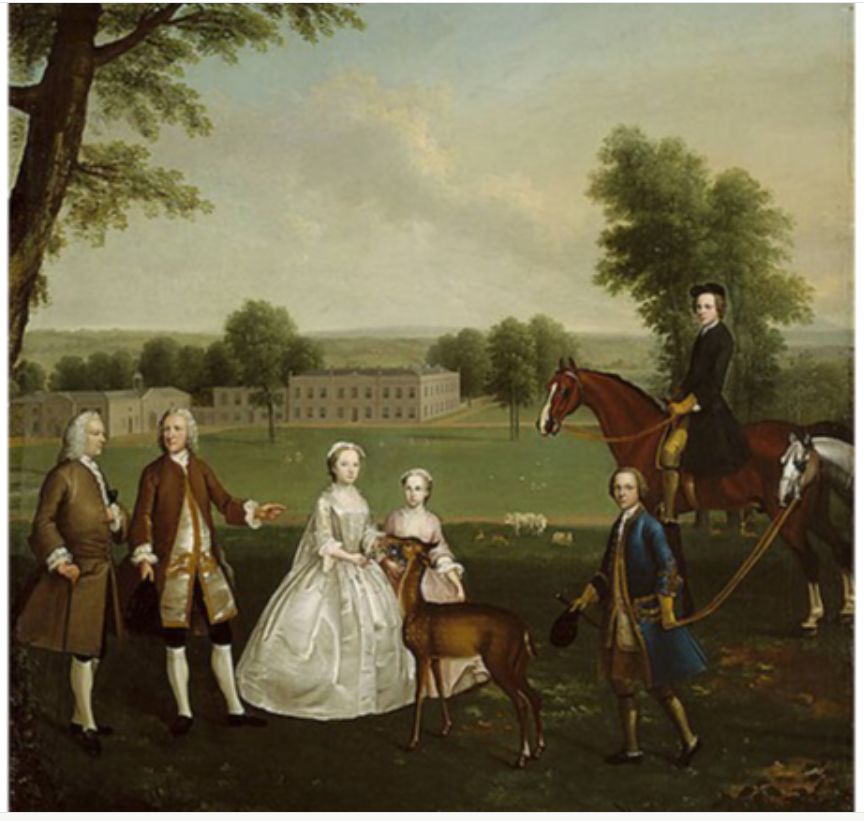
Westminster School
Lister’s formal education began at Westminster School, then one of the most demanding classical institutions in England. Its pupils were trained through rigorous study of Latin and Greek authors, formal debate, and the near-constant exercise of memory and composition.
Life at Westminster was not merely academic. It was a world of intense tradition, discipline, and boyish bravado. Nowhere is this more vividly preserved than in the Coronation Chair in nearby Westminster Abbey. For centuries, Westminster boys were permitted—and sometimes encouraged—to carve their initials into its oak surface. The chair, used for the crowning of English monarchs since the Middle Ages, bears this remarkable graffiti including that of Nathaniel Lister from 1737.
Oxford: Forming the Gentleman
From Westminster, Lister proceeded to Lincoln College, Oxford, continuing the expected path of a well-born young man. He attended as a Gentleman Commoner and would have often therefore dined with the tutors. One of these tutors was John Wesley, who became a co-founder and principal leader of Methodism. Lister was conservative in his theology and attached to traditional, High Church, Anglican worship and would not have been happy with Wesley’s evangelist approach to Christianity.
Academic life was comparatively gentle, but the university provided time to read, converse, and observe the social codes that governed polite society. Lister left Oxford not as a scholar in the strict sense, but as a thoroughly formed eighteenth-century gentleman—thoughtful, well-mannered, and prepared for the measured, cultivated life he would later build at Armitage Park.
Courtship and Marriage
Meeting Martha
Sometime in the mid to late 1750s, during one of the journeys expected of a young gentleman of means, Nathaniel Lister encountered Martha Fletcher, a woman whose family, education, and refinement aligned naturally with his own. His presence in the Midlands at this time was far from accidental. In 1752, Nathaniel’s cousin, Assheton Curzon, had purchased Hagley Hall in Rugeley and settled there after his marriage in 1754. This Curzon residence placed a well-connected branch of the family firmly within the orbit of Lichfield, and it was almost certainly this new centre of kinship that first drew Nathaniel southwards and introduced him to the county’s sociable, literate milieu. Hagley Hall would have provided him not only with family hospitality but also access to the networks that linked Rugeley, Lichfield, and the neighbouring Staffordshire gentry.
His connection to the Fletchers pre-dated any romantic interest. Between 1756 and 1758 Nathaniel purchased property in Rushton Spencer from Martha’s father, John Fletcher, (Senior Proctor of Lichfield Diocese), a transaction that would have brought the two families into direct contact several years before any hint of courtship.
Although the evidence for their first acquaintance is sparse—no diaries, no surviving letters—their early relationship, insofar as it can be reconstructed, appears entirely in keeping with the polite Georgian pattern: deliberate, sociable, and steered by family oversight. Both came from households that valued learning, decorum, and respectability, and everything about their later life suggests compatibility of character rather than strategic calculation.
Courtship in this period unfolded through visits, shared acquaintances, and a watchful management of reputation. For a second son like Lister—handsome, educated, yet without the inheritance of a great estate—financial sensibility mattered. Martha brought with her a comfortable dowry and the promise of a settled, affectionate domestic life, making their eventual union both personally and socially sound.
Marriage, Status, and Expectation
Nathaniel and Martha married in Lichfield Cathedral in 1761, marking his transition from youthful freedom to the responsibilities of married life. Unlike his elder brother Thomas, whose role as heir anchored him to Gisburn, Nathaniel enjoyed greater latitude. The earlier Curzon establishment at Hagley Hall had already created a familial and social foundation in Staffordshire, and it was upon this base that Nathaniel chose to build.
His decision to settle near Lichfield rather than return north reflects a man drawn less to political influence and estate management than to a quieter intellectual life—one shaped by letters, conversation, and reflective companionship. Marriage gave him the stability to pursue such a path, while Martha’s presence provided its emotional core.
Their early years together embodied the virtues later praised in Seward’s epistle: domestic harmony, measured taste, and moral steadiness. These qualities formed the foundation for the next major step in Nathaniel’s life—the creation of a house and estate expressive of his character and aspirations.
Building Armitage Park
Choosing the Site
In 1759 Nathaniel Lister purchased Nether Park, the parcel of land that would become Armitage Park, an acquisition made two years before his marriage and signalling his intention to establish a settled base in Staffordshire. Significantly, the land he bought constituted roughly half of the medieval deer park created by Sir Simon de Rugeley in 1327, an enclosed hunting ground bounded by paling fences and deep ditches. These ancient features gave the site a distinctive historic structure long before Lister began to build.
The parish of Armitage lay within easy reach of Lichfield, then a small but culturally vibrant cathedral city whose clergy, writers, and professional families formed one of the Midlands’ most influential intellectual circles. The land itself occupied a gentle rise above the River Trent, offering meadow, woodland, and river views—precisely the landscape composition admired in eighteenth-century aesthetics. Lister, therefore, was selecting not simply a building plot but a site of deep historical resonance and natural beauty.
Designing the House and Grounds
A house already stood on the site when Lister acquired it, and by 1760 he undertook the works that created Armitage Park. Whether the earlier structure was wholly demolished or partially retained is uncertain, but surviving fabric indicates that the servants’ quarters were left in plain red brick, forming the functional core of the house. Above these quarters, a row of guest bedrooms extended in the same unstuccoed red brick, preserving the material character of the earlier building phase.
The principal new build adopted a distinctive neo-Gothic style, with red brick stuccoed in ashlar, giving the main elevations the refined pale finish fashionable in mid-eighteenth-century Gothic revival houses. Classical symmetry of Georgian Palladianism was carefully blended with pointed arches, battlements and turrets. The result was a building that projected Lister’s architectural ambition while still incorporating traces of the earlier structure.
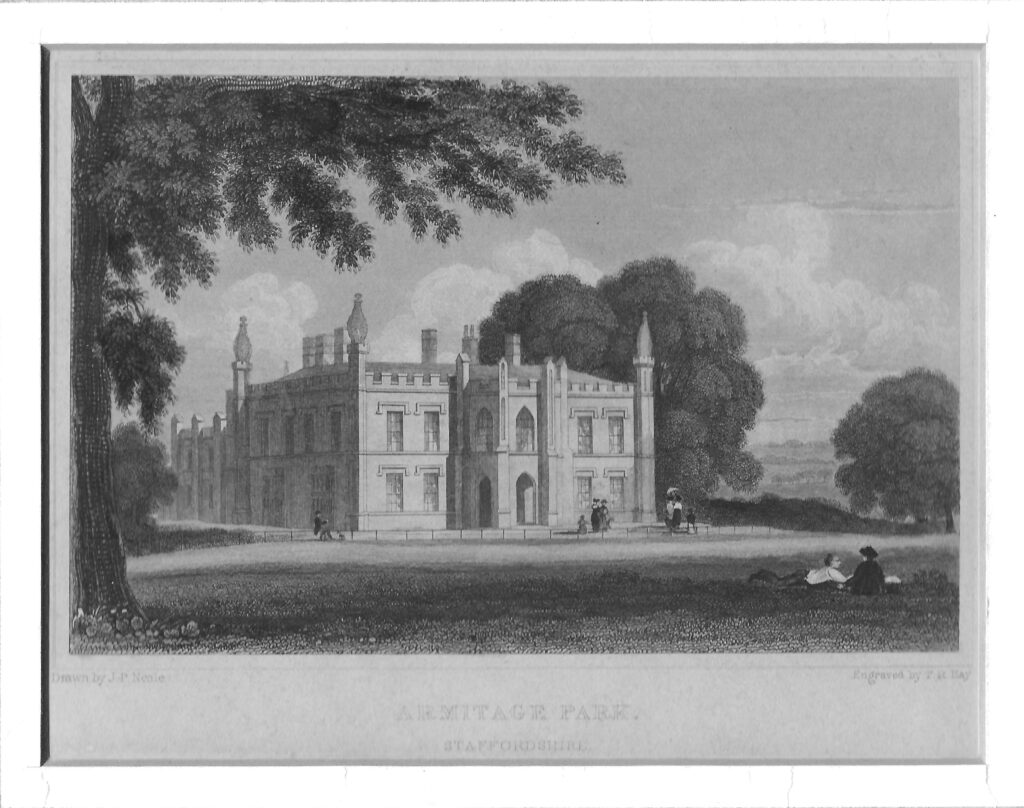
Inside, Lister planned a house suited to study, conversation, and quiet sociability. Its most impressive feature was a sixty-foot library, a long, dignified room that reflected both his learning and his desire to create a domestic environment shaped around books, writing, and intellectual fellowship. This great library complemented the arrangement of parlours, withdrawing rooms, and guest spaces, giving Armitage Park a cultivated atmosphere far beyond its modest scale as a country estate.
Beyond the house, Lister shaped the grounds in the naturalistic style then rising in popularity. He opened views toward the Trent, planted small groves, and laid out gentle walks that blended domestic enclosure with pastoral openness—still following, in softened form, the lines of the former medieval deer park.
When the canal was built through the village Lister’s influence on its route ensured that the estate’s views and approach remained aesthetically pleasing with the canal enhancing rather than disrupting the landscape he designed.
A House that Reflected a Life
Armitage Park soon became more than a residence; it expressed the life Nathaniel, and, from 1761, Martha, fashioned together. Visitors remarked on its calm atmosphere, tasteful restraint, and settled dignity. Nothing was showy; everything was deliberate. The house offered Lister space to read, write, and entertain friends—its great library standing as the clearest architectural embodiment of his character.
By establishing his home on land purchased in 1759 and reshaping it in 1760—before his marriage and before the Lichfield literary circle reached its height—Lister rooted himself in Staffordshire at a formative moment. This early decision placed him within the orbit of Lichfield’s sociable and intellectual world, a milieu that suited him perfectly. Through that connection, Armitage Park gained not only historical and architectural interest but also a quiet place in the region’s literary memory.
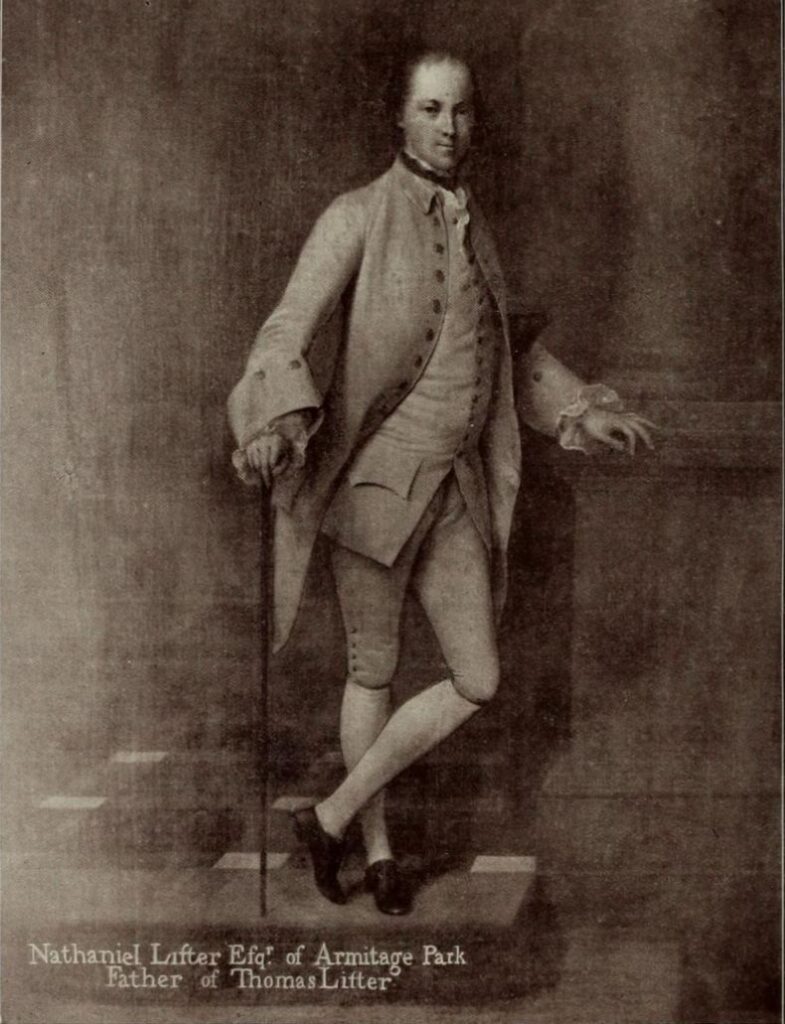
The Lichfield Connection: Anna Seward and the Literary Circle
Lister in Lichfield Society
By settling at Armitage Park, Nathaniel Lister placed himself within reach of one of the most vibrant provincial intellectual communities in late-eighteenth-century England. Lichfield, though modest in size, nurtured a remarkable constellation of writers, thinkers, and clergy whose influence extended far beyond the Close. By the late 1770s, Lister had begun to shift his focus from Armitage Park toward Lichfield. In 1780 he purchased a house in Beacon Street in the city and leased out Armitage Park, signalling the start of a permanent engagement with urban life. Later, in 1791, he acquired the lease to Dr. Erasmus Darwin’s house on the Cathedral Close and moved into it, placing himself at the centre of Lichfield’s intellectual and social circles.
The daughters of the cathedral precinct—among them Anna Seward, the self-styled “Swan of Lichfield”—created a sociable literary culture that attracted both admiration and occasional ambivalence from contemporaries.
Lister, with his polite education, gentle disposition, and reflective tastes, was a natural fit for this world. Though not a public author, he was known within the circle as a man of quiet talent, one who wrote verses privately, appreciated conversation, and took part in the circle’s characteristic routine of shared literary activity. His poems circulated in manuscript among friends—an entirely conventional practice within genteel literary society—and it was through such circulation that they reached Seward’s hands.
Crucially, Seward’s circle did not simply discuss literature: they enacted it. Evenings in the Close typically included the reading aloud of poems, letters, and newly published books, a practice central to the group’s way of thinking about literature. Members performed their own work and the work of others, reading with expression, and inviting critique and conversation in return. This performed, sociable mode of reading allowed Lister—soft-spoken yet thoughtful—to participate fully without seeking the exposure of print. It was in exactly this context that Seward first encountered and then admired his verses.
Anna Seward’s Regard for Lister
Seward’s reaction to Lister’s poetry was characteristically expansive. She valued elegance, moral sentiment, and classical control in verse—all qualities she believed she recognised in Lister’s lines. Her praise was sincere, though expressed in the elevated, occasionally florid language typical of her correspondence. Lister, in her view, was a man whose life and writing reflected virtue refined by cultivation.
Her respect for him was not solely literary. She admired his domestic happiness with Martha, his benevolent manners, and his thoughtful retirement at Armitage Park. Seward’s friendships often blended admiration, affection, and moral approval, and her regard for Lister followed this pattern. He became, for her, an example of that genteel, principled masculinity she prized—far removed from the political bluster and worldly ambition she frequently criticised.
Epistle to Nathaniel Lister, Esq. of Lichfield on Having Read His Poems in Manuscript
Seward’s Epistle—one of her polished, public-facing poems—was written after she read a collection of Lister’s verses in manuscript. Far from being a casual compliment, the work served several purposes within the literary culture of the time:
• It acknowledged Lister’s poetic gifts in a formal, public mode.
• It situated him within a network of genteel manuscript writers whose work circulated among trusted friends rather than the market.
• It elevated his moral character alongside his artistic sensibility, reflecting Seward’s belief that poetry and virtue were intimately connected.
• It celebrated the domestic peace of Armitage Park as the natural setting for his reflective mind.
• It also reflects the routine of Seward’s circle, in which verse was heard before it was judged: poems were meant to be spoken, shared aloud, and refined through conversation—precisely the way Lister’s own manuscript verses first reached her ears.
Significantly, the Epistle was published in Stebbing Shaw’s The History and Antiquities of Staffordshire, ensuring that Lister’s poetic recognition reached a wider, enduring audience beyond the immediate Lichfield circle. It is not mere flattery; it provides a window into how Lister was perceived by his contemporaries—especially by one of the Midlands’ most discerning literary figures. In Seward’s portrayal he becomes a symbol of cultivated retirement: a gentleman whose learning and sensitivity enrich his private life rather than seek public display.
The Place of Literary Friendship
Their friendship never became a collaboration. Instead, it belonged to a well-established eighteenth-century tradition: the literary acquaintance, formed through conversation, shared reading, mutual respect, and the occasional exchange of verse. The spoken element—the reading aloud of books, poems, and letters—was foundational, creating a rhythm of sociable criticism that shaped how each member encountered the others’ work. Such friendships were sustained by manners, intellect, and a shared belief in the civilising power of polite letters.
For Lister, whose temperament inclined toward quiet reflection, this connection provided recognition without the exposure of publication. For Seward, accustomed to championing the talents she perceived around her, he represented another example of the cultivated provincial gentleman—an adornment, as she saw it, to the district she took such pride in.
Later Years and Legacy
Retirement from Public Life
By the 1770s, Nathaniel Lister had largely withdrawn from formal political life. Having stepped down from his seat in Parliament in 1773, he no longer faced the obligations of public service. His remaining years were devoted to the management of his estates, the cultivation of family and social ties, and the pursuit of literary and aesthetic interests.
Lister’s move to Lichfield in 1780 with the purchase of a house in Beacon Street offered both practical and cultural advantages. It brought him closer to Martha’s family, provided access to refined society within the Cathedral Close, and allowed him to oversee his properties with greater ease. Though the Listers no longer resided permanently at Armitage Park, the estate remained a symbol of their influence in Staffordshire and a tangible link to the social ambitions of Nathaniel’s youth.
Family Life and Children
The Listers’ domestic world remained central to Nathaniel’s sense of purpose. He and Martha raised seven children at Armitage Park, all of whom were baptised in the parish church. The eldest, John Fletcher Lister, inherited Armitage Park and the family estates, while the younger children were provided for through settlements and appointments that reflected both social standing and opportunity. Their first-born son, however, died in infancy and was buried at Armitage, a reminder of the personal sorrows within their otherwise structured household.
Nathaniel took a keen interest in their education and advancement. His younger sons benefited from military commissions or property arrangements that allowed them to maintain the family’s social position, while his daughters received guidance in the manners, accomplishments, and connections expected of women of their rank. The household’s rhythms—letters, visits, riding, and reading—continued to reflect the disciplined, cultivated life that Nathaniel had embraced from Westminster and Oxford.
Intellectual and Cultural Legacy
Lister’s influence extended beyond property and politics. His engagement with Lichfield’s intellectual circles linked him indirectly to the Midlands Enlightenment, a movement characterised by curiosity, rational inquiry, and artistic expression. Connections to figures such as Erasmus Darwin, Josiah Wedgwood, and Anna Seward positioned him within a network where literature, science, and innovation intersected.
Though he never published his poetry, Nathaniel’s verses and cultivated taste earned him recognition among contemporaries. His letters, friendships, and careful patronage reinforced the idea that refinement and moral virtue were inseparable from the responsibilities of a landed gentleman. In this, Lister embodied the ideal of eighteenth-century gentry: a man at ease in both country and city, guided by intellect, courtesy, and prudence.
Death and Inheritance
Nathaniel Lister died in late 1793, leaving a carefully arranged legacy. His will ensured that Martha was well provided for, granting her the house in Lichfield, personal possessions, investments, and the tithes of Armitage and Handsacre. His eldest son inherited Armitage Park, while younger children received property, shares, and financial settlements sufficient to maintain their social standing.
The distribution of Nathaniel’s estate reflected both family foresight and social propriety. It secured continuity for the Lister name, reinforced connections with the broader gentry, and ensured that his descendants remained integrated into the cultural and political worlds he had navigated with careful attention throughout his life.
Nathaniel Lister may have lived at Armitage Park for only part of his life, but the estate he shaped, the landscape he nurtured, and the household he established left a lasting mark on the parish. He and Martha raised seven children at Armitage Park, some of whom—and later their grandchildren—would go on to make their own contributions to Staffordshire and the wider world. Amongst his grandchildren was Thomas Henry Lister who, apart from setting up the National Census system also wrote novels about London Society and even early science fiction. Their stories of ambition, intellect, and public service will be explored in future articles, continuing the tale of a family whose roots were firmly planted at Armitage Park, yet whose influence extended far beyond its gates.