
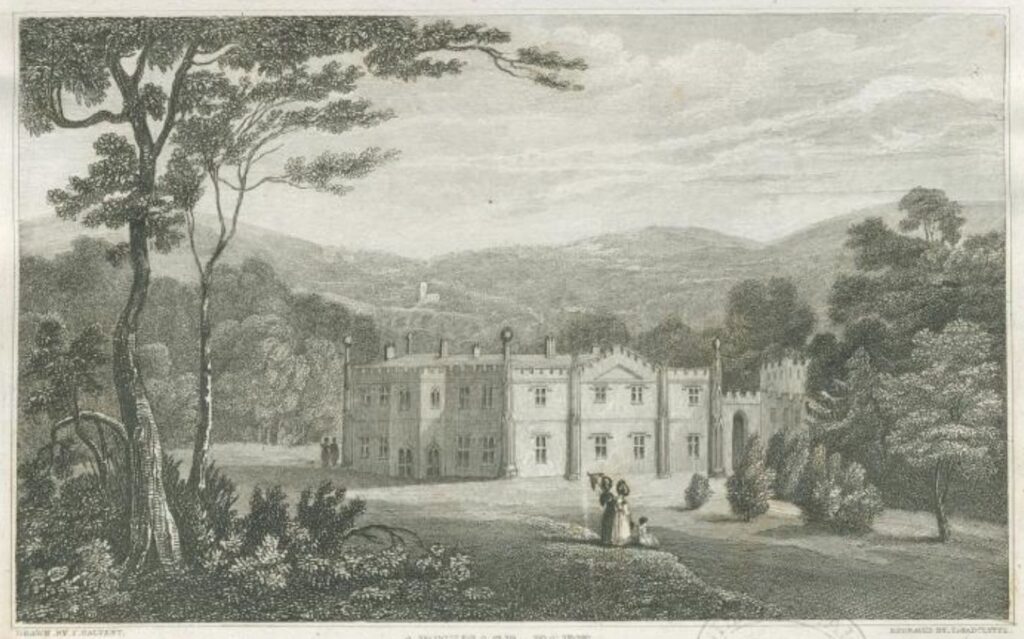
The sale advertisement and auction catalogue of 1839 provide a rare and detailed glimpse inside Hawkesyard, then called Armitage Park, owned by Thomas Henry Lister (1800–1842). Read alongside what is known of Lister’s life and career, these documents allow the house to be understood not merely as a residence, but as a setting shaped by intellect, social ambition, and the emerging bureaucratic modernity of the nineteenth century.
Lister was an English novelist and biographer, an early practitioner of the fashionable silver fork novel, and, from 1836, the first Registrar General for England and Wales. As head of the newly created General Register Office, he established the system of civil registration for births, deaths, and marriages and oversaw the organisation of the 1841 census. His professional responsibilities increasingly tied him to London, and for some years he lived primarily in his London house, letting Armitage Park to a local baronet. This arrangement reflects both the demands of his career and the growing tendency among elite families to divide their lives between metropolitan and provincial residences.
Lister moved within an influential social and political network. One of his half-sisters, Adelaide Lister, married Lord John Russell, later 1st Earl Russell and Prime Minister, situating him within the orbit of high Whig politics. Such connections help to explain both his ease within fashionable society and his appointment to a senior civil service post during a period of administrative reform.
A house of polite society
The principal rooms listed in the sale—dining room, drawing room, breakfast room, library, and hall—formed the public face of gentility. Their arrangement reflects established Georgian conventions combined with newer patterns of comfort. The breakfast room suggests increasingly private and informal family habits, while the library proclaimed education and leisure.
For a man whose novels, such as Granby (1826), Herbert Lacy (1828), and Arlington (1832), explored manners, rank, and social nuance, these spaces would have been both familiar territory and practical settings for sociability. Granby, an early example of the silver fork novel, was favourably reviewed by Sydney Smith in the Edinburgh Review, confirming Lister’s place within fashionable literary circles.
Fine mahogany furniture, expensive Brussels, Turkey and Scotch carpets, musical instruments by Broadwood and Stoddard, and a library of over 2,000 volumes in fine bindings all signal a household conscious of taste, cultivation, and display. Even when the house was let, such contents reflect a residence furnished to impress and to accommodate genteel occupation.
Service, production, and a let household
Behind this refined façade lay an extensive service infrastructure. The catalogue lists kitchens, scullery, dairy, brewhouse, cellar, laundry, shoe house, granary, coach house, and even a chamber over the blacksmith’s shop. Such spaces reveal the house as the hub of a largely self-sufficient estate economy, where brewing, food production, storage, laundering, and repair were carried out on site.
That the house could be rented to a baronet while retaining such an elaborate internal organisation suggests a residence of sufficient status to attract elite tenants. Letting a country seat was a common and socially acceptable practice among landowners whose professional lives required long periods in London. It also helps explain the completeness and careful ordering of the contents listed for sale.
Servants and domestic hierarchy
The internal geography of the house rigidly reflected social rank. The catalogue records a servants’ hall, maid’s tea – room, multiple lodging rooms for servant men, a butler’s sleeping room, and a chamber maid’s closet. The butler’s pantry and under-butler’s pantry were critical control points for plate, glass, and wine, underlining the butler’s trusted position.
A second staircase and long upper passages allowed servants to circulate discreetly, reinforcing the separation between those who served and those who were served. Such arrangements were typical of prosperous households, yet the scale here suggests a particularly well-organised establishment, capable of functioning smoothly whether occupied by the owner or by a tenant of rank.
Authority, intellect, and privacy
At the heart of household authority lay Lister’s study, with an adjoining bedroom. This masculine suite embodied privacy, work, and control. The study would have been the setting for correspondence, reading, and possibly literary composition, while also accommodating the administrative concerns of a senior civil servant whose professional life increasingly unfolded in London.
Lister’s bedroom, furnished with a tent bedstead hung with scarlet moreen, mahogany commode, bidet, chamber horse, wash furniture, and fire equipment, prioritised function and personal comfort. The restrained decoration contrasts with more ornate chambers elsewhere in the house and reflects contemporary ideals of masculine order and rationality.
The chintz bedroom and married life
The chintz bedroom, described in the catalogue as “elegant and lofty,” was among the finest rooms in the house. Its mahogany four-post bed with chintz hangings, layered mattresses of straw, hair, wool and feathers, Brussels carpet measuring eighteen by fifteen feet, Marseilles quilt, extensive mirrors, and comfortable seating mark it as the principal or best bedroom.
Although Lister was married, the existence of separate bedrooms should not be read as marital distance. By the 1830s it was increasingly common among the gentry for husbands and wives to maintain more than one bedroom, using them flexibly according to season, health, or routine. The principal bedroom was often used jointly or associated more closely with the wife, while the husband retained a private room adjoining his study. Such arrangements reflected comfort, privacy, and domestic efficiency rather than emotional separation.
Children, guests, and storage
The presence of a nursery bedroom, numerous additional bedrooms along the long passage, and large storerooms indicates a house designed to accommodate children, guests, and a substantial accumulation of furniture and linen. These spaces supported a fluid household, capable of expanding and contracting according to social demands, whether under the Listers’ own occupation or that of a tenant.
Culture, curiosity, and the modern imagination
Beyond its domestic functions, the house supported a rich cultural life. The extensive library, musical instruments, globes, firearms, and over 100 paintings, portraits, and prints point to intellectual curiosity, leisure, and visual sophistication.
Notably, Lister’s literary interests extended beyond fashionable society. His 1830 story “A Dialogue for the Year 2130”, published in The Keepsake, imagined a future world of machines, automated servants, and mechanical conveniences—anticipating themes later explored by writers such as Jules Verne and H. G. Wells. This imaginative engagement with modernity sits intriguingly alongside the traditional domestic arrangements revealed by the catalogue.
Conclusion
Taken together, the 1839 sale documents transform the mansion from a static symbol of status into a living, adaptable household shaped by hierarchy, comfort, intellect, and labour. Read in the context of Thomas Henry Lister’s life—as novelist, social observer, civil servant, and part-time absentee landowner—the house becomes a lens through which to view a society balancing tradition and innovation.
It was a place where silver fork elegance coexisted with brewing vats and servant staircases; where metropolitan careers reshaped patterns of country-house occupation; and where one of the early architects of Britain’s civil registration system lived amid the material culture of genteel early Victorian life.