A View from the Hill: Present Day Hawkesyard
Perched on a hill with sweeping views of the Trent & Mersey Canal and the A513 between Rugeley and Armitage, Hawkesyard Estate blends modern function with deep historical roots. Today, it hosts weddings, conferences, and meetings, yet its story begins some 500 yards to the northeast—at a much older site once known as Haukesherd.
What’s in a Name? The Origins of Haukesherd
Like Handsacre, Haukesherd is a Saxon name, marking an area in the western part of the parish of Armitage-with-Handsacre. The name comes from the Old English heafocscerde: heafoc meaning ‘hawk’ and scerde meaning ‘gap’, ‘pass’, or ‘clearing’. This may have been a place where hawks were flown in falconry, but it’s also possible that heafoc referred to a man named Hawk—making it, quite literally, Hawk’s clearing.
The Lost Hall: Tracing Hawkesyard through Heraldry
All the histories of the original Hawkesyard Hall and the Hawkesyard family are based on Stebbing Shaw’s History and Antiquities of Staffordshire which was published in 1798. In that publication he wrote a section about Hawkesyard Hall and the Rugeley family who owned it and stated that:
“Hawkesyard was an ancient manor, within Armitage, held under Handsacre; and had an old mansion, which was the seat of gentlemen for several ages. I presume it was once the property of a family that assumed their name from this their place of residence, and bore for their arms A. a horse’s head erased S. alluding probably to some similarity of sound to the first syllable of their name”.
In heraldry, the notation ‘A. a horse’s head erased S.’ is broken down as follows:
- ‘A’ is an abbreviation for the colour argent meaning silver or white
- ‘a horse’s head’ is the charge i.e. the main emblem or figure and is simply the head of a horse shown in profile unless otherwise stated
- ‘erased’ describes how the head is depicted as having forcibly been torn off, rather than cleanly cut and would typically show jagged or ragged edges at the neck
- ‘S’ is an abbreviation for the colour sable meaning black
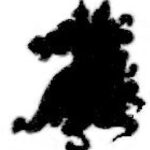
Putting this all together it means ‘on a silver (or white) background, a black horse’s head erased’ as shown in Figure 1 below.
Shaw goes on to state: “Of this family {Hawkesyard} I have not found any particular mention, yet it is likely the estate was carried anciently, by Hawkesyard’s heiress, into the family of Rugeley, who always bore Hawkesyard’s coat amongst their quartering”’.
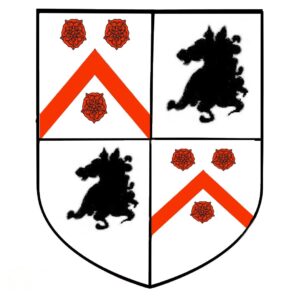
The term ‘quaterings’ is a way of combining multiple coats of arms into a single shield to represent inheritance, marriage or family lineage. The shield is divided into four (or more) sections each showing a different coat of arms. This could represent a heiress, descent from multiple families or status and lineage.
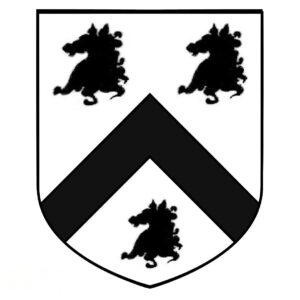
There is a Hawkesyard in Cheshire near Minshull Vernon and Richard de Haukeserd is shown as buying land in Dilhorne in 1322, but Hawkesyard does not appear in any documents as a family name in the Rugeley or Handsacre area. Shaw however asserts that the emblem shown in Figure 1 must be that of Hawkesyard. No record of that being the case exists but there is a coat of arms that does show the emblem – the Norman family. Their coat of arms actually shows three horse’s heads, but it was not unusual to change a shield from displaying multiple emblems to a single emblem particularly if it represented marriage.
Shaw does later state that Thomas de Rugeley married Mary Norman, (in about 1440), co-heiress of Richard Norman of Bold Hall near Chartley Castle but he does not appear to know their coat of arms. The properties or dowry she brought into this marriage included multiple houses and land in Amerton, Draycott, Hixson, Newton, Kings Bromley, Kingston, Callowhill, Caverswall in Loxley and Uttoxeter.
In his section on Handsacre Hall Shaw states that the Handsacre arms were also quartered by Hawkesyard. Other than this he makes no mention of a marriage between Hawkesyard and Handsacre. He relates a story about Sir William de Handsacre being killed by Sir Robert Mavesyn in a skirmish by the Trent and being succeeded by his son, William. The story is not only false but also shows that he did not know that the William, supposedly killed in the skirmish, had married the daughter of William Norman of Caverswall in Loxley.
These two instances of the Norman family and the presence of the quartering of both the Rugeley family and the Handsacre family coats of arms reinforce the argument that the horse’s head emblem relates to the Norman family and that there never was a Hawkesyard family.
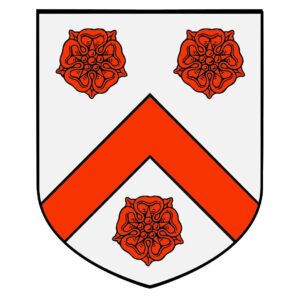
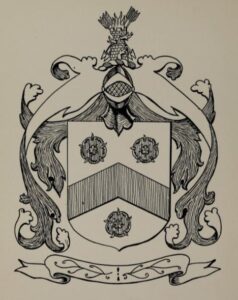
The Rugeley coat of arms is shown in Figure 3 and is described as ‘Ar. Cheveron entre 3 roses G.’
- ‘Ar’ is an abbreviation for the colour argent meaning silver or white
- Cheveron is a broad ‘V’-shaped band pointing upwards
- Three roses
- Gules meaning red
The quartered coat of arms to which Shaw refers is depicted in Figure 4.
The Rise of Simon de Rugeley
The first recorded reference to Hawkesyard in the manor of Handsacre appears in 1337, when Edward III granted Simon de Ruggeley and his heirs the right of free warren in all his demesne lands at Rugeley. In addition, royal permission was granted to enclose a tract of land known as le Hawkeserd in the manor of Handsacre. This parcel comprised 100 acres of woodland and pasture and was to be held by Simon and his descendants, provided it lay outside the bounds of the royal forest.
This royal charter amounted to a licence to empark—the creation of a private deer park. In medieval society, a park was a powerful status symbol, reflecting elite landownership and a privileged relationship with the Crown. Such parks were typically enclosed by a park pale—a substantial boundary formed by a ditch and bank, topped with a wooden fence or hedge. Within this enclosure, deer and other game could be kept, providing a supply of venison—an elite food used for feasts and as prestigious gifts.
Ten years earlier, Simon de Ruggeley had been recorded as resident in Rugeley in the Staffordshire Lay Subsidy of 1327. His rise to prominence is traceable through a series of influential appointments. In 1326, he became Bailiff of the Bishop’s Liberty in Lichfield, a senior official role overseeing justice and revenue collection in an area where the bishop held jurisdiction independently of the royal sheriff. Between 1330 and 1333, he served as Chamberlain of Chester—a royal office responsible for managing the financial and administrative affairs of the County Palatine of Chester, a semi-autonomous region under the English Crown. In 1336, he was appointed Sheriff of Staffordshire and Salop (Shropshire), taking on wide-ranging responsibilities including tax collection, court organisation, law enforcement, and even military recruitment on behalf of the Crown.
These prominent positions help explain why Simon was granted the licence to empark Hawkesyard. As a man of rising status, he would have required a suitable residence to reflect his standing. It appears highly probable that Simon de Ruggeley was the builder of Hawkesyard Hall.
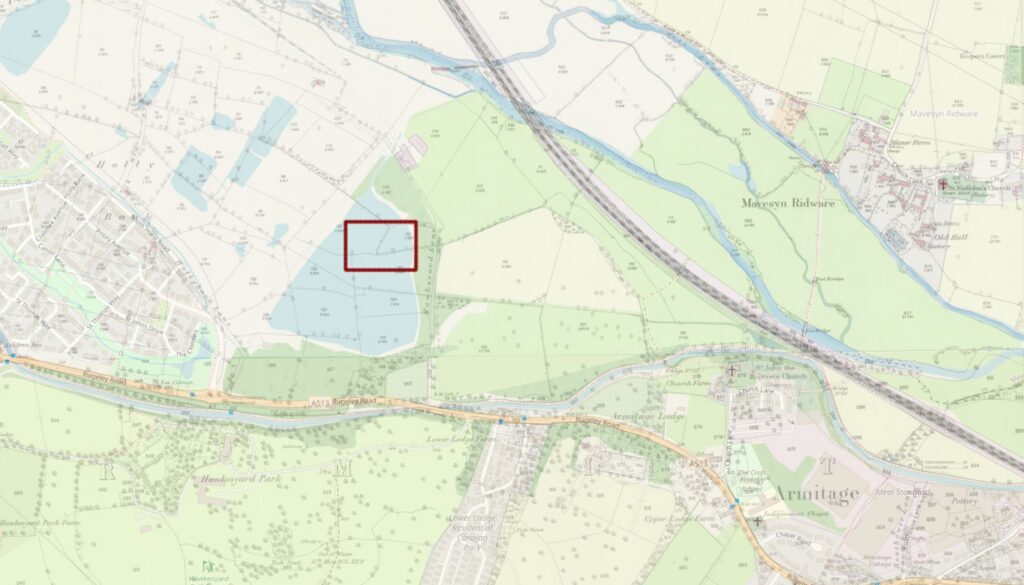
No contemporary illustrations of the Hall survive, and the site now lies beneath water, making exact details difficult to reconstruct. Nevertheless, aerial photographs taken shortly before the construction of the power station, together with Shaw’s description and Bill Wright’s A History of Armitage, provide useful evidence for its location and layout.
As shown in Figure 5, the Hall stood approximately half a mile west of the parish church. It formed a square, each side measuring 36 yards, with stone foundations four feet thick. A broad moat, about 12 yards wide, enclosed the structure—more a display of prestige than a military defence. Opposite the bridge crossing the moat were stables, outbuildings, an orchard, and dovecotes. To the east, between two streams, lay a formal walk carefully aligned to frame the tower of the church in the distance—a striking example of deliberate landscape design. To the southeast, a large fishpond measuring around ten acres provided an additional source of food and a further indication of the estate’s wealth and self-sufficiency.
The Manor in its Prime
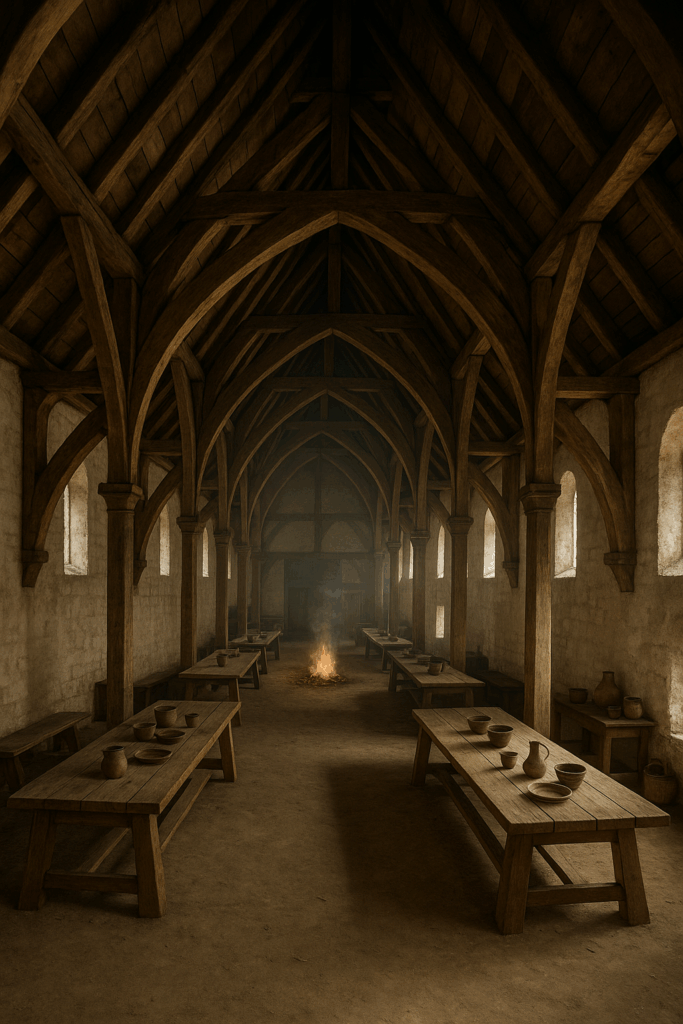
Given the period in which it was built, Hawkesyard Hall was likely constructed as an aisled hall, as illustrated in Figure 6. This type of building featured a large central open space, flanked on either side by aisles—much like the layout of a church. These side aisles enabled a wider roof span than a single-span structure could support.
The hall would have been timber-framed, using vertical posts and horizontal beams. At its heart was a central hearth, the main source of light and warmth. The central space—referred to simply as the hall—was open to the roof, with rows of timber arcades supporting the structure and forming the side aisles.
At the time of construction, the main section of the hall likely had no upper floor, as medieval roof designs were unsuitable for bearing the weight of heavy upper rooms above a wide open space. However, it is probable that Simon de Ruggeley and his family occupied a private first-floor chamber, known as a solar, located at one end of the building. This space would have provided sleeping quarters and a degree of privacy, both highly valued by elite families.
As was common among the nobility and gentry, the hall included a private oratory—a small chapel for family worship. This reflected both religious devotion and social status.
The nearby chancel of St John the Baptist Church is thought to date from this period. It is highly likely that Simon de Ruggeley was responsible for its construction. Supporting this theory is the fact that stained glass in the east wall once prominently displayed the initials “S” and “R”—a strong indicator of Simon’s patronage.
Simon de Ruggeley held numerous high-ranking positions, reflecting his close ties to both the Crown and the Church.
He frequently served as Sheriff of Staffordshire, and at times jointly with Shropshire, managing royal revenue collection, law enforcement, and county administration. He also represented Staffordshire in Parliament, acting as a link between local and national governance.
In 1341, he was appointed Wool Commissioner, responsible for collecting a royal tax on wool to fund Edward III’s military campaigns in France—a vital source of income for the king during the Hundred Years’ War.
The following year, in 1342, Simon became Commissioner of Array for Staffordshire, charged with drawing up lists of men-at-arms, archers, and infantry, and ensuring they were dispatched to key muster points such as Portsmouth or Dover for overseas service.
Between 1338 and 1343, he also acted as a Special Commissioner, a role granting him broad powers and demonstrating the significant trust placed in him by the Crown.
Inheritance, Marriage, and Expansion
Simon died in 1349, probably yet another victim of the Black Death which peaked in that year. His heir was 14-year-old Humphrey who at the time was studying at Oxford University. A writ of ‘diem clausit extremum’ – he has closed the last day i.e. died – was held in September 1349 concerning Simon’s landholdings showing that he had land in Stafford, Rugeley and Longdon as well as at Hawkesyard. As a sub-manor under Handsacre he paid Simon, son and heir of Sir William Handsacre, two marks per year by service for Hawkesyard. The land at Hawkesyard was stated as being poor and sandy with a third lying fallow every year. Some small pockets of land in the shallow valleys where drainage was poor were often waterlogged in the rainy season. Some 250 years later when land in Hawkesyard was sold the rights to cut peat was included in the sale.
Simon’s line was only one of the Rugeley branches and others with the family name were also in Staffordshire. Humphrey’s son Thomas died without heirs in 1405 and was succeeded by his cousin, Nicholas. Although Nicholas lived in Hawkesyard he bought land throughout Staffordshire e.g. Shenstone and Great Wyrley, and he also bought land in Warwickshire and Worcestershire. He bought the manor of Dunton in Warwickshire for his hunting seat and moved there leaving Hawkesyard to his son, Thomas, who married Mary Norman in about 1440 thus creating the quartering depicted in Figure 4.
Armour and Arms: The Rugeleys in Tudor England
Pope Paul IV had excommunicated Henry VIII in 1538 and attempted to get Emperor Charles V and Francis, the King of France, to depose Henry for his heretical opinions. The King and his Privy Council ordered a muster to be made of the entire armed force of the kingdom.
Of the 18 men listed under ‘Hannysaker and Armytage’ in the Muster Roll of Staffordshire in 1539 there were four who are listed as having a horse. By far the best equipped was Thomas Rugeley, gent. who was shown as ‘Able a bowman with horse hernes gorget splenttes salet polax’. This short phrase means:-
- Able – a fit and capable man of military age, suitable for service.
- A bowman – probably not a longbowman
- With horse – probably simply as a mounted soldier for mobility rather than as a cavalryman
- Hernes – a suit of armour, probably light armour
- Gorget – a piece of armour for protecting the throat
- Splenttes – metal strips or plates used as limb protection, especially for the arms and leg
- Salet – helmet
- Polax – A polearm weapon, featuring an axe blade, a hammer or spike on the reverse, and a spike on top. Suitable for dismounted combat, particularly against armoured opponents.
When Thomas died in 1553, his son and heir, Thomas, inherited twenty houses and farms, 1000 acres of arable land, 200 acres of meadow land, 500 acres of pastureland and 200 acres of wood.
From Healers to Heirs: The Learned Rugeleys
Thomas, (son of Thomas), not only attended university but earned a medical degree and he is described as Thomas Rugeley MD.
He presumably therefore practiced as a doctor, but the practice of medicine was vastly different from today. Medicine was still based largely on ancient theories and the idea that health depended on the balance of four bodily fluids: blood, phlegm, yellow bile, and black bile. Diagnoses were based on observation and reasoning, not physical examination as today, and some would also consult astrological charts. He would of course only treat the wealthy and treatment was often bleeding using leeches or purgatives and emetics. He did not perform surgery — that was the job of barber-surgeons, seen as craftsmen rather than scholars.
Reuniting the Rugeley branches
Thomas had two daughters and Mary married Richard Rugeley Esq. of Shenstone and Callingwood who was a cousin of some degree. After Thomas died Richard moved with his family to Hawkesyard. In total they had five sons and nine daughters.
The Hall had been modified over the years. The introduction of a chimney instead of the open hearth had allowed the installation of an upper floor. There were now a number of separate rooms each with their own hearth and chimney. The Hearth tax of the 1660s shows that the Hall had eight hearths whilst Handsacre Hall only had four showing the greater status and influence of Hawkesyard.
The Last Rugeleys of Hawkesyard
On 5th July 1623 Richard Rugeley died and was buried the day after at St. John the Baptist church in Armitage. The Stuart period was deeply conscious of social rank and display and as he had a coat of arms this was not the end of the matter. An officer of the College of Arms, the Herald, Samuel Thompson Windesore, organised a more elaborate ‘funeral’ with all the correct heraldic procedure.
A heraldic funeral, or solemnisation, was not just a family affair. The main aims were to publicly honour the deceased’s life and status, display his arms and achievements and reinforce the legitimacy of the heir and family lineage.
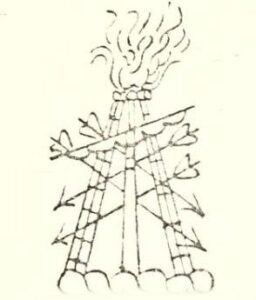
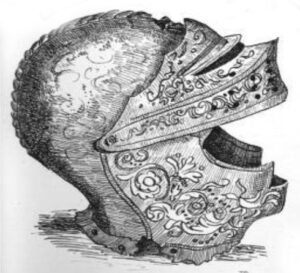
On Tuesday 23rd September the funeral procession, led by the Herald, left Hawkesyard Hall with all the principal mourners dressed in black. The Herald wore his velvet tabard, a short square-cut sleeveless garment, trimmed with gold braid and emblazoned with the arms of King James I. He carried the coat of arms and crest of Richard Rugeley (see Figure 8). Chief mourner was Simon Rugeley, eldest son and heir to Richard, followed by Thirkell and Rowland Rugeley (Richard’s brothers). Simon’s brother, Thomas, carried their father’s pennon, a long tapering, swallow-tailed flag displaying their father’s coat of arms. Also on display was a wooden version of the Rugeley crest – a ship’s mast topped with flames transfixed with arrows – and Richard’s helmet.
In the church was a coffin-shaped structure, known as a catafalque, placed in the chancel. Following the Herald’s instructions Richard’s helmet was placed on the catafalque and his coat of arms and crest hung over it. The normal burial service was followed apart from the committal (“earth to earth, ashes to ashes …) and the eulogy and sermon praised Richard’s life. A certificate was created confirming the details of his death and solemnisation and the main mourners signed it, (with their own interpretation of their surname), – Simon Ruggeley, Thirkell Rugeley, Henry Rugley and Thomas Rugsley.
War, Mortgages, and Departure
Simon Rugeley had studied at Cambridge University and married Jane Skipworth of Dishley Thorpe, Leicestershire, in 1621. Through his marriage he had acquired the manor of Knighthorpe, Leicestershire and he lived there at least part of the time. The Staffordshire Muster Roll of 1640 showed Simon as a cuirassier, a heavily armed cavalryman, living at Hawkesyard. He mortgaged Hawkesyard to Sir Richard Skiffington later that year and in 1642 Skiffington is described as being ‘of Hawkesyard’.
Simon Rugeley was a colonel in Cromwell’s army during the Civil War and details of this can be found in Mark Eades’ booklet ‘Friends in arms’, available from the Ridware History Society.
In 1660 Simon sold the Hawkesyard estate to Sir Richard Skiffington but Sir Richard did not live there. The 1665 Hearth Tax states that seven of the eight hearths were no longer in use and the remaining one was in the occupation of a Thomas Jackson.
The story of Hawkesyard is not just a tale of buildings and names, but of shifting power, social status, and the evolving landscape of medieval and early modern England. From a Saxon clearing possibly used for hawking, through its transformation into a manorial estate with deep-rooted heraldic ties, to its role as a residence for prominent figures such as Simon de Rugeley and later a stage for solemn heraldic funerals, Hawkesyard stands as a testament to the layered history of Armitage-with-Handsacre. Though none of the original hall remains above ground today, its legacy lives on in records, armorial bearings, and the very fabric of the landscape—connecting the local story to the wider currents of English political, social, and cultural history.
Special thanks to Nancy Norman Hopkins for her insight into the heraldry of the Norman family and for information on the later Rugeley family. The Internet Archive allows free access to many old books and on it you can find Stebbing Shaw’s book ‘The history and antiquities of Staffordshire’, ‘Twenty one sons for Texas’ on the Rugeley family and Staffordshire Visitations.