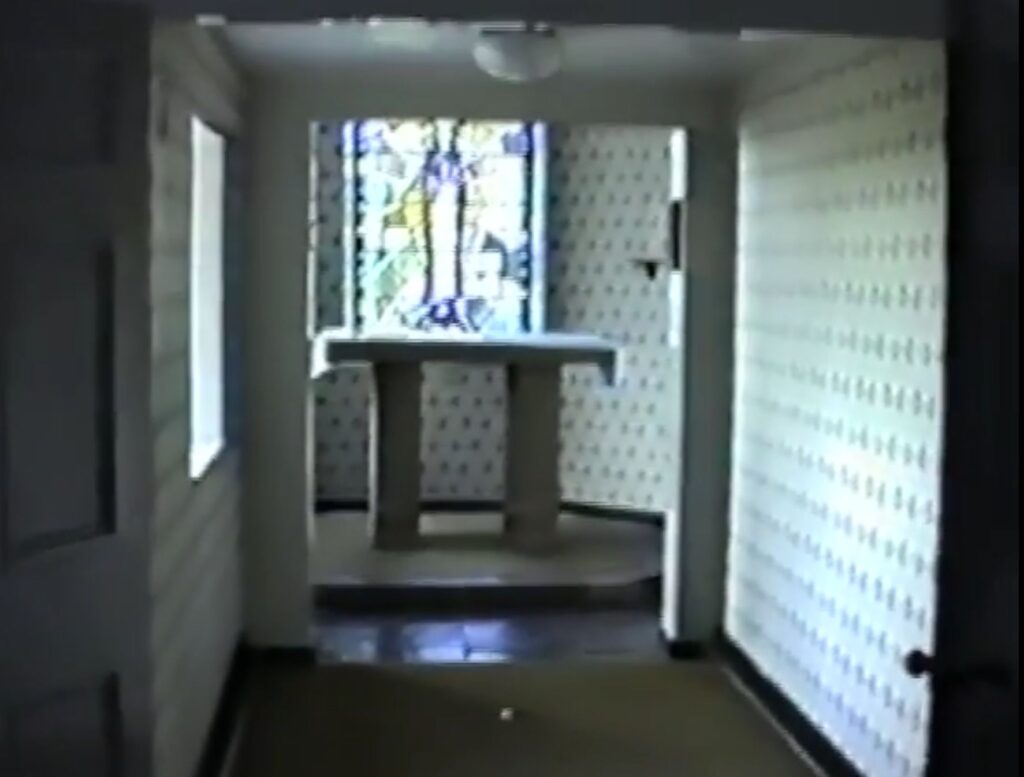
Among the most evocative—and now sadly vanished—expressions of 19th-century Catholic devotion in Armitage-with-Handsacre were the stained-glass windows commissioned by Josiah Spode IV (1827–1893), a member of the famous Spode pottery family and a late-life Roman Catholic convert. Although the windows no longer survive in situ, a brief sequence in a 1988 video recorded when Hawkesyard was placed on the market preserves a tantalising glimpse of them. At approximately 8 minutes 35 seconds, the footage captures the chapel and the east and south windows glowing above the altar. When the current owners purchased the property in 1999, both the altar and the stained glass had disappeared and have not been traced since. The 1988 video therefore constitutes the only known record of this small yet sophisticated devotional scheme.
An Octagonal Chapel: Architecture With Meaning
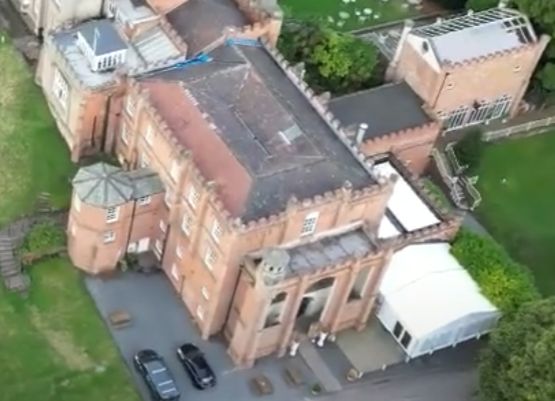
The windows were housed in a newly-built, distinctive octagonal chapel attached directly to Spode’s residence—an architectural form with deep Christian resonance. Since the early Church, the octagon has symbolised rebirth, resurrection, and the “eighth day” of creation, meanings especially appropriate for a man who had embraced a new religious identity late in life. Octagonal oratories also enjoyed a revival during the late-Victorian Catholic resurgence, where their centralised shape lent itself to quiet, personal devotion.
The chapel’s internal layout further emphasised these theological ideas. The Marian window was placed on the east wall, the traditional Christian focus associated with the rising sun and spiritual renewal. Here stood the altar, forming the principal devotional axis of the space. The narrative window—depicting the Holy Family, labour at Nazareth, and a resurrection-themed lower panel—was set on the south face of the octagon, where it received full daylight. Worshippers entered from the west and moved symbolically toward the light of the Virgin Mary: a spatial journey mirroring the spiritual themes of rebirth and illumination.
A Local Industrialist’s Conversion
Spode came from a world of industry, design, and skilled craft. Yet in 1885, like many Victorian seekers drawn by history, liturgy, and beauty, he converted to Roman Catholicism. For such converts, commissioning sacred art became a way of expressing new-found identity and shaping an environment for prayer. The chapel at Hawkesyard—its octagonal form, altar, and stained glass—was part of this personal religious world.
The Marian window
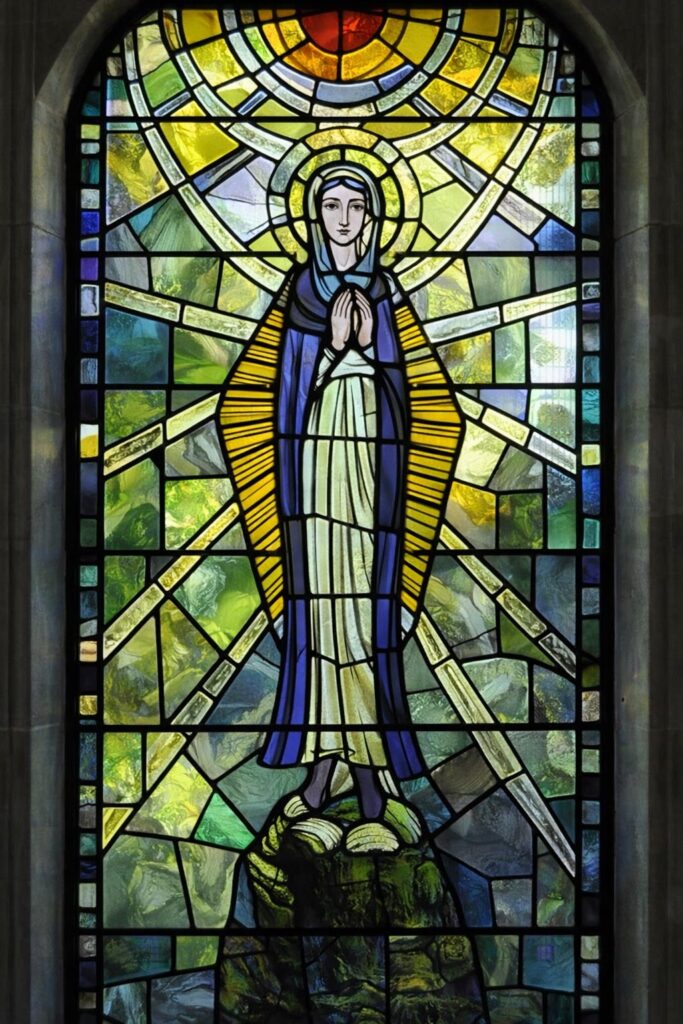
The east-facing placement of the Virgin Mary window reinforces its devotional importance. Marian imagery held a central place in late-Victorian Catholic spirituality, especially among converts for whom Mary symbolised protection, intercession, and the security of tradition. The window opposite the entrance ensured that the Virgin’s image was the first sight on entering the chapel, inviting prayer before the altar.
The Narrative Window: Family, Labour, and Redemption
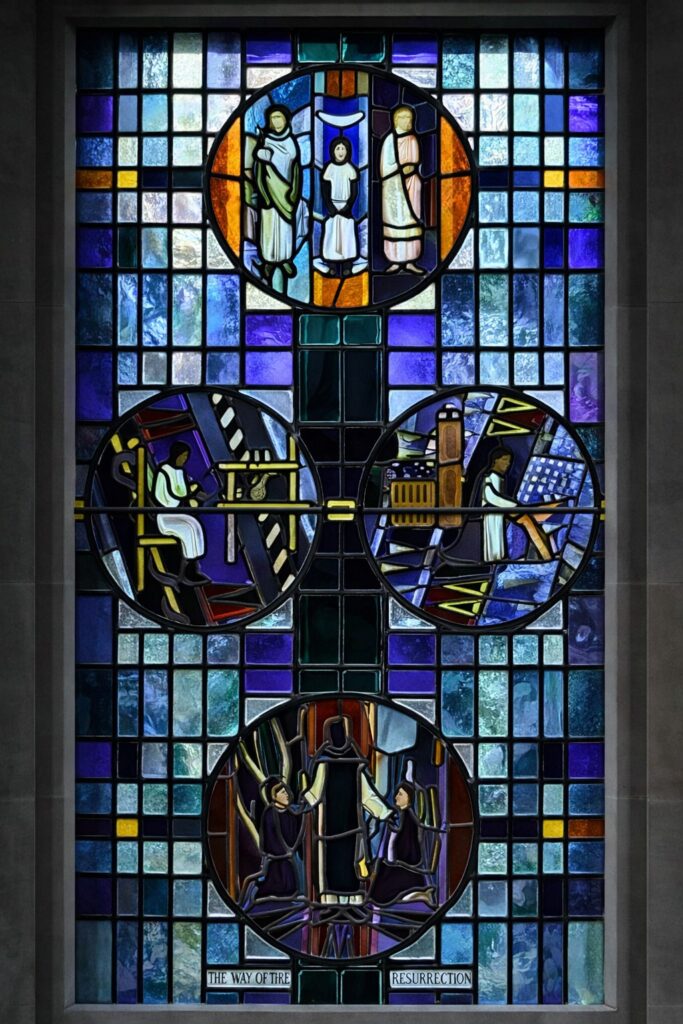
The second window, placed on the southern wall, was composed of four circular medallions.
1. The Holy Family (upper panel)
The upper roundel depicts a bearded man, a woman, and a child—St Joseph, the Virgin Mary, and the Christ Child. This theme, popular in post-1850 Catholic art, highlighted domestic holiness and the virtues of family life, forming a natural counterpart to the Marian focus on the east wall.
2. The Workshop at Nazareth (middle panels)
Two medallions show figures working with tools—almost certainly St Joseph teaching the young Jesus in the carpentry shop. Known as the “Hidden Life at Nazareth,” this refers to the roughly 30 years Jesus spent in obscurity with Mary and Joseph, a period the Gospels largely ignore, teaching lessons in humility, obedience, prayer, and finding holiness in ordinary daily life, work, and family. It emphasizes divine simplicity and consecration to God through everyday tasks like carpentry, showing that meaning and virtue are found not just in grand acts, but in quiet submission to God’s will within the mundane, a powerful example for spiritual growth. This subject was beloved by Victorian Catholics and would have deeply appealed to a member of the Spode family, whose pottery craft traditions linked artistry with industry.
3. Redemption and Resurrection (lower panel)
At the base, Christ appears to raise or receive two kneeling figures from curling, enclosing shapes—an image closely related to the Harrowing of Hell or the Raising of Lazarus. The surviving inscription beneath reads “THE WAY OF THE … RESURRECTION”, uniting the chapel’s themes of new life, devotion, and renewal.
Placed on the sunlit south side, this window acted as a theological companion to the eastward Marian focus: Christ’s life and labour leading toward redemption, mirrored by the worshipper’s movement through the chapel toward the east.
Who Made the Windows?
The style of both windows—strong leading, rich colour blocks, circular medallions, and simplified Victorian figuration—suggests the influence of John Hardman & Co. of Birmingham, the leading Catholic stained-glass studio of the period and closely associated with the wider Gothic and Catholic Revival. Hardman catalogues from the 1870s–1890s contain numerous parallels to the Hawkesyard scheme. While Mayer of Munich or Powell & Sons remain theoretical possibilities, Hardman offers the closest stylistic and contextual match.
When Were They Made?
Given:
- Spode’s conversion in 1885,
- his death in 1893,
- and the late-Victorian stylistic traits visible in the windows,
a date between c.1887 and 1892 is most probable. This was the height of Hardman’s later production and a period when Marian devotion and Holy Family imagery were especially popular among English Catholic converts.
A Lost Yet Illuminating Heritage
Although the stained glass and altar have been missing since before 1999, the surviving 1988 video still allows us to reconstruct much of the chapel’s design and devotional atmosphere. The combination of an octagonal architectural form, an east-facing Marian window, a south-facing narrative window, and Spode’s late-life conversion creates a coherent spiritual scheme in which architecture and imagery were deliberately unified.
Taken together, the elements of this lost chapel speak eloquently of a prominent local figure whose faith, craftsmanship, and personal history shaped a unique sacred space within Armitage-with-Handsacre. If further images or documentation come to light, our understanding of this remarkable devotional ensemble may yet grow.
All the more interesting, because we often visited Spode House when it was occupied with Hawkesyard Priory by the Dominican Friars. In the 1970s -early 80s the Dominicans invited the Rugeley and District Council of Churches to meet either at Spode House, or more often in Hawkesyard Priory ( Ocassionally in the chapel ) . Open to God meetings were held monthly, sometimes attracting more than 100 people from various church denominations. We never did worship or see the octagonaL chapel .