
The tunnels
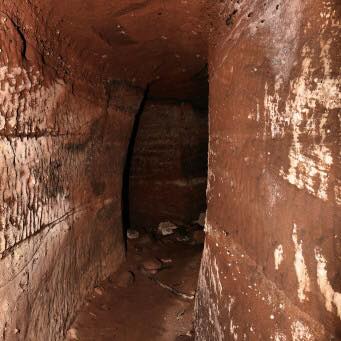
Ask almost anyone who grew up in Armitage about Hawkesyard and the first thing they mention is not the house. It is the tunnels.
Dark, cool and slightly forbidding, their stone entrances half-hidden by ivy and bramble, they have long stirred the imagination. Stories have travelled with them for generations. One tunnel, it is said, runs all the way to Lichfield. Another leads to a hidden nunnery. Some say priests once used secret passages in troubled times. Others insist there were miles of underground routes beneath the hill.
As children, few of us needed much encouragement to believe it. The air inside is damp and still. Light fades quickly behind you. Voices echo strangely. Even in summer, the temperature drops as you step inside. It is easy to see how legend took root.
But step back nearly two hundred years, and those same tunnels tell a different story.
Not Secret — Designed
In Victorian times, the tunnels were not mysterious at all. They were deliberate features of a carefully planned show garden built by unemployed miners under the direction of Josiah Spode in the late 1840s.
Rather than secret escapes, they formed cool transitions between heated glasshouses and shaded fernery. They allowed visitors to move from warmth into shadow, from tropical brilliance into green calm. What feels slightly eerie today would once have felt theatrical — a contrast in temperature and light, carefully orchestrated.
And when visitors emerged from the tunnel’s cool darkness, they would have seen something extraordinary.
The Glasshouse on the Rock
Above them stood a glasshouse perched on a rocky mount, its panes catching the light like a small Crystal Palace, echoing the great Victorian fascination with glass and iron. From below it must have seemed almost magical — a greenhouse raised above the slope, glowing in the sun.
Climbing towards it, Victorian visitors from Armitage and nearby villages would have felt the air grow warmer. Inside were plants from distant continents: brilliant Ixoras blazing red and orange, orchids clinging in curious shapes, palms arching high under the roof.
In a great tank floated the immense leaves of the Victoria Regia, the giant water lily whose vast leaves could carry a child and caused excitement when it flowered here in the 1850s.
For parish families accustomed to fields, hedgerows and canal banks, this was a journey far beyond Staffordshire — without ever leaving the hill.
How Legends Grow
The tropical plants are long gone – sold in 1894 after the death of Josiah Spode IV. The great boiler chimney that once powered the heat was taken down in 1964. Most of the glasshouses have gone with just ‘the summer house’ remaining.
But the tunnels remain.
Perhaps it is no surprise that, once their original purpose faded from memory, stories filled the space. A passage to Lichfield sounds far more romantic than a Victorian garden walkway. A hidden nunnery makes a better tale than a fernery.
Yet in their own way, the truth is just as remarkable. These were not medieval escape routes but part of one of the region’s most ambitious show gardens — a place where heat, glass and imagination combined.
And perhaps that is why the legends persist. The tunnels were always meant to lead somewhere different.
I understood that the tunnels and rock garden were created a little later than the 1840s. Taken from a booklet I was shown in Staffordshire archives in 1984 they were built under the supervision of William Chapman the head gardener. He worked there from after 1851 & before 1861 to 1894. He is my Great Grandfather. Unfortunately I cannot now find a copy of the booklet.
There are newspaper clippings from 1853 showing that the tunnels were already in use for visitors and George Bolas was the Head Gardener at that time. He left in late 1855 or early 1856. The 1861 census shows that both William May and William Chapman were recorded as gardeners. Most of the newspaper clippings for the late 1850s, 1860s and 1870 s that I have seen refer to William May as Josiah Spode’s gardener and those to William Chapman appear later. The tunnels and the extensive garden grottos do not have a definitive date but Spode was exhibiting his grand ornamental flowers in the late 1840s. The local church, St. John the Baptist, was rebuilt 1845 – 1847 and Josiah Spode took all the old masonry to his estate. His house had already been heavily modified by then so it seems reasonable to assume that the stone was used in creating the elaborate grotto that accompanied the tunnels.