
A House of Two Gothics: Hawkesyard Explained
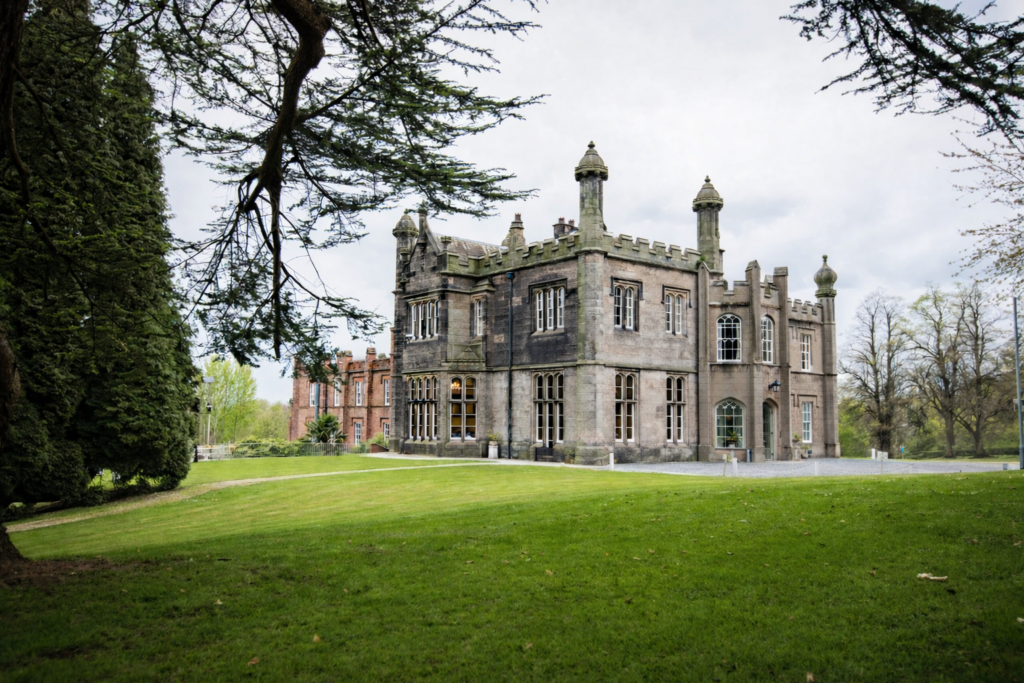
Hawkesyard Hall is a country house formed in stages with its present appearance shaped by building work in both the 18th and 19th centuries: the construction of a mid‑18th‑century Gothic villa for Nathaniel Lister, extensive remodelling and enlargement carried out around 1840 for Mrs Mary Spode, widow of Josiah Spode III and later additions by Josiah Spode IV. Together these phases illustrate the evolution of Gothic taste from the classically ordered ‘Gothick’ of the Georgian period to the more forceful and fully Gothic Revival of the early Victorian era.
The Lister House of c.1760
The original house was built in about 1760 for Nathaniel Lister and was more complex in plan and use than its external appearance might suggest. Although Gothic in intention, it belonged firmly to the early Gothic Revival, a period in which medieval motifs were applied to buildings that were otherwise planned and organised according to classical Georgian Palladian ideals. While later newspaper reporting implies that the family block may have been stuccoed, the absence of colour evidence in pre-1840 drawings and the lack of contemporary written description mean that this finish cannot be stated with certainty, though it would be consistent with mid-18th-century practice for a house of this status. Its outward composition was extremely regular and symmetrical, in keeping with mid-18th-century building conventions.
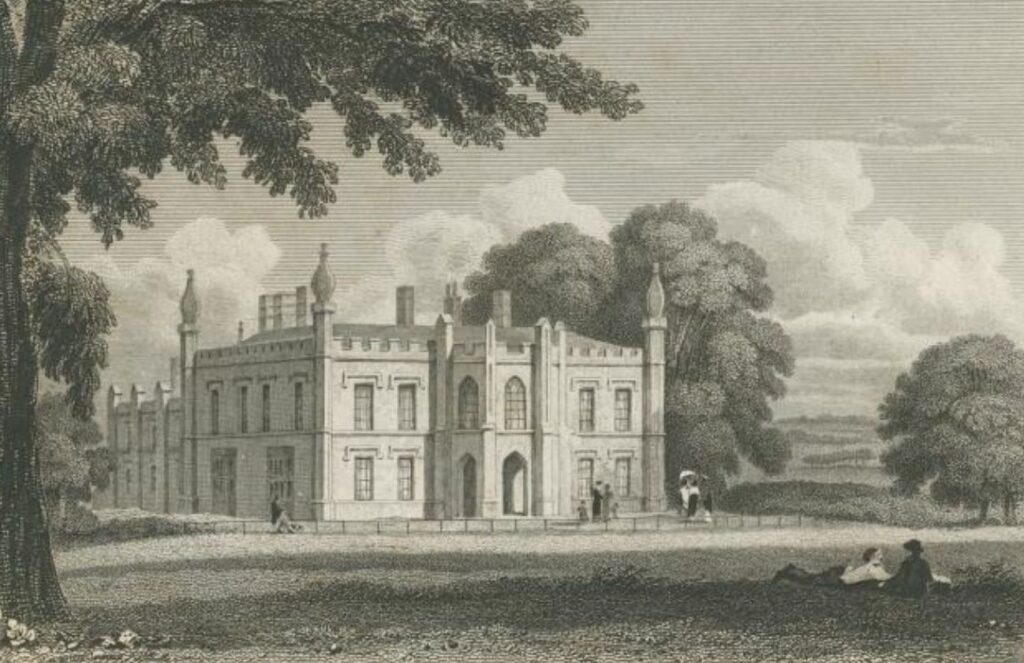
To the north, and set further down the slope of the site, lay the service range. This was a substantial structure, rising to four storeys, reflecting both the falling ground and the practical demands of running a sizeable household. Importantly, the upper two storeys of this range were not purely functional but were used by the family, principally as guest accommodation. Below these four levels were extensive cellars, hewn directly from the rock, emphasising the utilitarian role of the lower parts of the building while exploiting the natural topography of the site. Attached on either side of the North end of the service range were identical two-storey blocks, one of which was used as a coach house.
In this early Gothick phase, medieval motifs were used for effect rather than to recreate medieval architecture accurately. Battlements, pointed or Tudor-arched openings and surface ornament evoked the romance of the medieval past, but beneath this costume the house remained fundamentally Georgian in its planning. Circulation, hierarchy of rooms and the vertical stacking of family, guest and service spaces followed established 18th-century norms.
The Spode Extensions of c.1840
The second major phase of development came around 1840, when Hawkesyard was extended and heavily remodelled for Mrs Spode. This work did not consist of a single modification but a series of substantial changes that reshaped the plan of the house, extending it further down the slope and altering its internal balance. By this date Gothic Revival architecture had moved beyond surface decoration and was increasingly concerned with massing, vertical emphasis and visual impact, and these priorities are clearly expressed in the 1840s Spode work.
The materials alone signal this change in ambition. The west block replacement of part of the family house was built of rough-faced ashlar, contrasting with the brick core of the 18th-century house, and roofed in slate with prominent ashlar chimney stacks capped by octagonal shafts. To match this, the rest of the family block was faced with ashlar stucco with lines incised to match the blocks of ashlar stone.
Lister’s building had consisted of two main rectangular blocks linked by a narrow central connector. Next to the West modification Spode inserted a new one-storey redbrick block filling in the space between the two parts of the building. Although the earlier south-facing orientation was retained in principle, the cumulative effect of the additions was to draw attention increasingly towards the south-west whilst also making a grand architectural display facing towards the canal, river and church.
The Spode alterations included a major extension to the service end of the house with the addition of a monumental loggia, which effectively lengthened the building and gave the north side a new architectural focus.
In 1844 a further addition was made in the form of a single-storey billiard room in the east side recess between the family and service range. It was stuccoed in ashlar, marking it as a family room, and attached to the side of the house in-between the family building and the service range and protruded out from the building line. This space, lit by a large roof light, further highlights the disregard for symmetry. Although modest in height, its insertion added to the growing complexity of the plan and further loosened the distinction between the original family house and its service range.
Although the original house and the Spode extensions were treated in a broadly unified Gothic style, the scale of the new work fundamentally altered the building’s visual balance. Each addition is internally coherent and carefully designed, yet in aggregate the house moves away from Georgian composure towards a heavier, more dominant Gothic presence.
At some point in the mid-19th century a further alteration was made with the construction of an organ loft, described in later accounts as a minstrel’s gallery, projecting from the rear of the entrance hall. Built to house a substantial organ, the gallery introduced a pronounced vertical and ceremonial focus within the principal interior. Its presence indicates that the house was adapted not only for architectural display but also to accommodate structured musical and devotional activity.
After Josiah Spode IV’s conversion to Catholicism in the 1880s he added a three-storey octagonal chapel protruding from the East side of the service range and an octagonal clock tower on one corner of the loggia. It is probably at this time that the east side, two-storey wing of the service range was removed.
The South Front
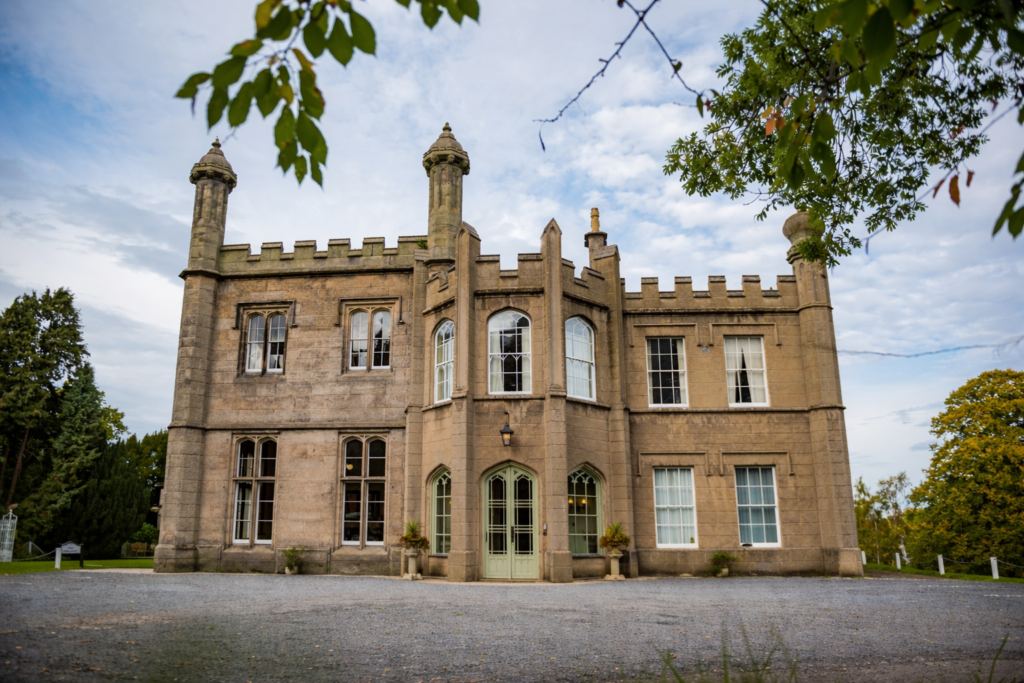
The south front, and main entrance, is two storeys high and is crowned by a decorative moulded strip of stone below the parapet and a crenelated parapet, reinforcing the castellated character of the house. In overall terms the elevation retains a 2:3:2 window composition, preserving an echo of Georgian balance beneath the Gothic dress, but this symmetry is no longer expressed through uniformity. On the right hand side are 12-pane sash windows with shallow projecting stone mouldings (returned hood moulds) to channel rainwater.
At the centre is a canted projection forming the principal entrance, with sash windows enriched with Gothic tracery and four-centred arches. Buttresses mark its angles, and a central glazed doorway, also under a four-centred arch, provides the main approach. The centre and the right-hand section are part of the original Lister design as can be seen in Figure 3. On the right-hand corner stands an octagonal turret capped with a domed finial whose smooth profile matches the hybrid Gothick taste of the mid-18th century.
To the left stands a slightly higher two-bay block, forming the terminal end of the 1840 modification. Its two-light Tudor-arched windows have fixed lights at ground-floor level and sash windows above. This narrow block is a replacement for part of the original building and at each corner stand tall octagonal turrets capped with domed roofs and coronets, giving it a strongly vertical and emphatic character within the wider elevation. From this south view only two of these turrets can be seen and they are higher than the right-hand Lister turret.
Although the south front reads as a balanced composition when viewed as a whole, the variation in height, window size, form, turrets and proportion across the façade makes clear that this balance is achieved pictorially rather than structurally. The Spode work respects the appearance of symmetry but deliberately allows hierarchy and mass to override strict regularity, reflecting the heavier and more assertive character of the new construction.
The East Front
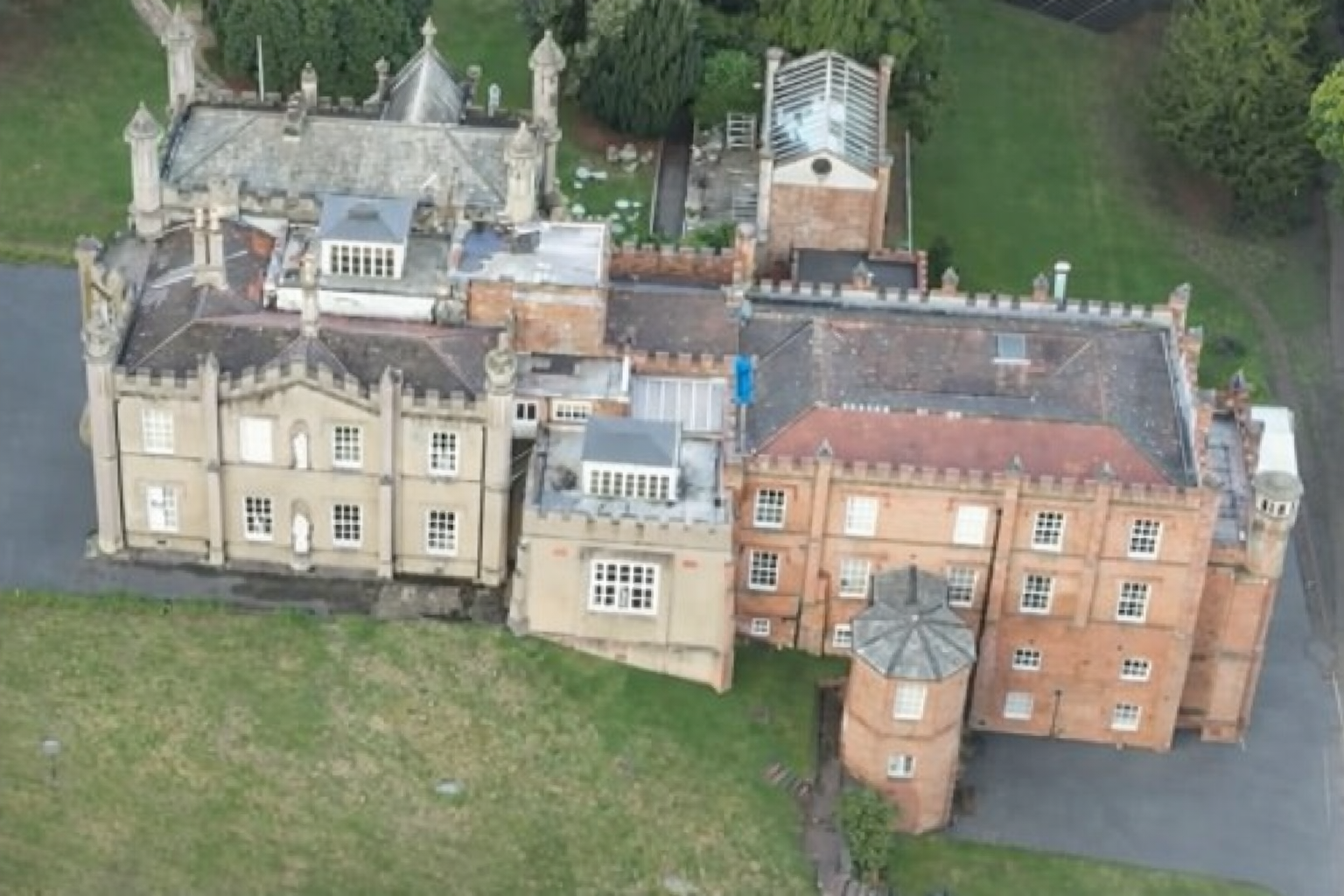
The east front is organised around the two-storey, family block that formed the core of Lister’s original house on this elevation. This block presents a regular and disciplined composition, its windows evenly spaced and defined by glazing-bar 12-pane sash windows set beneath returned hood moulds. In the centre of both storeys are pointed arch niches. At the corners of the family block rise octagonal turrets, capped with domed finials, which frame the elevation and lend it a vertical emphasis without disturbing its overall balance.
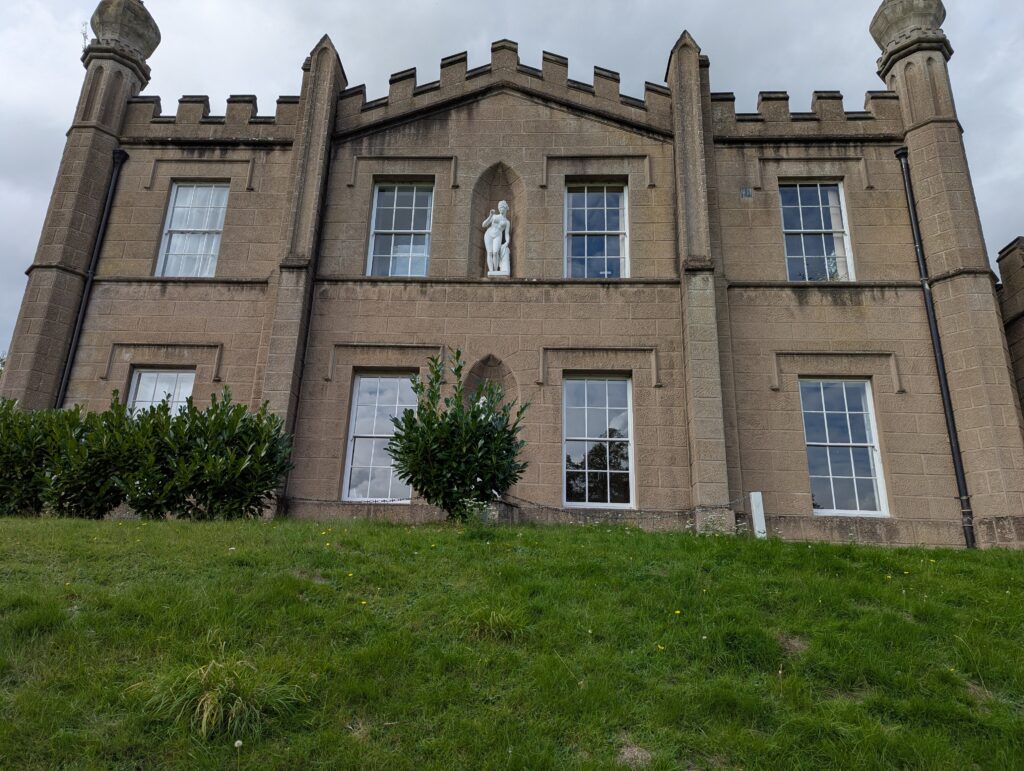
Within this otherwise ordered composition occurs the only deliberate departure from a continuous horizontal roof line in Lister’s original house. It sits above the dining room and drawing room, the principal reception rooms of the house, giving these spaces greater scale and prominence. Here, internal hierarchy was allowed to override strict external uniformity, marking the importance of these rooms on the exterior fabric.
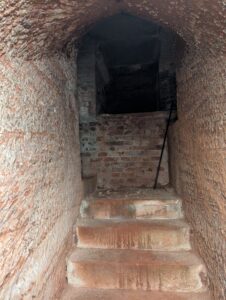
To the right of this five-bay family block, the building extends downhill into the service range, following the contours of the ground. This part of the house was conceived as an integral component of Lister’s design rather than as a secondary appendage. It rose to four storeys, with the upper two levels used by the family, principally as guest accommodation, while the lower storeys served practical and storage functions. Beneath these were extensive cellars, hewn directly from the rock, exploiting the site’s geology to provide cool, stable conditions and reinforcing the vertical organisation of the range.
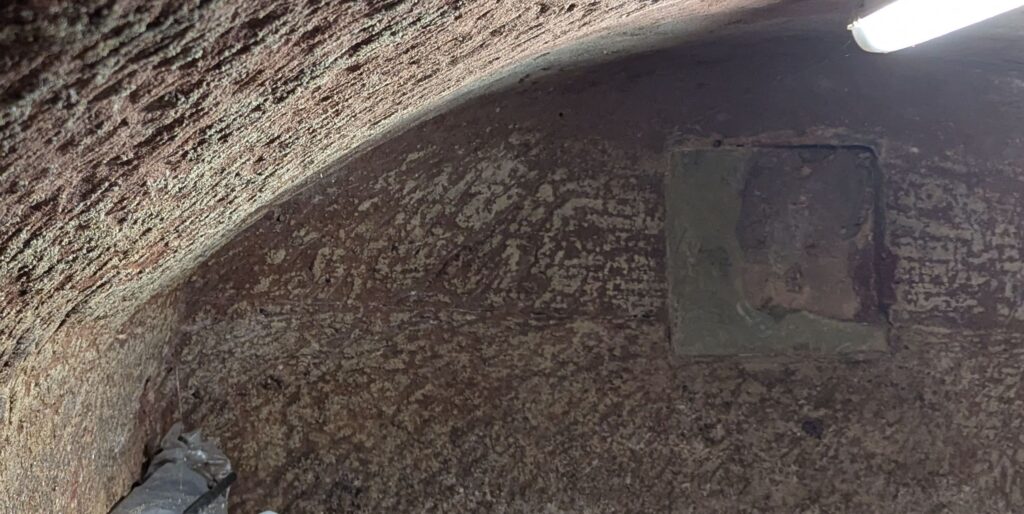
The structural sophistication of the service range is most clearly demonstrated in its vaulting. Both of the two lower storeys were constructed with brick arched vaults arranged in a deliberate and ordered system. The central range was vaulted longitudinally along the axis of the building, while the flanking rooms to either side were vaulted transversely, at right angles to it. This alternating arrangement reflects a carefully planned approach to load-bearing construction, distributing thrust efficiently across the width of the building and supporting the accommodation above.
The red-brick service range is a single long block with five sets of windows. The brickwork is broken up by four decorative buttresses to avoid a flat, featureless wall although the second decorative buttress was removed when the octagonal chapel was added in the mid 1880s.
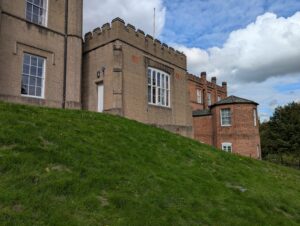
A significant change to this carefully graded arrangement came in 1844, when Mrs Spode added a single-storey billiard room to the east front. This new space was inserted between the family accommodation and the service range, occupying a position roughly midway along the elevation. Like the family section it is ashlar faced and lit by a large roof light. It fills in the gap between the family building and the service range but rather than in line with the two adjacent buildings it protrudes thus disrupting the building line.
Jutting out from the lower ground level of the service range is a three-storey building in red brick. This is Josiah Spode’s chapel added in the mid to late 1880s. Its octagonal plan carries long-standing associations with ecclesiastical buildings—particularly baptisteries and private chapels—and gives the structure an immediately recognisable religious character without recourse to any of the overt Gothic detail used by the Spode family earlier. There is no display of pointed arches, tracery, or structural buttressing. The roof is low-pitched and polygonal, capped without a spire or lantern, reinforcing the domestic rather than public character of the building. It shows Spode’s intention to add a chapel that was appropriate, dignified and restrained, quite different from the 1840s interventions.
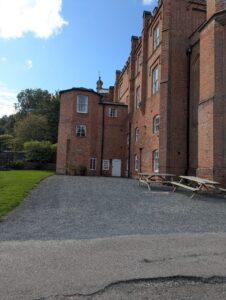
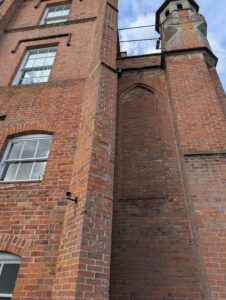
Although now altered, the east front was originally a deliberately composed elevation forming the approach to the service quarters. Evidence in the fabric suggests that the surviving coach house on the east side was once balanced by a corresponding structure on this side of the service entrance. On the wall where this missing building would have stood is a blocked-up door and the decorative buttresses rise only from mid-wall level rather than from the ground, a feature that doesn’t make sense unless the lower part of the wall was originally concealed by an adjoining structure – see Figure 9.
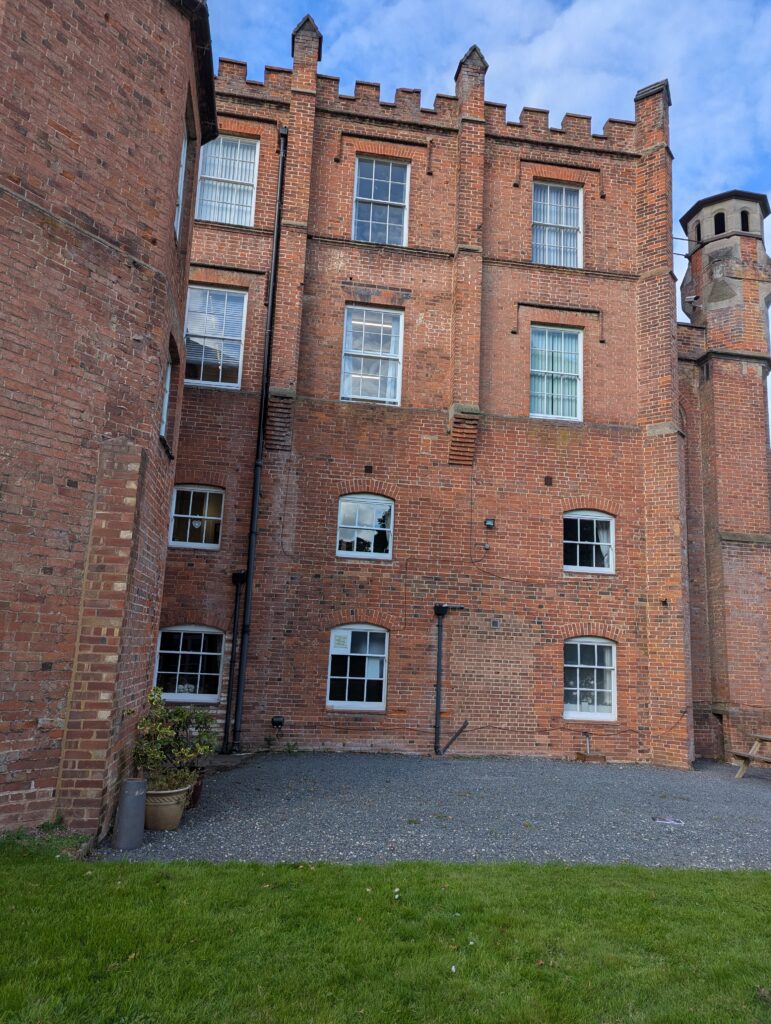
The date and reason for the removal of this structure are not documented. Its loss may reflect a combination of factors, including structural instability, redundancy following changes in service arrangements, or the gradual rationalisation of the service area in the later 19th century. It is also possible that its presence conflicted with later alterations, including the construction of the chapel, or that the building was dismantled deliberately to recover materials for reuse, (possibly in the chapel). Whatever the cause, its removal has left that service elevation visually exposed and has obscured the original symmetry of Lister’s carefully planned service approach.
The east front and service range illustrate both the discipline of Lister’s original planning and the cumulative effects of later intervention upon it. Lister’s design expressed hierarchy through controlled variation in roof line, structure and massing, while the Spode additions paid no regard to the existing building ethos.
The West Front
The west front is dominated by the two-storey, family block. This side of the family block, representing about 40% of the original Lister family home, was completely replaced by Mrs. Spode in c1840. The earlier, lower and more restrained Lister building has been built up into a taller, more emphatic pavilion with pronounced corner turrets. The ashlar masonry is finely jointed and crisply detailed but in places it is now severely darkened to almost black.
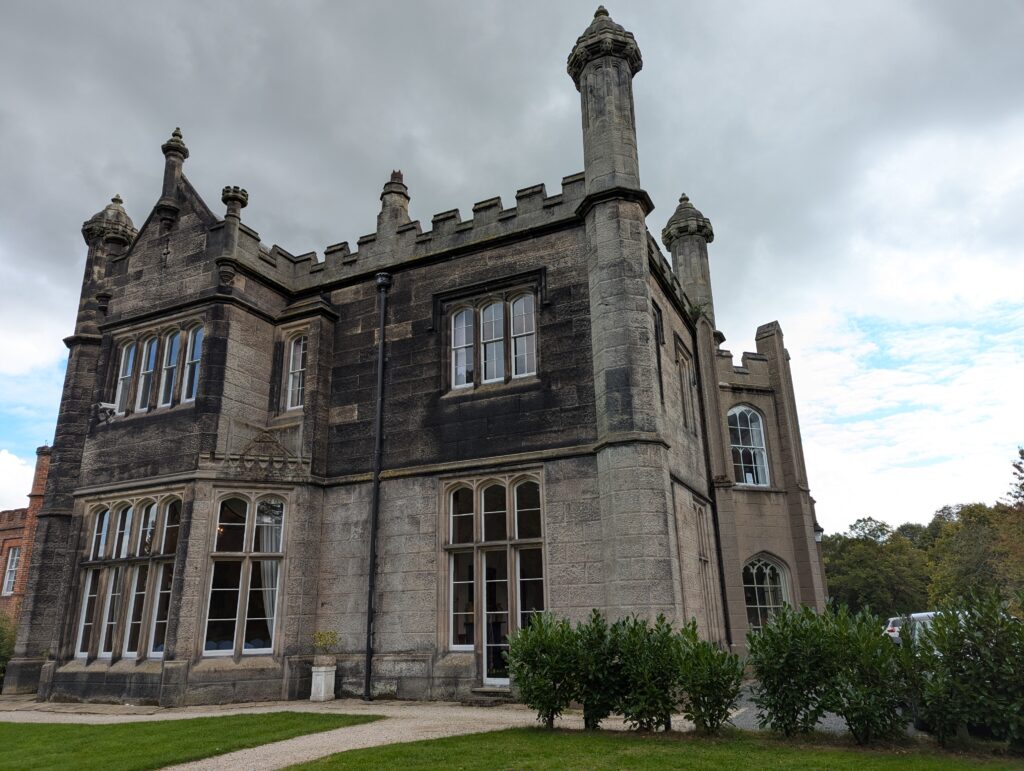
The ground floor of this side of the family block is internally divided into two rooms. The larger room is expressed externally by a projecting canted bay whilst the other room, about half its size, has a flat, regularly fenestrated elevation.
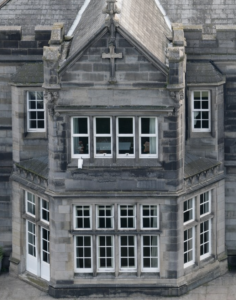
At ground floor level the canted bayed block, organised in three bays, is lit by tall, multi-light timber sash windows, grouped in pairs or triplets. These windows sit beneath shallow stone lintels and are closely spaced, creating a broad glazed surface. A glazed door occupies one bay, integrated into the window rhythm rather than treated as a separate entrance feature. The upper storey repeats the bay arrangement but with shorter, vertically proportioned sash windows, maintaining alignment with those below. The left and right bays on this upper storey are flat with shorter windows. A small stone cross is set above the upper windows probably as a moralised Gothic motif rather than as a religious symbol given that Josiah Spode was only 16 at the time that it was built.
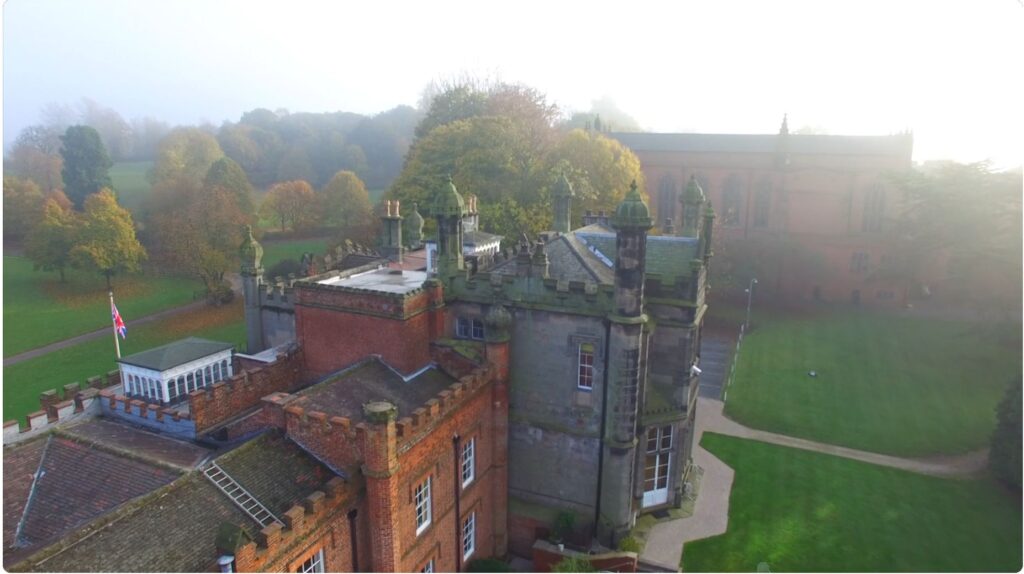
Immediately to the left of this block and directly opposite the billiard room is a similar rectangular building to the billiard room but with two storeys and in redbrick rather than in ashlar. It does not protrude from the building line though and in order to fit it in part of the service range to the left has been cut out and replaced by this new section. The older section now only has four windows, unlike the east side with its five sets of windows and is noticeably lower than the new service section addition. The new section has two sets of two windows each set at the same level as the rest of the service wing giving this side of the service range six sets of windows.
The North Front
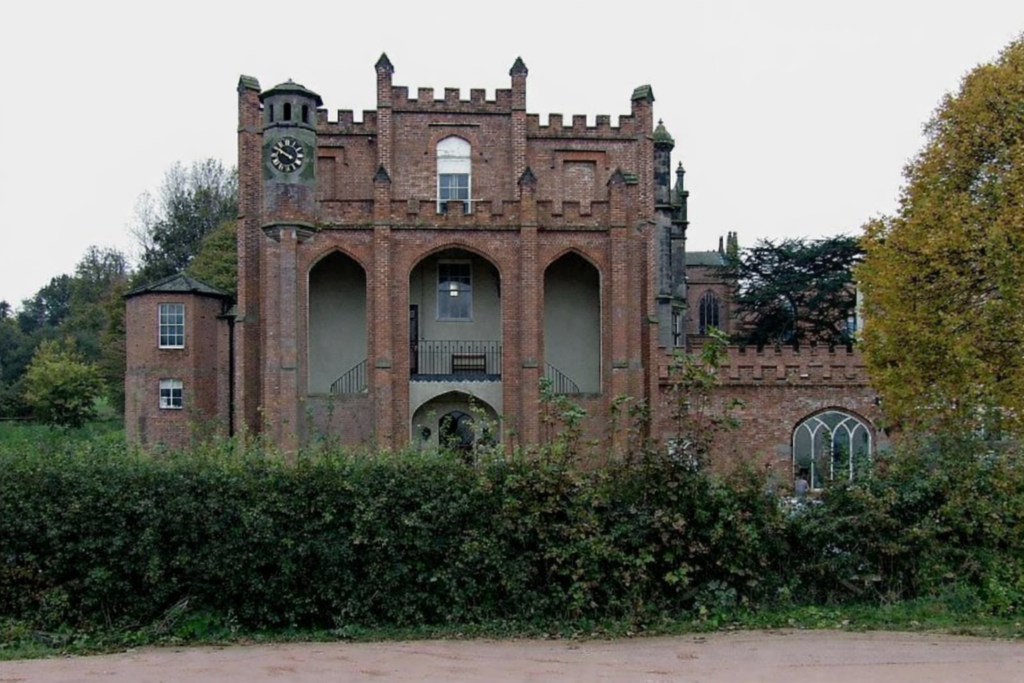
The north front is dominated by the monumental loggia added as part of the Spode remodelling of c.1840. Conceived on a grand scale, it forms a two-storey, three-bay composition of tall four-centred arches, in which a dramatic stair rises to the second floor of the house. It transforms what had previously been a service-facing elevation into a principal architectural statement.
Closer examination, however, reveals that the loggia is not a single, resolved design but a structure that masks and adapts an earlier elevation. At upper level, blocked window openings are visible to the left and right of the central bay. These correspond to original north-facing windows that pre-date the construction of the loggia and would have lit the rooms behind. Their identical level, proportion and detailing indicate that they formed part of a regular elevation rather than being incidental openings. The loggia should therefore be understood as a screen placed in front of an existing façade, rather than a complete rebuilding of it.
Between these two blocked windows, the parapet is raised in the centre with a window inserted below the raised parapet. This window does not align with the original window level and is visually emphasised by the altered parapet above. Given the proportional discipline evident elsewhere in Lister’s work, it is unlikely that the original elevation consisted of only two flanking windows separated by an unusually wide expanse of blank wall. A more plausible reading is that the original north front contained three evenly spaced windows beneath a continuous parapet, and that the present arrangement reflects a later reworking of the central bay to accommodate the loggia.
The loggia itself also shows signs of early modification. On both the east and west sides are large four-centred arched openings that have been carefully infilled. These blocked arches are identical in scale, proportion and detailing to the two open arches on the north front and should not be interpreted as blocked windows. Their size and form make it clear that they were conceived as full arches, indicating that the loggia was originally designed as a more open and symmetrical arcaded structure. Their subsequent closure appears to have been deliberate and likely early, undertaken to reduce exposure and draughts in an elevated and exposed position overlooking the canal, river and church. The blocking allowed the loggia to retain its monumental external character while improving internal comfort and practicality, particularly given the stair immediately behind.
Although the stair within the loggia appears complex, this complexity should not be read as evidence of an underlying planning deficiency. Elsewhere in the house, Lister’s original stair arrangements successfully accommodate changes in level between the service range and the family block, exploiting the sloping site through a series of short, logical flights. The loggia stair was therefore not structurally necessary. Instead, it represents an additional and largely independent circulation route introduced as part of the Spode remodelling. Its insertion required the blocking and reshaping of earlier openings and the reworking of the north elevation, creating irregularities that stem from the loggia itself rather than from the original design.
At the north-west corner of the loggia stands an octagonal clock tower, added later in the 19th century, probably around the same time as the chapel. Its form deliberately echoes the chapel and gives the loggia a public and symbolic emphasis that was not part of the original Spode scheme. The tower further complicates the reading of the elevation, reinforcing the sense that this part of the building accumulated meaning and function over time rather than being resolved in a single phase.
To the east of the loggia stands the surviving coach house, which provides further evidence of an originally more ordered composition. The principal window on its elevation is noticeably off-centre, a placement that makes little sense in isolation but is readily explained if the building was conceived either as one half of a symmetrical pair flanking a service approach, or if the coach house itself originally contained two similar openings, one of which has since been lost or infilled. Either interpretation is consistent with Lister’s preference for balanced ensembles and with the later simplification of the service court. The loss of the opposing structure, together with possible alterations to the coach house itself, has left the present arrangement fragmentary and visually unbalanced.
Taken together, the north front and loggia encapsulate the broader architectural history of Hawkesyard. The loggia was conceived as a bold and coherent statement, yet it was imposed upon an earlier, more regular elevation and subsequently modified to accommodate use, comfort and later symbolism. What appears today as a powerful but slightly awkward composition is therefore the product of ambition tempered by adjustment, and of balance eroded not only through enlargement but through selective alteration and loss. The north front stands as a vivid expression of how Hawkesyard evolved not through a single controlling vision, but through successive acts of adaptation layered upon an earlier, disciplined framework.
Interior Character
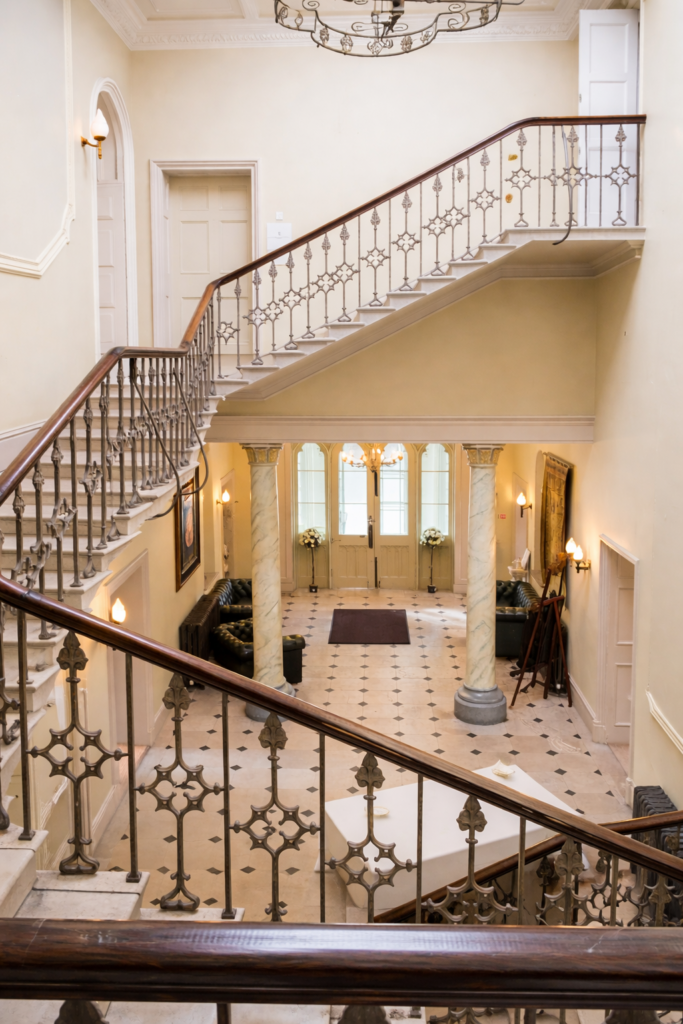
Internally, the family building continues the fusion of Gothic imagery with formal planning. The porch is fitted with a plaster Gothic vault, setting the tone on entry. The entrance hall is ornamented with a frieze of urns — a classical motif that quietly acknowledges the building’s Georgian roots — while at its inner end stands a pair of columns with palmate capitals.
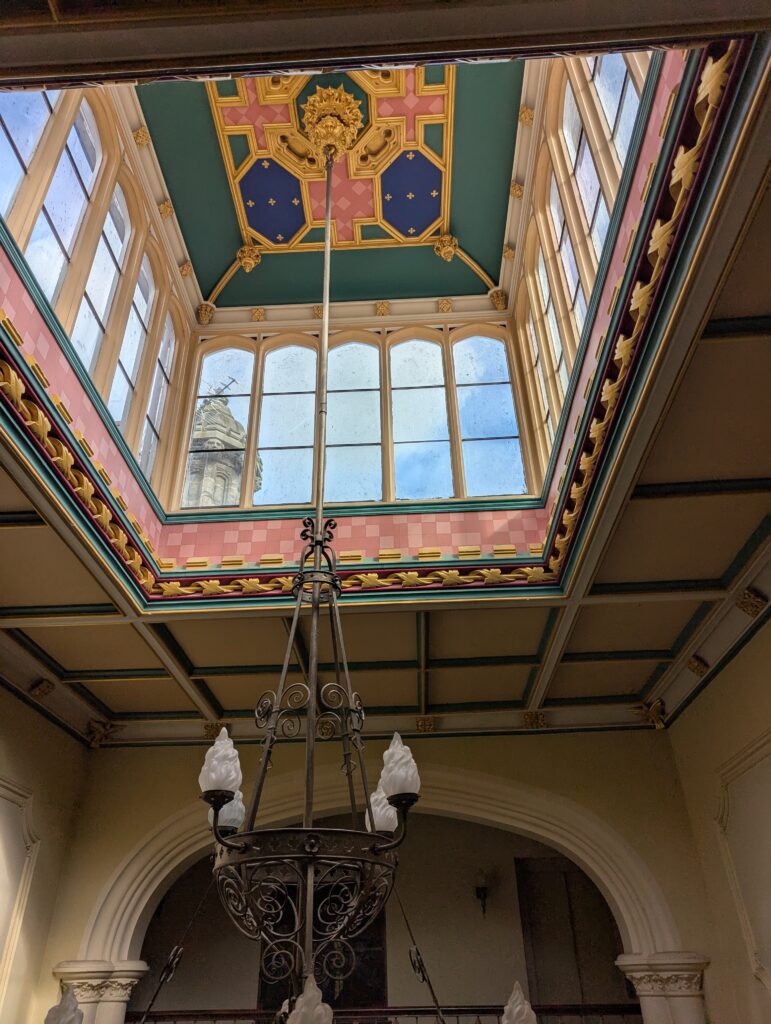
The staircase is one of the most elaborate interior features, with a wreathed handrail and cast‑iron balustrade. Above the stairwell, the ceiling is panelled and enriched with a frieze of square fleurons, with dragons occupying the corners. A light‑well above, inserted by Mary Spode in 1840, is brightly coloured, reinforcing the vertical drama of the space.
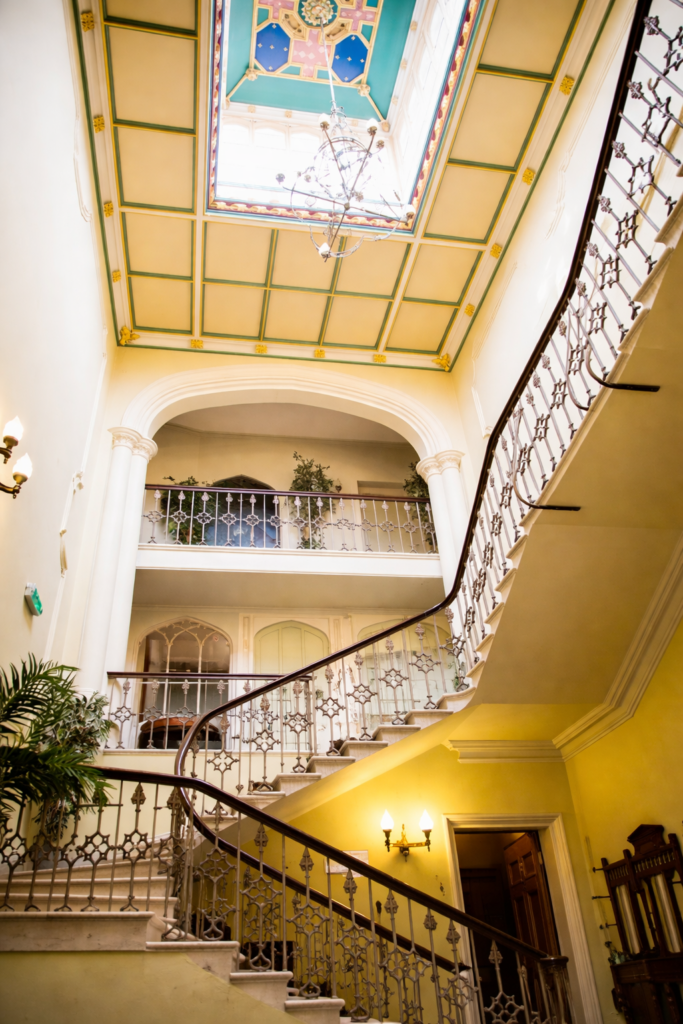
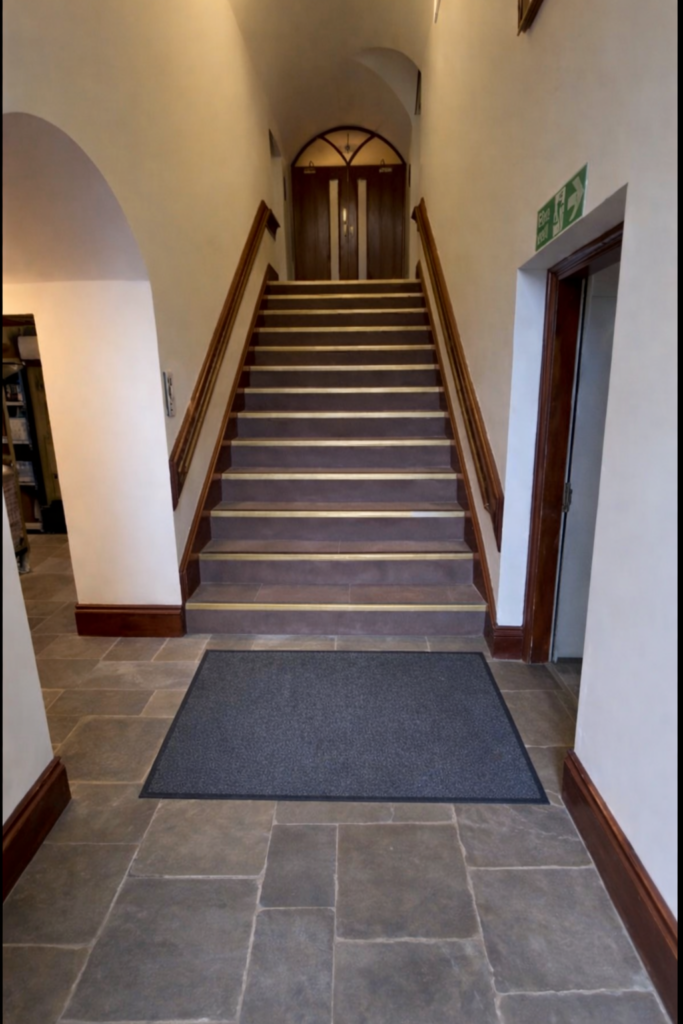
At the other end of the building, inside the ground floor entrance to the loggia, a staircase rises to the first floor of the service range. This was not in the original Lister design but inserted later, directly into the earlier fabric of the building. The two lowest storeys of the service range constructed by Lister were vaulted in brick, forming a carefully planned structural system. The insertion of the stair therefore cut through the primary axis of the vaulting scheme and must have required the removal or truncation of the central vaulted bay and the disruption of at least part of the adjoining transverse vaults. Although the precise number of rooms lost cannot now be established, the alteration represents a substantial reworking of Lister’s service architecture, prioritising new patterns of access over the integrity of the original structural design. It is not known whether Mary Spode or Josiah Spode IV inserted these stairs, but it would certainly have caused issues with service. Given that the stairs come out next to the first-floor chapel entrance it is more likely that the stairs were installed by Josiah Spode in the late 1880s as part of the building of the chapel.
Apart from these new stairs, numerous sets of stairs link all the floors in the service range from the cellars all the way up to the third floor although some are now blocked off.
Roof line
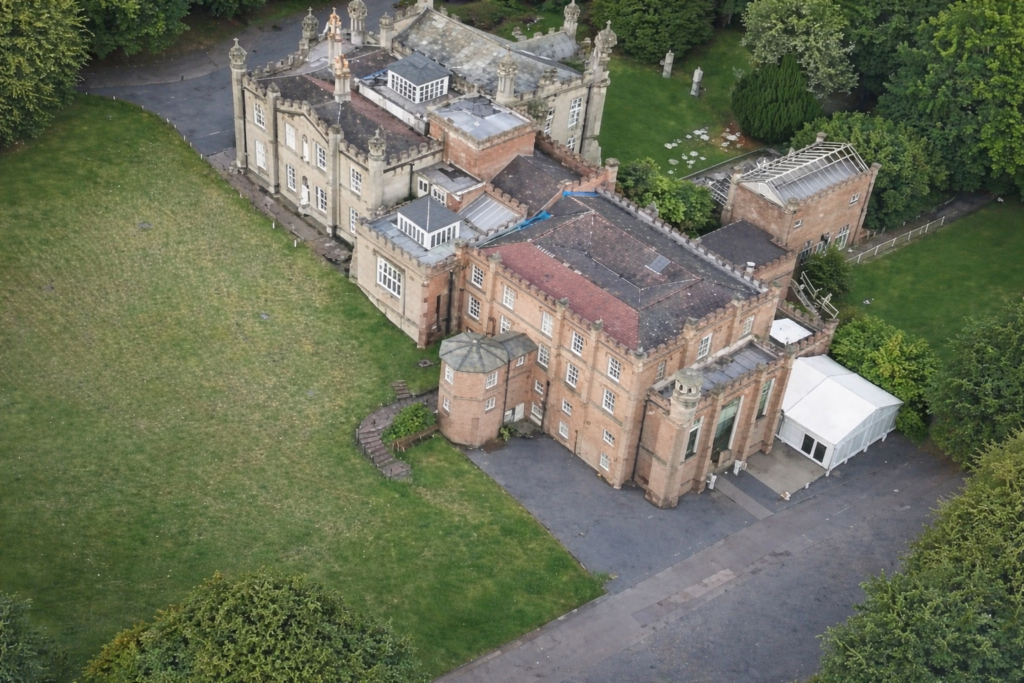
Both the family house and the service range were originally roofed with low, rectangular hipped roofs of four pitches largely hiding the roof from ground level in keeping with Georgian style. The inner slopes met in a central longitudinal valley, punctuated by numerous chimney stacks, creating a unified and carefully balanced roofline. Most of the roofline on the service range has been retained as can be seen in Figure 20. Subsequent alterations to particularly the family house, together with the insertion of two rooflights and additional larger chimney stacks, has disrupted this coherence, giving the roof a very irregular and congested appearance.
Around 1850, Josiah Spode added a central coal burner at the junction of the house and service range largely intended to supply heat to his expanding range of heated greenhouses. Although this exceptionally large chimney was removed in 1964, its former presence is still legible in the tall, square red-brick block that survives on the roof positioned in between the family block and the service range.
Conclusion
Hawkesyard is a house formed through successive phases rather than a single architectural vision. The Lister house of c.1760 applied Gothic imagery to a disciplined Georgian plan, while the Spode alterations of the 19th century introduced greater scale, mass and visual emphasis. Although each addition was carefully designed, their combined effect altered the balance of the original house, which came to be dominated rather than simply extended. The building that survives today reflects confident enlargement, practical adaptation and selective loss layered onto an earlier, ordered framework, making Hawkesyard an unusually clear record of changing architectural priorities over time.
I would like to thank Hawkesyard Estate for generously allowing access to the location and in particular to Paul Shelley for his valued help and cooperation.
That is so interesting and informative. Thank you Richard,
When we first came to this area in the 1960’s we knew the property as ‘Spode House’ It was owned then by the Dominicans who also occupied the Priory ( now the St Thomas’ Priory Nursing Home) We knew the Priory simply as ‘Hawkesyard’. We had many Council of Churches meetings and worship both in ‘Spode House’ and ‘Hawkesyard Priory’.
I am now corrected .