The Hawkesyard Mystery: Was There Ever a Hawkesyard Family?
For more than two centuries, local histories have repeated the same story: that Hawkesyard was once the home of a medieval family who took their surname from the estate before it passed through marriage to the Rugeley family. The idea can be traced back to Stebbing Shaw’s The History and Antiquities of Staffordshire, published in 1798, and has been accepted ever since.
Yet despite extensive surviving records relating to medieval Staffordshire, no documentary evidence has ever been found for such a family. Was Shaw correct, or did he make an assumption that later historians simply repeated?
The Name Came First
Before examining Shaw’s theory, it is worth considering the name itself.
Like Handsacre, Haukesherd is a Saxon place-name marking an area in the western part of the parish of Armitage-with-Handsacre. It derives from the Old English heafocscerde: heafoc meaning “hawk” and scerde meaning a gap, pass or clearing. It may have referred to a place where hawks were flown for falconry, although it is equally possible that heafoc referred to a man named Hawk, making it literally “Hawk’s clearing”.
Whatever its precise meaning, the name existed as a place-name long before the present house was built.
Shaw’s Theory
In his history of Staffordshire, Stebbing Shaw described Hawkesyard as:
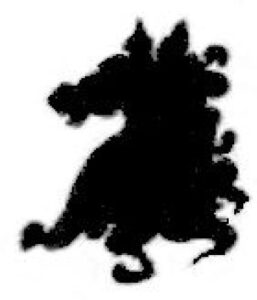
“Hawkesyard was an ancient manor, within Armitage, held under Handsacre; and had an old mansion, which was the seat of gentlemen for several ages. I presume it was once the property of a family that assumed their name from this their place of residence, and bore for their arms A. a horse’s head erased S. alluding probably to some similarity of sound to the first syllable of their name.”
In modern heraldic language this describes a black horse’s head, shown as if torn from the body, displayed on a silver background.
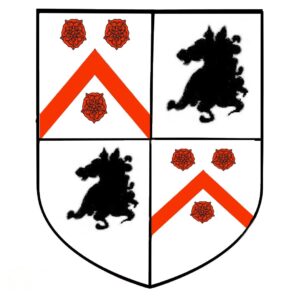
Shaw went on to suggest that, although he had found no direct evidence for this Hawkesyard family, the estate had probably passed through a Hawkesyard heiress into the Rugeley family. As supporting evidence, he noted that the Rugeleys quartered these supposed Hawkesyard arms with their own.
Quartering is the practice of combining different coats of arms into a single shield to represent inheritance, marriage or descent from several families. It was therefore reasonable for Shaw to assume that the horse’s head represented an earlier family connected with Hawkesyard.
The difficulty is that he never found any evidence that such a family actually existed.
Looking for the Hawkesyard Family
There was certainly a place called Hawkesyard elsewhere in England. A Hawkesyard existed near Minshull Vernon in Cheshire, and a Richard de Haukeserd is recorded purchasing land at Dilhorne in 1322.
What is missing, however, is any comparable evidence for a Hawkesyard family associated with the manor in Armitage or Handsacre. Despite numerous surviving medieval records relating to neighbouring families, no member of a Hawkesyard family has been identified as holding the manor or appearing in local documents.
This absence raises an obvious question. If there was no Hawkesyard family, where did the horse’s head come from?
The Norman Connection
Although Shaw appears not to have recognised it, there is another family whose coat of arms prominently features horse’s heads: the Norman family.
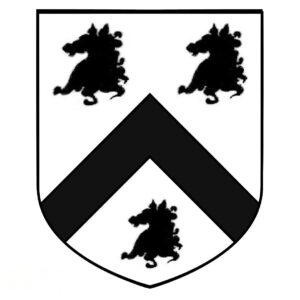
Their shield displays three horse’s heads rather than one, but it was not uncommon for quartered arms to simplify or adapt an inherited device, particularly when representing a marriage rather than reproducing an entire shield.
Shaw himself records that Thomas de Rugeley married Mary Norman, co-heiress of Richard Norman of Bold Hall, near Chartley Castle, around 1440. Through this marriage the Rugeleys acquired substantial property in Amerton, Draycott, Hixson, Newton, Kings Bromley, Kingston, Callowhill, Caverswall in Loxley and Uttoxeter.
Curiously, while Shaw records the marriage, he makes no connection between the Norman family’s heraldry and the horse’s head quartered by the Rugeleys.
If the horse’s head can already be explained through documented Norman marriages, there is no longer any need to invent a lost Hawkesyard family to account for it.
A Second Piece of the Puzzle
Further evidence comes from Shaw’s own account of Handsacre Hall.
There he notes that the Handsacre arms also appeared among the Rugeley quarterings but makes no attempt to explain how they were acquired. Instead, he repeats a story that Sir William de Handsacre was killed by Sir Robert Mavesyn in a skirmish near the River Trent before being succeeded by his son William.
That story is now known to be incorrect.
More significantly, Shaw appears to have been unaware that this William de Handsacre had married the daughter of William Norman of Caverswall in Loxley. Once again, the Norman family provides the obvious heraldic link.
Taken together, these marriages suggest that the horse’s head entered the Rugeley quarterings through the Norman family rather than through a previously unknown Hawkesyard family.
Rethinking a Long-Held Assumption
None of this proves beyond doubt that there was never a medieval Hawkesyard family. Medieval records are incomplete, and absence of evidence can never be treated as conclusive proof.
However, the surviving evidence points in another direction.
The place-name Hawkesyard clearly predates the medieval manor. No documentary evidence has yet been found for a Hawkesyard family in the Armitage area. The horse’s head that Shaw attributed to such a family closely matches the heraldry of the Norman family, whose marriages into both the Rugeley and Handsacre families provide a straightforward explanation for its appearance in the quartered arms.
It therefore seems likely that the long-accepted story of a Hawkesyard family originated not from medieval records but from an assumption made by Stebbing Shaw in 1798. Like many respected antiquaries, Shaw sometimes had to fill gaps in the historical record with informed speculation. In this case, later writers appear to have accepted that speculation as established fact. Given the evidence available to him in 1798, Shaw’s conclusion was understandable. Seeing an unexplained horse’s head among the Rugeley quarterings, he naturally looked for an earlier Hawkesyard family. The difficulty is that two centuries of subsequent research have failed to uncover one.
The Hawkesyard mystery may therefore have a simpler explanation than historians have long believed. Rather than preserving the memory of a forgotten medieval family, the name Hawkesyard appears to have belonged to the place itself from Saxon times. The medieval hall and its later owners gave the estate its history, but not its name.
Special thanks to Nancy Norman Hopkins for her insight into the heraldry of the Norman family and for information on the later Rugeley family. The Internet Archive allows free access to many old books and on it you can find Stebbing Shaw’s book ‘The history and antiquities of Staffordshire’, ‘Twenty one sons for Texas’ on the Rugeley family and Staffordshire Visitations.