
St. Magdelene Church
The first church in the parish was St. Magdelene. It is likely to have originally been a timber-built structure and rebuilt in stone by the Normans but very little is known about the building. The only written reference to the name of the church found so far is from a court case in 1386 concerning a murder in the church committed by the man who later became the Lord of the Manor of Handsacre.
By the 1700s St. Magdelene’s Church walls and roof had disappeared, and the materials no doubt used in other buildings. Stone foundations for the building had become submerged by the gradual build-up of organic matter and were rediscovered by a ploughman in 1795. Measuring 18 yards by 10-11 yards, with a square projection at the East end, the stone foundations were nearly a yard thick. It was a rectangular shape, pointed East to West, and was about 200 yards North of Handsacre Hall, adjacent to a field called Church Croft and on the edge of a field called Mill Croft. The tithe map does not show a field called the Church Croft but the approximate position of the church is shown below – now obliterated by the railway cutting.
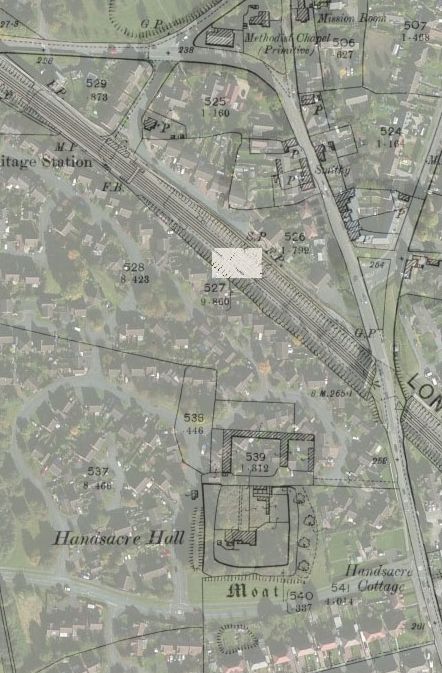
The square projection identified is presumably a steeple which would have made the church visible from all over the Parish acting as a landmark. A steeple is said to have symbolised the connection between the earthly and the divine. It would probably have housed a bell, or bells – these would have been used to mark important times of the day such as the hours of prayers as well as to signal important events like weddings or funerals. The bells could also have been used to alert the community to fire or danger particularly when the workers were in the far-flung fields of the manor.
Stebbing Shaw in his History and Antiquities of Staffordshire (1798)wrote ‘a person, whom I employed to dig here repeatedly, has brought me several pieces of glass and lead, within the last two months, which he found here; the shape of the lead shows it to have been formed into fancy-work or figures of some sort; and to be very ancient; the glass is so eaten, and cankered as to have lost all its transparency, and some of it crumbled between the finger after lying some time in warm water.’
Once the St. John the Baptist church had been built St. Magdelene became a family chapel for the de Handsacre family – Lords of the Manor. The last male de Handsacre died in 1374 and succession to the title was hotly disputed until 1398. Although a later Lord took the name de Handsacre he too died in 1428 and the name completely disappeared and probably the chapel was abandoned.