John Webb, Landscape Designer to the Gentry
By Roy Fallows
The churchyard to St John the Baptist parish church in Armitage is a pleasant place where generations of local families have been laid to rest. Most of the headstones and memorials are quite modest and in various states of repair. However, a short walk to the west end of the church reveals a seriously impressive sarcophagus which until recently was covered in ivy and brambles.
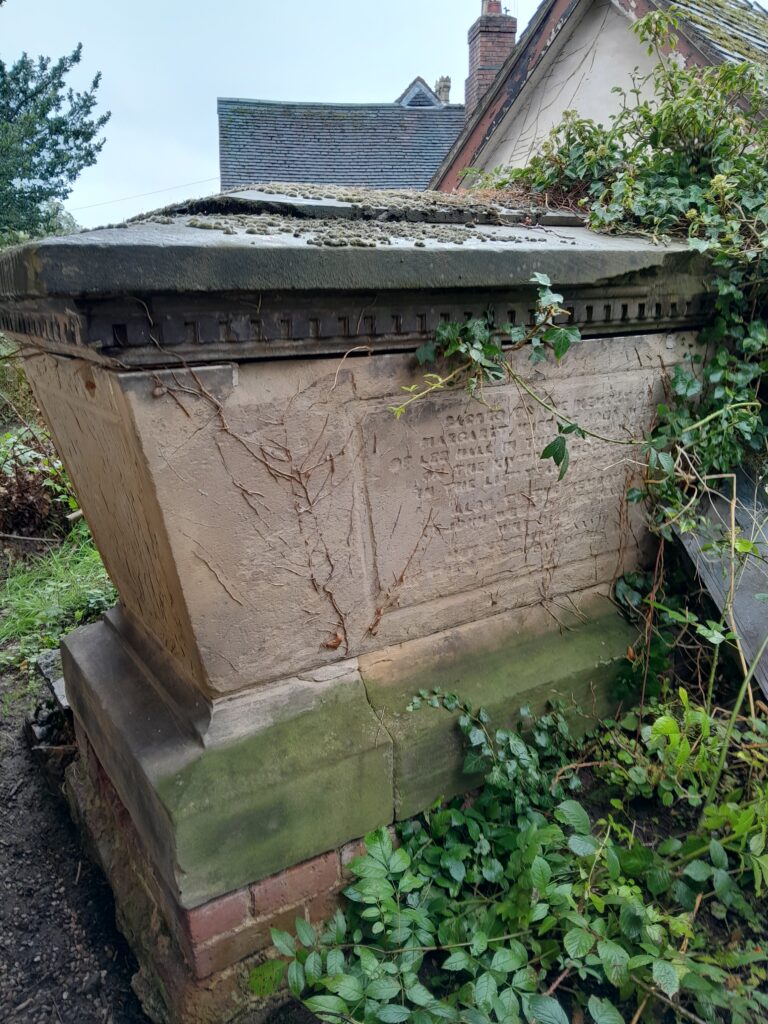
The inscription in the sandstone is barely legible but there is just enough to see the names of John Webb and his wife Margaret of Lea Hall.
Research has revealed that John Webb was born in 1754 in the small village of Radbourne near Derby. His father, Francis, was the head gardener at Radbourne Hall. Sadly, Francis died when John was only four years old. It is not known what happened to John and his family over the following years, although it is possible that they remained living and working at Radbourne.
By 1782, John was studying under William Emes who was a renowned landscape designer . Emes, who had started out as head gardener at Kedleston Hall in Derbyshire was influenced by the famous designer Lancelot ‘Capability’ Brown.
In 1793 John Webb ran his own business as a landscape designer and architect, although his skills as an architect were not highly regarded. He remodelled many estates in the Midlands and north of England. Some of his work can be found at Shugborough where he designed a wide ranging scheme following a disastrous flood in 1795. It was Webb that was responsible for diverting the River Sow to the course we can still see today. He also cleared the remaining part of Shugborough village. Webb’s contract was in excess of £9,500.
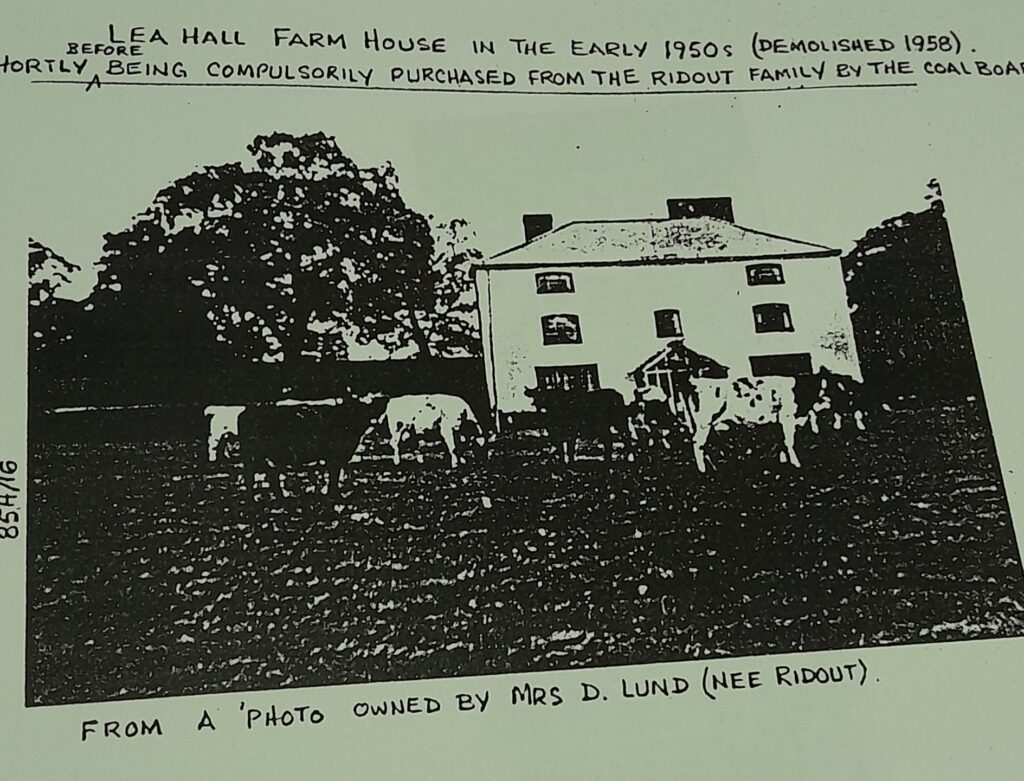
Between about 1794 and 1805 Webb and his family lived in Mavesyn Ridware. By 1806 he was living in Lea Hall, which was situated on the corner of Lea Hall Lane and Armitage Road, Rugeley although it was part of Armitage parish. Webb leased the property from Lord Robert Curzon who owned property all over England.
In the early 1800’s Webb was engaged by one of Josiah Wedgwood’s sons to carry out work in the grounds of Maer Hall near Newport. The family’s agent, John Wedge, wrote many letters to Webb which gave a good indication of his practice. In 1804 Wedge gave details of a list of gentlemen for whom Webb had worked and stated that, ‘Mr Webb is reputed to be a man of skill and of credit,’ but he had heard that he, ‘professes to be an Architect but in this branch he is said not to excel’. A letter of July in the same year set out clearly how Webb operated:
I give plans when required, mark out the improvements and either execute the work by contract or the gentlemen pay the labourers as be most agreeable to them. Where the work is done by contract it is indispensable to have a foreman to superintend the labourers, and in most cases a foreman is required when the parties find labour, my terms are two Guineas per day for journeys and attendance. I charge for plans according to what they are and either execute or not as may be the pleasure of my employers. I never charge a percentage upon the money expended. I always consider it a very objectionable demand – when a foreman is required the charge is 20/- (a pound) per week and his board or board wages.’
Other estates where Webb worked are:
- Teddesley Park, Near Penkridge
- Weston Park, near Shropshire
- Tatton Park
- Holkham Hall
- Sandon Estate
- Oulton Park, Cheshire
- Aqualate Hall
- Bromley Manor, Kings Bromley
John Webb died in 1828 and was buried at Armitage on 30th May. His wife, Margaret died in 1827 and was laid to rest with her husband.
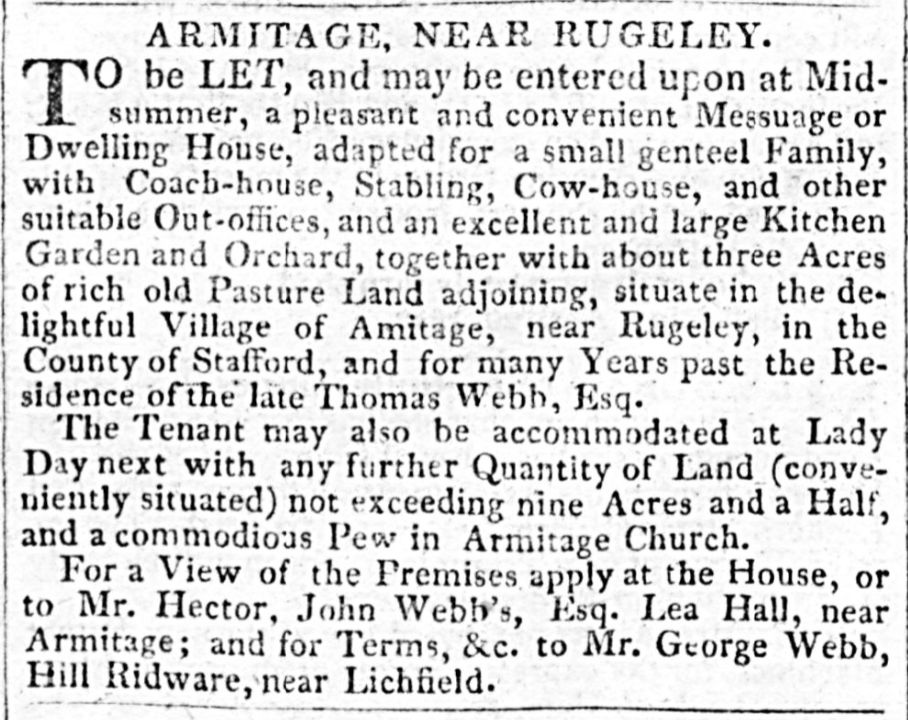
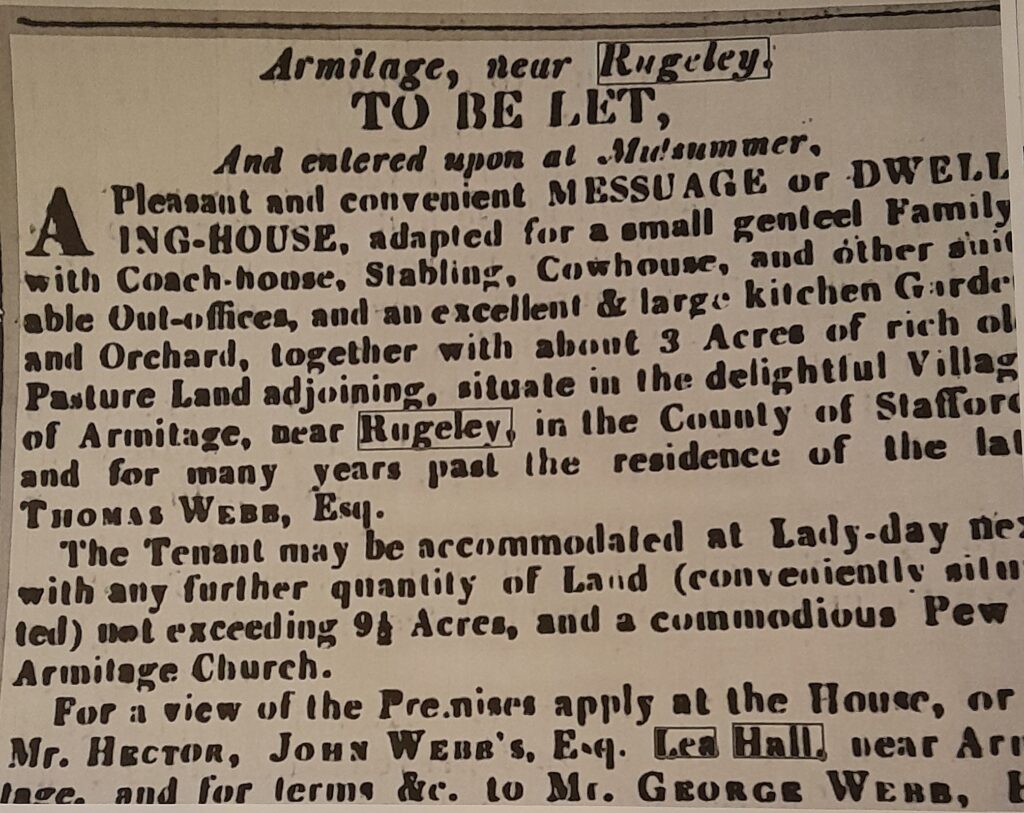
Lea Hall continued to be occupied by descendants of John Webb. Eventually Lea Hall was advertised to be let and copies of newspaper notices are below, together with information on Lea Hall. This information was kindly supplied by the Landor History Society from Rugeley.