
From Fiddles to Pipes: The Musical History of St. John the Baptist Church
During the English Civil War singing carols was banned as it was considered a political act and sinful. However, throughout its history, St. John the Baptist church has always resounded with music. But until the mid-1800s there was no organ available so different approaches were taken to enrich the services.
The parish clerk in the early years of the church was a minor religious position and even in the 1700s he was still required to wear a surplice, and he had a specific role in the church service. His duties included responses to the minister, reading lessons and singing psalms. In practice he also led the singing and conducted the choir. And the band.
Many village churches had a band composed of fiddles, flutes, drums and other instruments and Armitage was no exception. There is no record showing a complete list of instruments used and no doubt the parishioners owned their own fiddles etc. but the churchwarden accounts give some information.
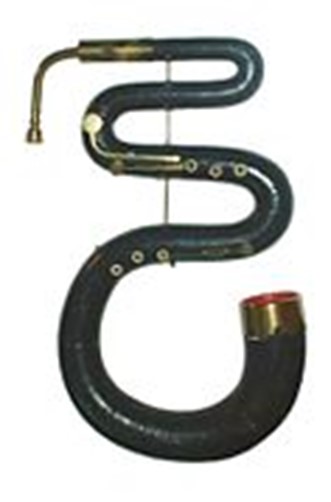
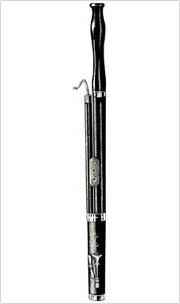
In 1808 William Conway, a blacksmith in Handsacre, was paid 6s 6d to make reeds for music and £1 11s 6d for mending a bassoon. Six years later two basses were bought for 16s – this was before the tuba was invented and Figure 1 shows the likely style. In the 1820s James Conway was paid for making bassoon reeds and for a bass horn costing £1 6s.
The south aisle wasn’t built until the mid-1840s and in the early 1800s the church was normally full for services. There were no choir stalls in the chancel and there is no indication where the band played. Many churches had west galleries intended to accommodate choirs and musicians and it is possible that a gallery was built above the entrance to the tower.
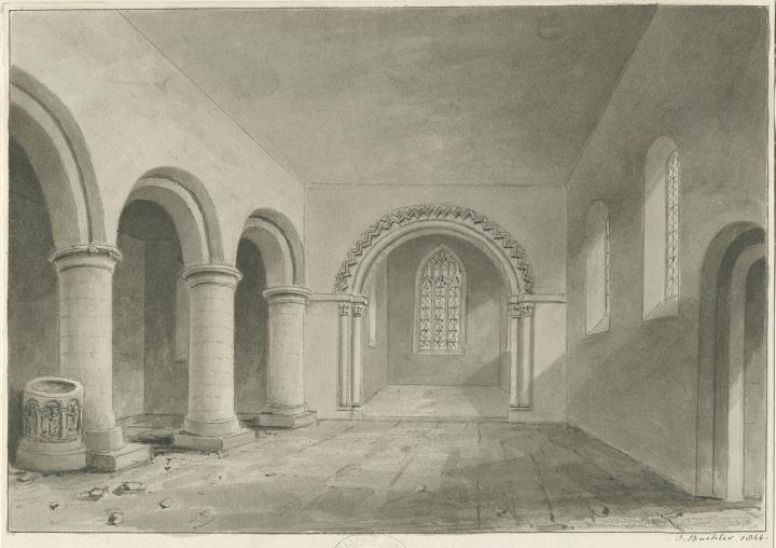
Figure 3 below from a drawing immediately prior to the church rebuilding suggests a different option though – a false ceiling for the choir and musicians. Following a vestry meeting in 1818 the churchwardens were instructed to effect repair and improvements – re-tiling of the south aisle roof (what we know as the nave) and installing a ceiling in the main body of the church. The churchwarden accounts, available at Stafford Record Office, contains an estimate for the work and as well detailing the work for the ceiling it states “Install a skylight over the singing loft 6ft by 4ft to be glazed with knobed glass and leaded round complete and the ceiling to be in the dormer form to relieve and give light.” A plan of the church immediately prior to the main rebuilding in 1845 shows a set of stairs in the area at the bottom of the tower and this was probably the main entrance to the singing loft.
The rebuilding of the church in 1845 removed the false ceiling and added the south aisle but left the vestry in the base of the tower. A pipe organ was bought to replace the band and it was initially placed at the west end of the north aisle i.e. in the far left of the church as you come in from the main entrance. In 1852 Josiah Spode IV who owned Armitage Park, (now Hawkesyard) paid for the building of the current organ chapel and vestry and the organ was relocated. At the same time the current choir stalls were installed.
In 1861 Josiah Spode paid £1000 for a new organ for Lichfield Cathedral to complement the rebuilding of the Quire by Gilbert Scott and the old organ, built by Samuel Green in 1789, was put up for sale. No buyers were found for Green’s organ and when the St. John’s organ had to go to London for repair Green’s organ was loaned to St. John on a temporary basis. Further efforts were made to sell it without success, and, in 1862, Spode paid £300 to the Cathedral Restoration Fund and donated the organ to St. Johns.
In 1987 Alan Stott set up a trust fund, (the Alan Stott Memorial Fund), containing £7,500 for the sole purpose of maintaining the organ and this still is still in use today.
It is a G organ i.e. its lowest note is a G rather than the more typical C or F, with three keyboards and a set of foot pedals used to play deeper notes. It has 36 stops, which are controls that change the sound by adding or removing different sets of pipes. With three couplers it allows different keyboards to be connected, so pressing keys on one can also play notes from another.
It has a rich, full tone and is considered to be of particularly high quality. Although it is capable of a tremendous volume of sound its position within the church with the low chancel arch and the massive Norman style of the nave and aisles means that it is not overwhelming.
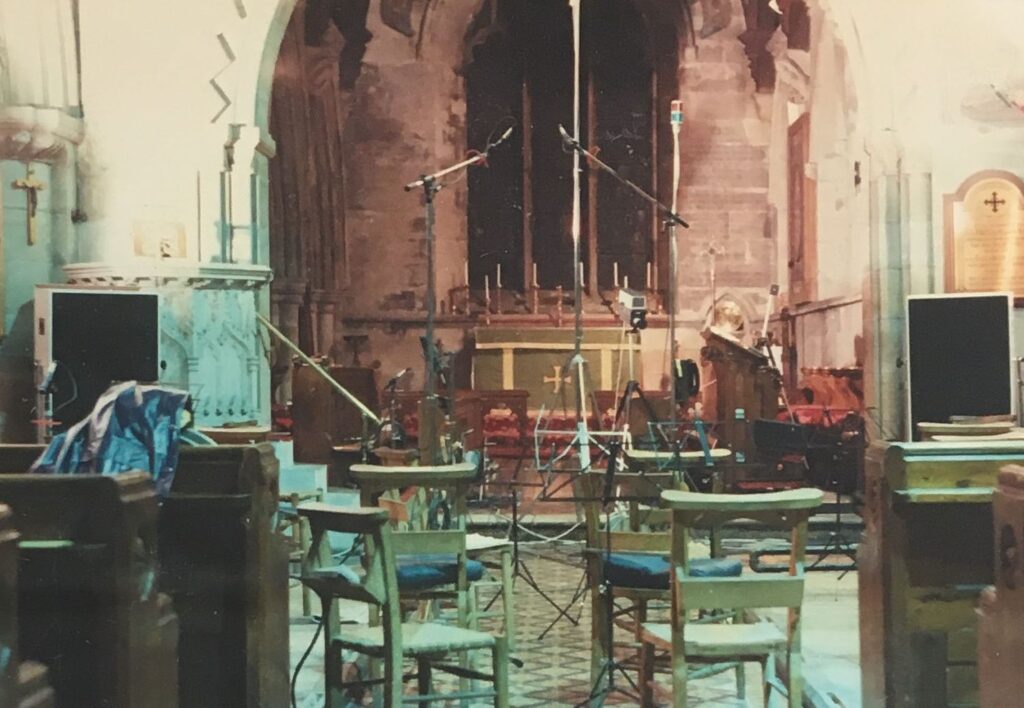
In 1983 Archiv Produktion wanted to celebrate Handel’s tricentenary and selected St. John’s organ as the most suitable organ. Simon Preston, organist from Westminster Abbey, inspected it and suggested various alterations to restore the original sound and the work was carried out by Martin Renshaw. An orchestra was engaged with Trevor Pinnock as Director and in June and September 1983 the recording was made. As can be seen in Figure 4 the front pews were removed for the orchestra and the recording equipment was set up in a nearby bungalow. The CD is entitled Early English Organ Music.
To experience the rich tones of this remarkable organ, you can listen to the CD “Early English Organ Music,” tune in to Classic FM where it is sometimes featured, or best of all—go to a service at St. John’s.