
Doug Matthews: From D-Day to 1,000 Goals
A Boy from Newtown, Handsacre
Doug was the youngest of six children born at Rose Cottage, Newtown, Handsacre to Ned and Fanny Matthews. Ned, who had been employed throughout his life in agriculture, was already sixty-five when Doug was born and died in 1937 at the age of seventy-nine. Doug was then twelve years old. Although he lost his father while still at school, he grew up within a large extended family that included five older brothers and sisters, as well as older half-siblings from Ned’s first marriage.
Like most boys in Armitage, Doug left school at the age of fourteen. The headmaster, Walter Hully, gave him a glowing reference stating “Douglas Matthews has been with me in school for about four years, and during that time I have always found him honest, hard-working and cheerful… Out of school he has been a leader in all our games and sports.”
The opportunities open to him were limited. Manual work dominated the local economy, particularly at the pottery and the industries that supported it. The 1939 Register records him as a laundry hand. As Armitage Ware operated its own laundry, it is possible that this was his first employment, although no surviving record confirms this. Whatever the workplace, Doug had entered the world of manual labour that would remain the foundation of his working life.
The Matthews family at war
All six of Ned and Fanny’s children served in the forces. His eldest brother George served in the King’s Shropshire Light Infantry, Ray in the Household Cavalry’s Life Guards, Denis in the glider-borne 2nd Battalion South Staffordshire Regiment, Peggy in the WAAF and Ken in the Grenadier Guards. Doug himself volunteered for the Navy in 1943 and served aboard the destroyer, HMS Brissenden.
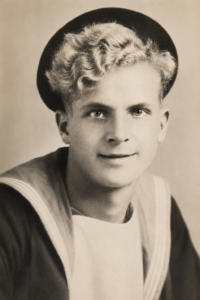
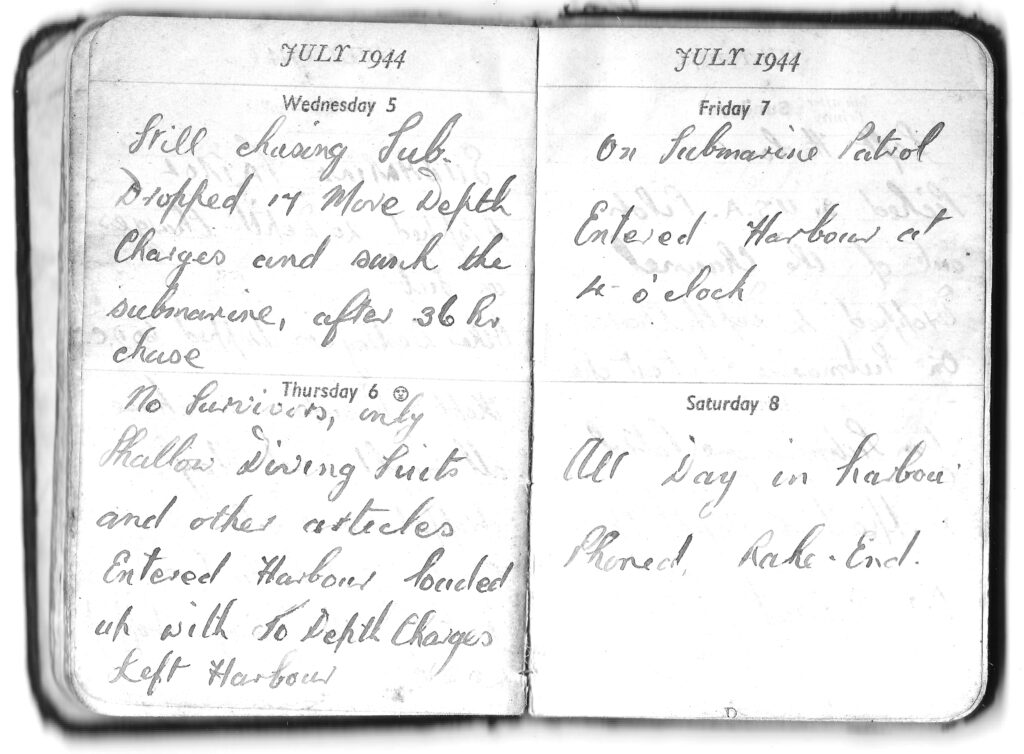
Doug also left behind a remarkable record of his wartime service. Beginning shortly before D-Day, he kept a handwritten diary while serving aboard HMS Brissenden. Although sailors were not supposed to keep diaries, Doug quietly recorded his experiences as they happened.
The diary itself is striking for its simplicity. Rather than describing his feelings, Doug wrote brief factual entries noting convoy movements, patrols, enemy aircraft, E-boats, mines and depth-charge attacks. It reads almost like a ship’s log, recording events with a clinical detachment.
Exercise Tiger
Shortly before D-Day, Doug and HMS Brissenden had already witnessed the consequences of another major wartime operation. In his later account he recalled being on escort duty during Exercise Tiger, the American rehearsal for the Normandy landings held off Slapton Sands on the south Devon coast. During the exercise German E-boats attacked the American convoy, with catastrophic results.
Doug remembered that Brissenden, which was on escort duty, gave chase to the German E-boats, although they escaped. By the time the ship returned, he wrote, “havoc” had occurred. American bodies and vehicles were floating in the water. He later heard that about 750 men had been lost.
Brissenden then joined other ships searching for the E-boats responsible. Doug’s recollection also captures how the disaster was understood by those involved. He remembered it as one of the worst wartime disasters in the Channel and believed that the American survivors had been instructed not to speak about what had happened. Writing forty years later, he still described Exercise Tiger as a “secret disaster”.
Operation Overlord
Only a few weeks later Doug was recording the real invasion in his diary. At 23.30 on Sunday 4 June, the destroyer’s captain told the crew that they would be sailing to invade Normandy as part of a force that Doug recorded as including 192 other destroyers, 23 cruisers, two shore-bombardment monitors and eight battleships. The invasion was delayed for 24 hours, however, because of the weather and rough seas.
At noon on 6th June 1944 Brissenden was off the Normandy beaches, where once again he encountered bodies in the water. This time he recorded recovering American lifejackets from the dead because they were better than their own. There is no attempt to dramatise the events—just a quiet record of what he witnessed.
Perhaps the most poignant entry concerns 14th July 1944, when Doug’s brother George died of wounds received near Caen while serving with the King’s Shropshire Light Infantry. Against that date appears the single sentence:
“My brother dies of wounds received at Caen (K.S.L.I.).”
Doug could not have known of his brother’s death as it happened, so this entry must have been added to the diary later. There is no further comment.
The Exercise Tiger account formed part of a letter Doug wrote forty years later to place his wartime diary in context. It also added detail to events recorded only briefly in the diary, including the death of his elder brother George, who died after being wounded near Caen while serving with the King’s Shropshire Light Infantry.
The contrast between the two documents is revealing. The diary records events as a nineteen-year-old sailor experienced them, with little reflection or emotion. The later letter, written after four decades of perspective, explains their significance and preserves memories that the diary alone could never convey. Together they provide an unusually personal account of one Handsacre man’s experience of war, combining the immediacy of a contemporary record with the reflections of a lifetime.
Recognition of Doug’s wartime service
HMS Brissenden‘s service took Doug far beyond the events surrounding D-Day. During his time aboard the destroyer he served in the Atlantic, Mediterranean and Arctic waters, and after the war he received the 1939–45 Star, the Atlantic Star with France and Germany Clasp, the Defence Medal and the War Medal 1939–45.
Recognition of his Arctic service came much later. In 1993 or 1994 Doug received the Soviet Jubilee Medal Forty Years of Victory in the Great Patriotic War 1941–1945, awarded to surviving Allied veterans who had taken part in the Arctic convoys.
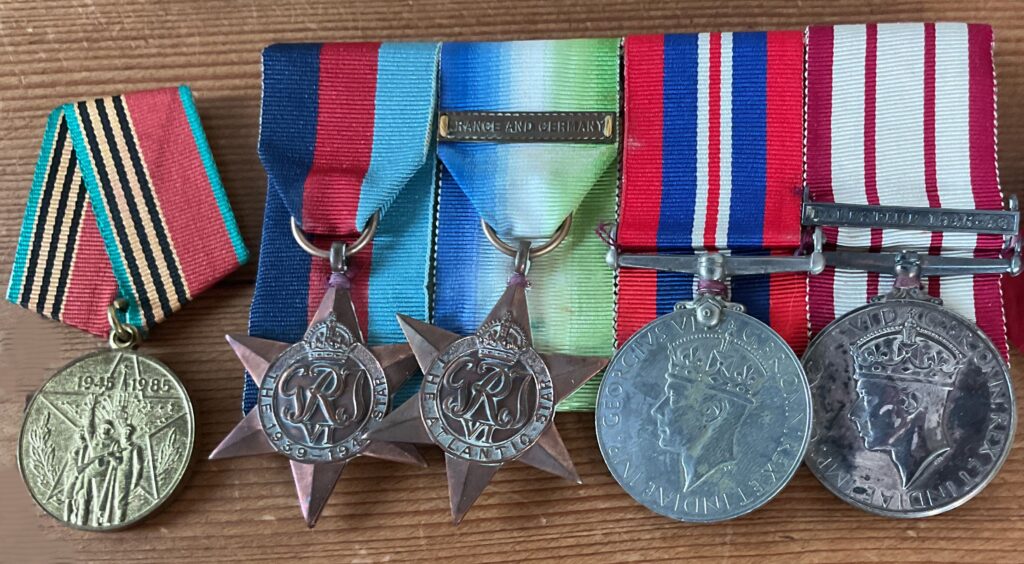
British recognition took even longer. The Arctic Star was not introduced until 2013, nearly seventy years after the convoys themselves. Doug received the medal that year, only weeks before his death.
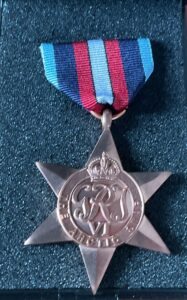
Together, the two late awards acknowledged a part of Doug’s wartime service that had gone formally unrecognised for decades. They provide a fitting conclusion to the story of a naval career that had taken the teenager from Newtown far from home into the Atlantic, Mediterranean and Arctic, and off the Normandy beaches on D-Day.
Family Life and Work
Doug had met Ellen Dawson in 1943 at the Shoulder of Mutton in Hamstall Ridware, while she was staying with her sister Annie at Rake End, Hill Ridware. Annie’s home may also have helped to bring other members of the Matthews and Dawson families into the same local circle. Early in 1945 Doug’s sister Peggy married Jim Dawson at Mavesyn Ridware.
Doug and Ellen’s relationship continued while he was away with the Navy. On 8 July 1944, while HMS Brissenden was in harbour, his diary contains the brief entry, “Phoned Rake End.” Doug later recalled that during his naval service he arranged for ten shillings from his weekly pay to be sent to Ellen. The officer dealing with the request was apparently surprised and asked why. Doug explained that Ellen was his girlfriend and that he hoped to marry her.
He did marry Ellen, on 7 May 1945 — VE Day. It was the first day of a fifty-two-day period of leave and they were married at St Mary’s Church in Stafford. Doug was not officially demobbed until August 1946, although accumulated leave meant that he probably left the Navy somewhat earlier.
For about their first year of married life Doug and Ellen lived with her parents at 12 North Avenue, Stone Road, Stafford. They then obtained one of the new houses being built at Chapel Road in Armitage. The minutes of the Armitage-with-Handsacre Parish Council Housing Committee for 23 December 1946 include D. Matthews of Rose Cottage, Newtown, among the names forwarded to Lichfield Rural District Council for consideration for either the new Chapel Road houses or the prefabricated houses in Upper Lodge Road. Their first child, Patricia Ann, was registered in the Stafford district early in 1947. Their son Douglas James, known as Jim, was born in 1949 and registered in the Lichfield district early the following year.
A Working Life
The manual work Doug had begun as a teenager continued after the war. He had a number of jobs before working for Whittaker Ellis while the company was constructing the pipeline between Blithfield Reservoir and Hanch pumping station.
He then joined E. E. Jeavons of Tipton, contractors to the gas industry, and remained with them for much of his working life. At first, simply getting to work could require considerable effort. Doug could not drive, and Jim remembers him walking from Armitage to Rugeley before catching buses to wherever the day’s work happened to be — Walsall, Tipton, Dudley or Hednesford. Pat remembers that his usual means of personal transport was a bicycle, which he also rode as far as Stafford.
The work sometimes took him much further from home. He spent periods working away in other parts of Britain, including Dorset, and several weeks in Cork in southern Ireland. Doug gradually took on greater responsibility at Jeavons. He became a ganger and was eventually offered a position as general foreman.
There was, however, a practical difficulty. The new job required him to have a works van so that he could travel between Stafford, Tipton and Stoke-on-Trent supervising men. Doug therefore had to learn to drive. Jim recalled a characteristically unconventional detail about his driving test: Doug drove himself to the test unaccompanied. After telling him that he had passed, the examiner offered to wait until his supposed accompanying driver returned. Doug had to invent an explanation for why there was nobody there.
Walter Hully, his school Headmaster, had described the fourteen-year-old Doug as “honest, hard-working and cheerful”, and the recollections of his children suggest that those characteristics remained with him throughout his working life. Pat could scarcely remember her father being ill beyond the occasional cold and did not remember him missing a day’s work.
Family, Work and Football
Work was only one part of Doug’s life. Football occupied much of his spare time and made him one of the best-known men in the area, but his children remember that his family remained at the centre of his life.
Pat remembers him as a quiet and gentle father who never raised his voice. If she and Jim had been misbehaving, Ellen might tell him when he came home from work, “Doug, speak to these kids.” Doug’s response was hardly fearsome. He would sit Pat on one knee and Jim on the other and simply say, “Hallo Pat, hallo Jim,” leaving Ellen shaking her head.
Family life also kept Doug closely connected to the places in which he and Ellen had grown up. Pat remembers visits to Rose Cottage in Newtown to see their grandmother, followed by long walks down Church Lane and across the meadows towards Hill Ridware and Rake End, where Ellen’s sister Annie lived. These were not journeys made by car but part of an everyday landscape which the family travelled largely on foot.
Football also became part of family life. During the 1960s Doug and his brother Ken helped to run Rugeley Juniors, a team which included their own sons. Doug’s son Jim played alongside Ken’s son John. Doug’s involvement with the game therefore continued beyond his own playing career, passing into the next generation of the Matthews family.
Pat also remembers that Doug had passed trials to play football for a London club but turned down the opportunity because of his responsibilities to his family and work. However remarkable his achievements on the football field became, football had to fit around earning a living and bringing up a family.
Later Years
In 1970 the family’s circumstances changed unexpectedly when Doug won £5,000 on the Premium Bonds — a considerable sum at the time. Doug and Ellen used the money to buy a bungalow in Hill Ridware.
Doug was eventually made redundant by Jeavons and for a time he worked at Armitage Garage dispensing petrol and cleaning cars. In retirement he and Ellen continued to enjoy walking, while Doug followed horse racing on television and would sometimes go to watch Jim playing football on Saturdays. Family holidays had included trips to Butlins when Pat and Jim were younger, while in later years Doug and Ellen took coach holidays to Scotland and Ireland. On one occasion they also travelled to Jersey with his brother Ray.
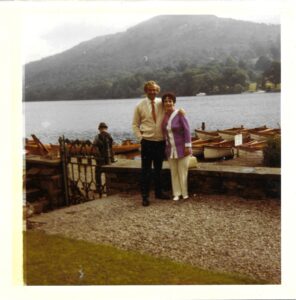
His relationship with his grandchildren continued the pattern his own children remembered. Jim recalls that before Doug finished working for Jeavons he would call on his way home from work, first to see Pat’s children and later Jim’s daughter Becky, usually bringing a few sweets. Becky remembered sitting on her grandfather’s knee when she was about seven or eight and pretending to shave him with a pen. She also remembered one of his favourite parting expressions: “See you on the flypaper.”
Pat’s own description of her father perhaps provides the simplest summary of this part of his life: “family, work, football.” The order is significant. Doug became known throughout the area because of what he achieved on the football field, but to those closest to him he was remembered first as a hardworking man and a quiet, caring father.
A Remarkable Football Career
Football had been part of Doug’s life from an early age. He played a few games for Brereton Old Boys including some while still at school, aged only thirteen, and Walter Hully’s school reference described him as a leader in games and sports. The war intervened at what would normally have been the beginning of a young man’s senior football career, and Doug was twenty-one before he was demobilised from the Royal Navy in August 1946.
His first recorded appearance for Armitage came only four months later, on 28 December 1946. The circumstances were unusual. Armitage had played matches on both Christmas Day and Boxing Day and, with most of the regular team injured, were forced to field what the Rugeley Times described as virtually a new side for their next match. Doug was one of those brought into the team — and he scored.
How regularly he played for Armitage immediately afterwards is uncertain. Newspaper coverage of village football was patchy and team lists were rarely printed, with reports generally mentioning only players such as the goalkeeper, captain or goalscorers. Doug was living in Stafford after leaving the Navy and is known to have also played for Brereton Social. What is certain is that by June 1947 he was already making an impression for Armitage. In the semi-final of the Fishley Cup against Chadsmoor Prairie he scored a hat-trick before half-time as the Blues, as Armitage were regularly called in newspaper reports, won 10–0.
Over the next two years Armitage developed into one of the strongest sides in local football. A league table early in 1947 shows them averaging fewer than two goals a game; by April 1948 they were scoring at around twice that rate. Doug’s precise contribution to that transformation cannot now be established, but his emergence as a prolific centre-forward coincided with a remarkable period of success for the club.
Armitage won the Rugeley League in 1948–49. At the beginning of the following season Doug was captain, playing in a side which included his brother Ken Matthews and his brother-in-law John Dawson. Football was very much a family affair – another brother, Dennis, served as Armitage FC’s club secretary
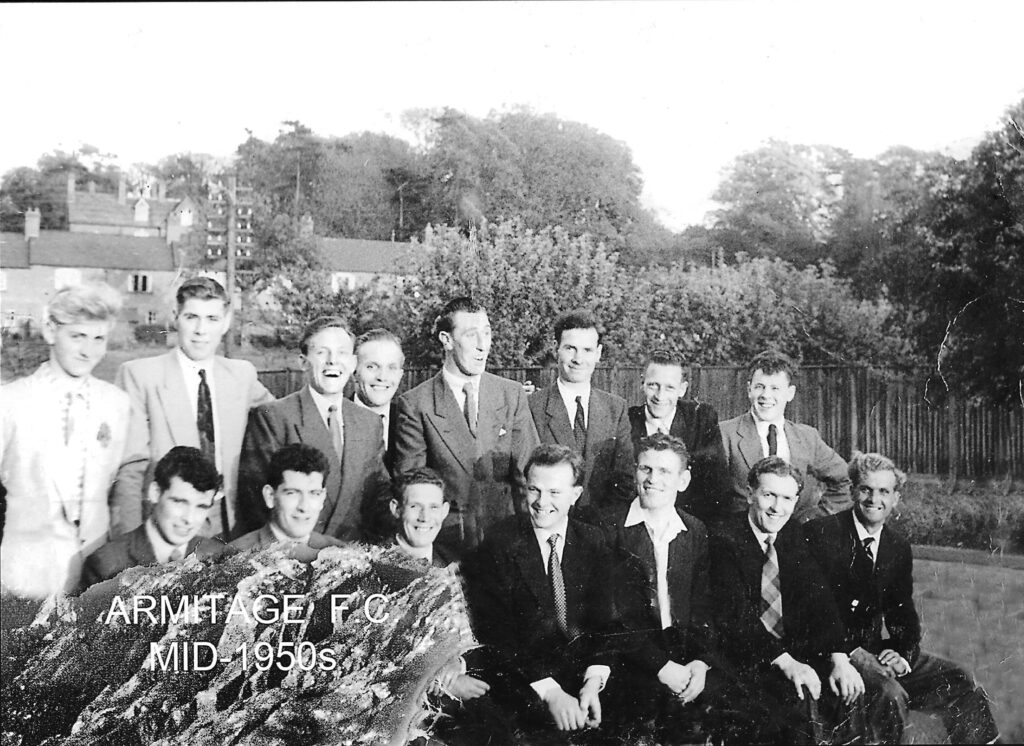
Colin Jones, Bob Follows, Gordon Richards, Dennis Matthews, Monty Sylvester, Gordon Gill, Tommy O’Neil, Roy Wood
Bottom Row L-R
Johnny Wharton, Johnny Clarke, Charlie Lehar, Roy Hodgkiss, Ginger Whitehouse, Dennis Varley, Doug Matthews
The opening weeks of the 1949–50 season give some indication of the goalscoring form that made Doug locally famous. In the first match he completed a hat-trick within 37 minutes. He scored another hat-trick in the second match and, after Armitage won their third game 5–0, scored yet another in the fourth. By the end of the season he had scored an extraordinary 106 goals.
The figure needs to be seen in the context of local football at the time. The league contained only about a dozen clubs and Doug’s total included cup matches as well as league games. Even so, 106 goals in a season was an exceptional achievement. Armitage themselves enjoyed an exceptional season, winning both the League and Cup, and repeated the League and Cup double the following year. Important cup matches and games against strong local rivals such as Rugeley could attract crowds of 500 or more.
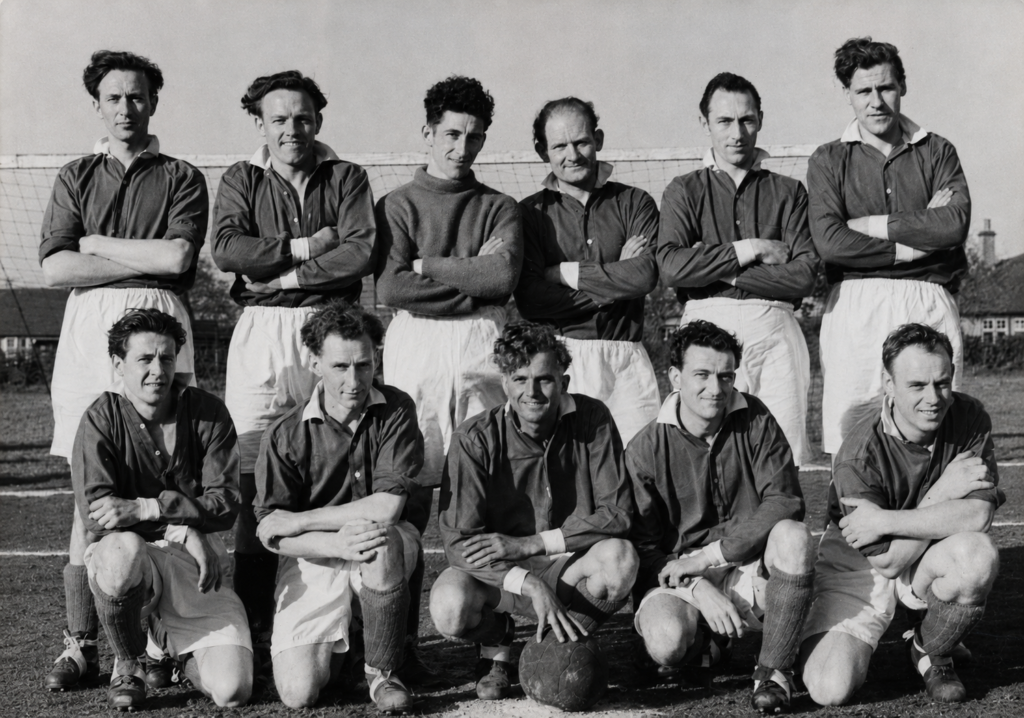
Back Row L-R
Ken Matthews, Gordon Richards, Johnny Clarke, G. Mountford, J. Keeling, John Dawson
Front Row L-R
Birch, J. Gardner, Doug Matthews, Birch, B. Webster
Doug’s ability also attracted attention beyond Armitage. He later recalled having trials with Stoke and playing for Walsall in the Birmingham League and Northampton in the London Combination. He also played a few games for Stafford Rangers while living in Stafford. These opportunities never developed into a professional career, however, and it was with Armitage that he established his reputation.
There were some extraordinary individual performances. On one occasion he scored all eight goals in an 8–0 victory over Lichfield St Chad’s. By October 1963 a newspaper was celebrating his 750th goal for Armitage. His eventual total for the club was 879.
His career might easily have ended several years earlier. Doug first decided to retire in 1959, but Yoxall persuaded him to continue playing. After two seasons there he returned to Armitage Reserves, where he had the unusual pleasure of playing alongside his own son. By then Armitage had necessarily found another centre-forward, and when Doug worked his way back into the first team he played at inside-right rather than in the position from which he had scored so many of his goals.
Another retirement followed, only for him to return once more to Yoxall. Later accounts suggest that he spent about five seasons with Yoxall altogether and scored more than 200 goals for them. He finally hung up his boots at the age of forty-six.
That longevity makes his achievement all the more remarkable. Doug did not have an uninterrupted footballing youth: the war and his naval service occupied the years when many players would have been establishing themselves in senior football, and he was already in his early twenties when his association with Armitage began. Yet he continued playing long after most footballers of his generation had retired.
His 879 goals for Armitage, added to more than 200 for Yoxall and goals scored elsewhere, took his known career total comfortably beyond 1,000 goals. It was an extraordinary record for the boy from Newtown who had been described by his headmaster many years earlier simply as a leader in the school games and sports.
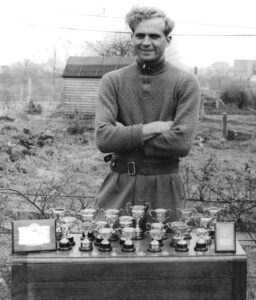
Richard, I must compliment you on a brilliant article about Doug and my family
One of the most enjoyable ones I have done – we lived opposite Doug and Ellen and they were great friends of my parents.