
The Heraldic Funeral of Richard Rugeley, 1623
On Saturday 5 July 1623, Richard Rugeley died at his home at Hawkesyard Hall. Like most people in seventeenth-century England, he was buried quickly, his funeral taking place the following day at St John the Baptist Church in Armitage.
For Richard’s family, however, this was not the end of the matter.
More than two months later, on Tuesday 23 September, Hawkesyard became the setting for a ceremony unlike anything most people in the parish would ever have witnessed. Led by one of the King’s officers of arms, a formal procession made its way from Hawkesyard Hall to the parish church, where Richard’s funeral was, in the words of the heraldic record, “worshipfully solemnized, according to his degree.”
Those few words reveal much about both Richard’s standing and the society in which he lived.
More Than a Funeral
Unlike the hurried burial that followed death, a heraldic solemnisation was a carefully organised public ceremony. It celebrated not only the life of the deceased but also his lineage, social standing and the succession of his heir. Every detail was governed by heraldic tradition.
The delay between Richard’s burial and the solemnisation was entirely consistent with such ceremonies. Time was needed to prepare the heraldic achievements, organise the participants and arrange for an officer of the College of Arms to attend. By the time the ceremony finally took place, it had become a public affirmation of the family’s position within the county rather than simply a private act of mourning.
The responsibility for organising the ceremony fell to Samuel Thompson, Windsor Herald in the College of Arms. As one of the King’s officers of arms, he was responsible for ensuring that every part of the solemnisation followed established heraldic custom.
The Procession from Hawkesyard
The heraldic record tells us that Samuel Thompson marshalled the funeral, directing the order of the procession and personally carrying Richard Rugeley’s painted coat of arms.
Behind him came the principal mourners, all dressed in black. Chief mourner was Simon Rugeley, Richard’s eldest son and heir. He was followed by Richard’s brother, Thirkell Rugeley, and his kinsman, Rowland Rugeley. Thomas Rugeley, Richard’s second son, carried his father’s pennon—a long, swallow-tailed banner displaying the family coat of arms.
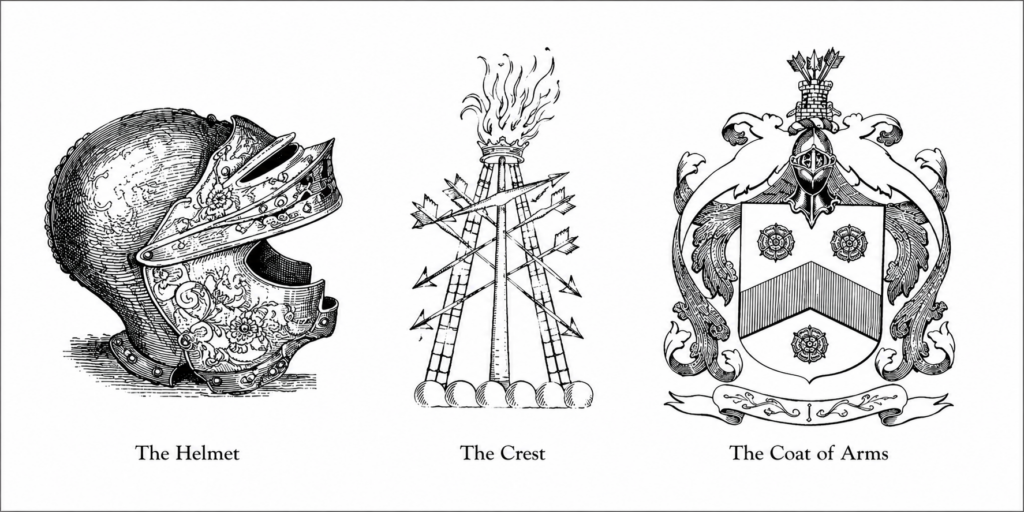
Also displayed were Richard’s heraldic achievements: his decorated helmet and the family crest, depicting a ship’s mast crowned with flames and transfixed by arrows. Together with the painted coat of arms, these objects represented the complete heraldic identity of the deceased, proclaiming not simply who Richard had been but the lineage and authority inherited by his family.
The Journey to the Church
Although no contemporary account describes the exact route, the geography of medieval Hawkesyard allows a reasonable reconstruction.
The Hall stood on the lower ground west of St John’s Church, close to the River Trent. From there the procession probably climbed to the main road linking Rugeley and Armitage before turning into what is now Church Lane towards the church.
On ordinary occasions the family may have entered through the doorway facing Hawkesyard, providing a more direct route from the Hall. A heraldic solemnisation, however, was intended to be seen. Approaching through the church’s south porch—the principal public entrance to the medieval church—would have allowed the full procession to unfold before entering the building.
For the inhabitants of the parish, this can scarcely have passed unnoticed. The appearance of a royal herald carrying the Rugeley coat of arms, accompanied by banners, helmet and crest, transformed the short journey from Hall to church into one of the most impressive public spectacles the village was ever likely to witness.
Inside St John’s
Passing through the south porch, the mourners entered the nave. After advancing only a short distance, the procession turned right to align with the chancel before continuing towards the eastern end of the church.
There, a coffin-shaped structure known as a catafalque had been prepared. Following the herald’s instructions, Richard’s helmet was placed upon it, while his coat of arms and crest were displayed above. The funeral service itself followed the normal order of worship, although the committal had already taken place at Richard’s burial in July. Instead, the emphasis was upon honouring his life, affirming his family’s lineage and publicly recognising Simon Rugeley as his heir.
The ceremony was not simply an act of remembrance. It publicly proclaimed the continuity of the Rugeley family and confirmed Simon Rugeley as the new head of the house.
A Record for Posterity
The solemnisation was formally recorded by the herald.
The record states that Richard’s funeral was “worshipfully solemnized, according to his degree“ and carefully identifies those who took part in the ceremony. Samuel Thompson carried the coat of arms, Thomas Rugeley bore the pennon, while Simon Rugeley acted as chief mourner.
The document concludes with the signatures of the principal family members:
- Simon Ruggeley
- Thirkell Rugeley
- Henry Rugley
- Thomas Rugsley
To modern eyes, the four different spellings of the same surname appear surprising. In the early seventeenth century, however, spelling had yet to become standardised, and even members of the same family frequently wrote their names differently.
A Rare Glimpse into Stuart England
Richard Rugeley’s heraldic solemnisation provides a rare glimpse into the values of early Stuart society. Status was displayed publicly, ancestry carefully proclaimed and inheritance confirmed before both church and community. What appears today to be elaborate pageantry carried real legal and social significance.
Nothing now remains of medieval Hawkesyard Hall. Within a generation the Rugeley family would leave the estate, and over time the Hall itself disappeared. The procession that climbed from Hawkesyard to St John’s Church faded from memory, while the heraldic achievements carried that September morning were scattered by time.
Yet the herald’s record preserves a remarkable snapshot of the old Hawkesyard at the very end of the family’s long association with the estate. For a single autumn day in 1623, it allows us to stand among the villagers of Armitage and watch a ceremony conducted, in the herald’s own words, “according to his degree.”