The Pocket Borough
How the owners of Hawkesyard in Armitage and Hagley Hall in Rugeley controlled parliamentary elections in Lancashire
What had Armitage and Rugeley to do with Clitheroe?
In the eighteenth century, the people of Armitage and Rugeley had little say in who represented them in Parliament. Yet two gentlemen living just a few miles apart exercised complete control over the election of MPs for a town more than a hundred miles away.
Nathaniel Lister of Armitage Park and his cousin Assheton Curzon of Hagley Hall, Rugeley, belonged to families that controlled much of the parliamentary representation of Clitheroe in Lancashire. It was an arrangement that seems extraordinary today, but it was perfectly familiar in Georgian Britain. Parliamentary seats could be controlled through property ownership, family connections and agreements between influential patrons.
Clitheroe was what became known as a pocket borough: a constituency effectively under the control of a small number of wealthy individuals. Such places were also frequently described as rotten boroughs, although the two expressions did not mean quite the same thing.
For many years, the Listers and Curzons cooperated successfully. Each family generally secured one of Clitheroe’s two parliamentary seats. But behind this apparently comfortable arrangement lay questions of ownership, inheritance and family pride. By 1780, the relationship had deteriorated into a bitter electoral struggle. And much of the story can be traced through the surviving correspondence of Nathaniel Lister of Hawkesyard.
How could someone control a parliamentary borough?
Before the Reform Act of 1832, parliamentary elections operated under a bewildering variety of local rules.
Some constituencies had substantial electorates. Others returned two MPs despite having remarkably few voters. In many boroughs, the right to vote depended upon property ownership, membership of a corporation or possession of particular local privileges.
Clitheroe was a burgage borough. A burgage was a particular property within the town to which a parliamentary voting right was attached. By acquiring sufficient burgage properties, a wealthy individual could accumulate electoral influence. This did not mean that every tenant automatically voted as his landlord instructed. The precise ownership, occupation and legal entitlement to vote could become matters of dispute. Nevertheless, control of the properties provided the foundation of political power.
It also meant that a property could be worth considerably more for the vote attached to it than for the rent it produced. In Clitheroe, the Lister and Curzon families had accumulated enough of these properties to dominate elections. The town continued to elect two MPs, but for much of the eighteenth century the choice was effectively settled by agreement between the two families.
A family arrangement
The origins of the partnership went back to the early eighteenth century. In 1716, Thomas Lister of Gisburn and Nathaniel Curzon married daughters and co-heiresses of Sir Ralph Assheton of Whalley. Through these marriages, the families acquired interests in Clitheroe’s voting properties.
The resulting connection developed into an electoral partnership. The two families continued acquiring burgages and generally agreed to support one parliamentary candidate each. By 1764, the Listers owned seventeen relevant properties outright, the Curzons three, and another thirty-six were jointly owned. The imbalance was significant. The Listers possessed the larger individual interest, but cooperation allowed both families to benefit.
These were not simply gentlemen supporting candidates whom they happened to favour. Their property interests gave them a direct stake in the parliamentary representation of the town. The arrangement was maintained through family relationships, personal understandings and a shared interest in avoiding expensive contests. For several decades it worked.
Two cousins in Staffordshire
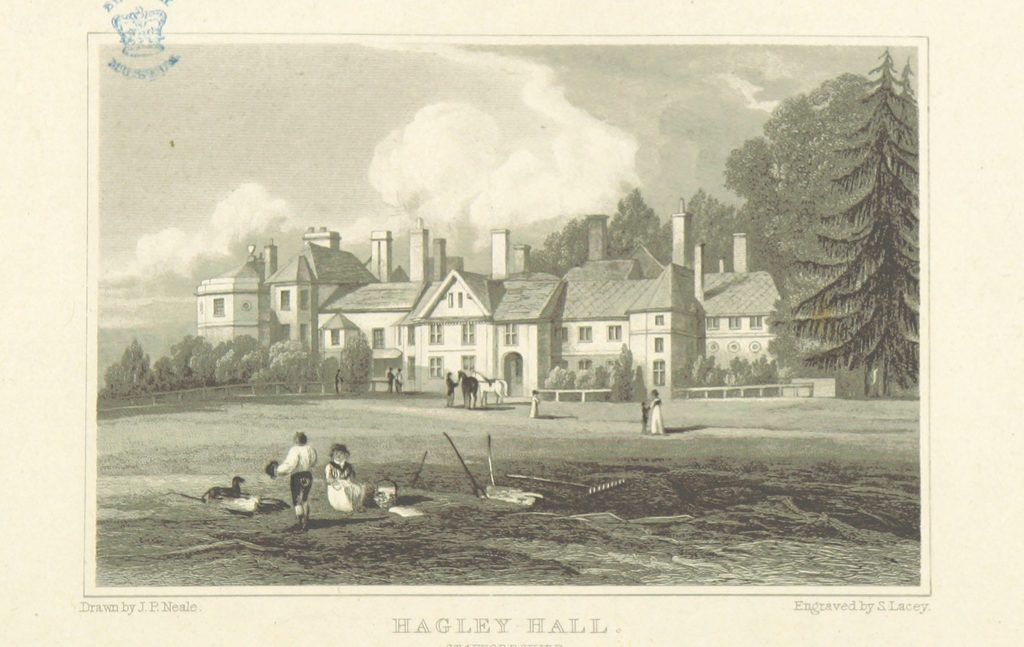
By the middle of the eighteenth century, the partnership had acquired a distinctly Staffordshire dimension. Assheton Curzon had purchased Hagley Hall at Rugeley in 1752 and settled there following his marriage in 1754. His cousin Nathaniel Lister subsequently developed close connections with the area. Through Curzon, Nathaniel was introduced to the society of the Rugeley and Lichfield neighbourhood, where he also became acquainted with the family of John Fletcher, whose daughter Martha he would marry.
In 1759 Nathaniel purchased the existing house and estate at Armitage Park, where Hawkesyard’s medieval deer park had once been. He subsequently enlarged and improved the house, which later became known as Hawkesyard. The two cousins were now near neighbours. Their social and family relationship was accompanied by an important political connection. Although both lived in Staffordshire, their parliamentary interests lay in Lancashire. This was not unusual in Georgian Britain, when the influence of landed families frequently extended far beyond their home counties. What made their partnership particularly interesting was that the two men were not only political allies but also cousins and near neighbours.
Staffordshire had its own arrangements
When Nathaniel entered Parliament in 1761, Staffordshire returned ten MPs: two for the county and two each for Stafford, Lichfield, Newcastle-under-Lyme and Tamworth. The county’s two seats were already dominated by the leading landed interests, particularly the Leveson-Gower and Bagot families. William Bagot of Blithfield, whom Nathaniel knew, represented Staffordshire from 1754. Their acquaintance provides another connection between Nathaniel and the county’s political society.
Nathaniel goes to Parliament
Nathaniel’s elder brother Thomas Lister had represented Clitheroe since 1745. When Thomas died in November 1761, Nathaniel succeeded him as one of the borough’s MPs, taking his seat in December. He was then in his early thirties and had only recently married Martha Fletcher.
Nathaniel’s parliamentary career was closely bound up with family expectations. His elder brother had left a son, also named Thomas, who was still a child. Nathaniel’s occupation of the parliamentary seat was therefore understood in the context of his nephew’s eventual succession. This was not simply a matter of waiting for the boy to grow up. The Lister family’s parliamentary interest had to be protected, and its relationship with the Curzons maintained. Surviving correspondence shows that Nathaniel took these questions seriously.
Whose borough was it?
For many years, the partnership between the Listers and Curzons had enabled both families to secure representation in Parliament without the expense and uncertainty of a contested election. But cooperation did not necessarily mean equality. The question of which family possessed the stronger claim was therefore more than a matter of family pride.
On 1 January 1764, Nathaniel Lister wrote to Nicholas Winckley about the respective interests of the two families. His letter defended the priority of the Lister interest while acknowledging the money that Curzon had contributed to the borough. Nathaniel’s letter reveals that, despite the longstanding cooperation between the families, their respective claims to Clitheroe were already being questioned in 1764. Nathaniel was not simply occupying a parliamentary seat until his nephew came of age; he was actively defending the Lister family’s interests.
His nephew comes of age
In 1773 Nathaniel’s nephew, Thomas Lister, reached the age of twenty-one. Thomas would later become the 1st Baron Ribblesdale. Now the time had come for the parliamentary seat to pass to the next generation and in April 1773 Thomas succeeded his uncle as MP for Clitheroe.
The surviving correspondence reveals that the transfer involved more than a straightforward change of representative. Nathaniel remained concerned about the relationship between the Lister and Curzon interests, while the younger Thomas had his own expectations about the position he was inheriting.
For Nathaniel, the arrangement brought twelve years of parliamentary service to an end. He was only forty-four, and his retirement should not be mistaken for a complete withdrawal from political affairs. He continued to take an interest in Clitheroe, corresponding with his nephew and maintaining his connection with Curzon. The letters also reveal the beginnings of a more difficult relationship between Thomas and Assheton Curzon. Thomas subsequently complained of his treatment by Curzon, suggesting that the old family understanding was no longer working as comfortably as it once had.
When the agreement collapsed
By 1780 the younger Thomas Lister was no longer content to accept the traditional division of Clitheroe’s parliamentary representation. His grievances against Assheton Curzon had developed into an open dispute over the families’ respective rights and influence.
For generations, the Listers and Curzons had been able to combine their interests and return candidates by agreement. But Thomas now challenged the arrangements through which the jointly owned properties were used. The resulting struggle was not between rival political parties. It was a contest between two related families who had previously exercised their electoral influence together. The Curzon interest supported Penn Assheton Curzon, while Thomas Lister backed John Parker alongside himself. Both sides sought to strengthen their positions by acquiring additional burgages.
Suddenly, properties whose ordinary rental value was modest became highly desirable. Their importance lay in the parliamentary votes associated with them. Between July and September 1780, Thomas Lister’s agent, Richard Eddleston, purchased burgages and associated property at a total cost of £24,490. In one transaction, three burgages producing an annual rent of only £4 10s changed hands for £600. It was an extraordinary price to pay for property producing so little income, but the buyers were not interested in rent but electoral influence.
The election returned Thomas Lister and John Parker, excluding the Curzon candidate. The result was subsequently challenged, but the parliamentary committee upheld the return. The old partnership had broken down, and the struggle had cost an enormous amount of money.
Nathaniel caught between the families
For Nathaniel Lister of Armitage Park, the dispute had a personal dimension. His nephew Thomas was challenging the parliamentary interests of Assheton Curzon, the cousin and neighbour who had helped introduce Nathaniel to Staffordshire society.
Although Nathaniel had retired from Parliament in 1773, he remained closely informed about events in Clitheroe. His correspondence provides a valuable insight into the deteriorating relationship between the two families.
By May 1781, the financial consequences of the struggle had become a subject of discussion. In a letter dated 4 May, Nathaniel reported to Thomas that Curzon was claiming Thomas’ election debts amounted to £60,000. We should not assume that Curzon’s figure was accurate. Nevertheless, the allegation is revealing. It suggests that the financial burden of the contest had become part of the argument between the families.
The price of a parliamentary seat
The Clitheroe dispute exposed a fundamental problem in the eighteenth-century electoral system. A parliamentary seat could be an immensely valuable possession in terms of influence, prestige and family standing. Yet the voting properties that made such influence possible could become ruinously expensive when rival patrons competed for them.
The events of 1780 also demonstrate why the long-standing partnership had been so advantageous. By agreeing to share Clitheroe’s representation, the Listers and Curzons had avoided precisely the sort of expensive contest that now threatened their fortunes.
Eventually, they came to a more amicable arrangement, but the events of 1780 had shown how easily the old system could collapse when family cooperation gave way to rivalry. The political influence that had once united the Listers and Curzons had become a cause of division.