
Armitage’s First Motor Car Accident – 1904
In June 1904, a motor car was still very much a novelty on the roads around Armitage. Only eight years earlier, the law had required these machines to be preceded by a man on foot, warning other road users of their approach.
The restrictions had been relaxed in 1896, allowing motorists to travel at up to 14 mph without an escort. By 1904, the speed limit had risen to 20 mph, and the more adventurous motorist could venture considerable distances.
One such adventure, however, ended rather abruptly on the road between Armitage and Rugeley.
A Sunday Morning Mishap
At midnight on Saturday 11 June 1904, six gentlemen set off from Stafford in a motor car for a drive through the countryside. Quite what prompted a motoring excursion at such an hour is not recorded. Perhaps a good dinner and a glass or two had encouraged someone to suggest an adventure. Whatever the reason, it was an unusual hour to begin a country drive. Among them was Mr Thomas Bailey of Stafford, who was at the wheel. Their journey took them through Lichfield and back towards Stafford by way of Armitage.
With six gentlemen aboard, it must have been a fairly substantial vehicle, although the newspaper unfortunately gives no indication of its make or model.
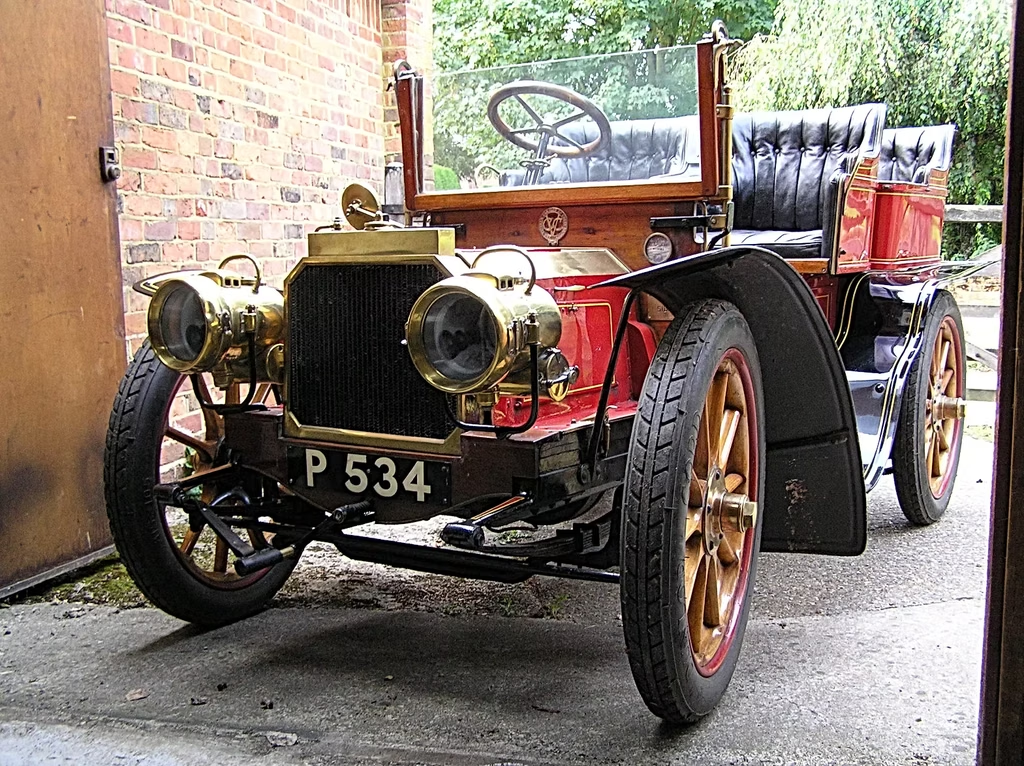
Photograph reproduced by kind permission of the Armstrong Siddeley Heritage Trust.
It was approaching four o’clock on Sunday morning when they passed the Ash Tree and continued towards Rugeley. According to the Lichfield Mercury, the car was travelling steadily until the steering gear failed.
Mr Bailey immediately shut off the petrol, but despite his efforts the car swerved sharply to the right, crashed through a wire fence, breaking two of its oak posts, and collided with the bridge near the basin.
Three of the six occupants were thrown from the car, two suffering serious injuries. The remaining three escaped with relatively minor injuries.
Early motorists were remarkably exposed to danger. Seat belts were virtually unknown, and many cars had open passenger compartments, sometimes with no doors at all or only low ones. Passengers sat on upholstered seats or benches, with little to prevent them being hurled out in a collision. Even at the relatively modest speeds of the day, an abrupt stop could have serious consequences.
The Lichfield Mercury considered the men’s survival remarkable. The roadside fence, constructed with stout oak posts and four strands of heavy pit wire, had probably saved them from an even worse fate. Without it, the car and its occupants might have plunged into the canal.
Help from a local farmer
Help was soon at hand. Mr Ridout, who farmed nearby, arrived and provided every assistance. Dr Chapman was summoned from Rugeley and attended to the injured men.
One passenger, Frederick Podmore, was so badly hurt that he could not be moved any further. He was taken into Mr Ridout’s farmhouse and put to bed, where Dr Chapman continued to attend him throughout the day. By Sunday evening his condition was considered more hopeful.
The remaining injured passengers were eventually conveyed home.
A Spectacle for the Village
The motor car had suffered almost as badly as its passengers. Both front wheels had been knocked off; its lamps were damaged and various other parts were ‘in disarray’.
There was, however, the practical question of what to do with the wreckage. The solution was straightforward. The damaged motor car was tied behind a cart and hauled into Mr Ridout’s farmyard.
Throughout Sunday a continuous stream of curious visitors arrived to inspect the remains. At one point, according to the newspaper, upwards of 200 people were gathered in the farmyard.
For some of those gathered, this may have been their first opportunity to examine a motor car at close quarters, even if it was missing both front wheels. The newspaper also recorded considerable sympathy for the injured men, whose misfortune had provided the neighbourhood with such an unusual spectacle.
The Lichfield Mercury published its account on 17 June under the headline “Motor Car Accident Near Armitage”, accompanied by the rather appropriate subheading “Miraculous Escapes.”
It is the earliest motor car accident so far identified in the parish’s newspaper records. Happily, despite the severity of the crash, no deaths were reported in the original account.
There was, of course, one final indignity for the motor car. Barely eight years after motorists had been freed from the requirement to have a man walking ahead of them, this particular machine had ended its adventure being hauled along by a horse.